I had some great luck just a few years ago when a good buddy of mine had a problem catching a flight back from L.A. to New York City. She was taping entertainment reports and there was snafu with her flight. She was rebooked to a later one. She called me and asked if I could substitute for her at a junket for a new series on Starz called POWER. I was in town and available to pinch hit for her at the Manhattan junket. Not only that, I'd seen the first season and I really dug it. The story of a role model New York City family man and society figure who's really a drug crime lord hooked me immediately. It's a juicy, sexy crime series.
In the seasons since I conducted those interviews, the show has found its voice and gotten richer. Its audience has grown. POWER has some immensely talented people in front off and behind the cameras. However, just like HBO's excellent OZ and THE WIRE, it doesn't get noticed by the folks who give out the Emmys. The TV Academy. Did you watch OZ and THE WIRE? Not a single one of the actors in either cast ever got an Emmy nomination. And there was some damn good acting on those shows. Well, the same goes for POWER. As of yet, not a single Emmy nomination has graced any member of its talented cast. Its new season begins Sunday night at 8:00, July 1st. Because of that, I thought I'd post those interviews I did. In addition to being talented, the actors were very polite. As we know in our modern times, courtesy is not exactly common anymore. I appreciated their politeness.
Omari Hardwick plays "Ghost" and Lela Loren is Angela. I met them when they were promoting the show's Season #2. He's a true gentleman and she has a very interesting story about the career she might have had if acting had not attracted her. They give Emmy-nomination worthy performances.
Curtis "50 Cent" Jackson is an executive producer on the show and he's also in the cast. Joseph Sikora plays Tommy. Sikora should be doing film roles for Scorcese and Spielberg. If you've seen the series, you might agree with me. He's terrific as a hood in this series. He too deserves an Emmy nomination.
I have much, much praise and respect -- and gratitude -- for Courtney Kemp, creator of POWER. I'm grateful that she created such fresh, strong and complicated characters for actors of color to play. She is a trailblazer and groundbreaker in television production. Her previous writing credits include THE BERNIE MAC SHOW and THE GOOD WIFE.
There you have it. I loved doing those interviews for Season #2. Season #5 of POWER stars Sunday night, July 1st, at 8:00 on STARZ. I wish them all a most successful new season. And some Emmy nominations.
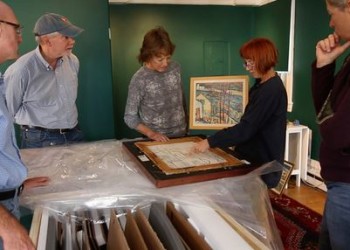
Art, love, sexual freedom, a shady lawyer, women's history, family devotion. A fascinating story. Please, go to Amazon Prime video. You must see the documentary called PACKED IN A TRUNK: THE LOST ART OF EDITH LAKE WILKINSON. It's only 1 hour and 20 minutes long. The time flies by because this search into the life of a late, overlooked painter is so interesting and driven by the love of a relative. The relative is also a visual artist, a married lesbian mom with a big son who loves basketball. She's Emmy winner, director/writer Jane Anderson, a woman so dear she'll make you wish she was a member of your family. Edith Lake Wilkinson was Jane's great-aunt. Aunt Edith was a lesbian too at a time when American women -- straight or gay -- had limited freedom in society compared to men. Edith Lake Wilkinson was committed to a mental health institution. That was a dark gray fate for someone whose colorful work was absolutely gorgeous. Her paintings made me gasp in awe.
Her style is modern. Her colors are vibrant, fluid, alive, rich. She's someone MGM director Vincente Minnelli should have made a film about. Why? Minnelli had a great eye for the visual. He adored color. He respected and revered artists and their uneasy journeys to add beauty to the world. Look at his Vincent van Gogh biopic, LUST FOR LIFE, starring Kirk Douglas. Look at his musical, AN AMERICAN IN PARIS, starring Gene Kelly as a struggling young painter in Paris who's been inspired by the greats such as Utrillo and Lautrec.
Works by Aunt Edith were found packed away in a trunk. Jane gives us family history. The story of Edith Lake Wilkinson, painter, goes back to New York City in the early 1900s. We learn about her life and creativity on East 23rd Street, on West 117th Street, in Harlem and in Provincetown, Massachusetts were artists were free to express their same-sex attractions in a Cape Cod community.
But even there, women were limited. They were only allowed to sell their paintings one day a week. The men could sell their work more days a week.
So did she ever make her artistic dreams come true? What was the state of her relationship with the woman constantly referred to as her "friend"? And how did Edith wind up in an institution at a fairly young age? I won't tell you. I really want you to see Jane's documentary, directed with care and wit by Michelle Boyaner.
I will tell you that the Edith Lake Wilkinson story is so compelling and relevant that it could inspire a good screenplay for excellent actresses such as Julianne Moore, Cate Blanchett, Laurie Metcalf, Ruth Negga and Meryl Streep.
Watch this trailer for PACKED IN A TRUNK:
One of filmmaking's earliest directors was a woman. Alice Guy-Blaché in France. For decades, her name was omitted when male film historians talked or wrote about silent era filmmakers. However, I once read that she originated some special effects in those turn of the century years that Hollywood's D.W. Griffith "borrowed" when making his famous films around 1915. I thought about that watching PACKED IN A TRUNK. I think male painters "borrowed" from Edith.
The revelations that come near the end -- Wow. Three women in a room talking. I found this way more interesting and surprising than a couple of comic book superhero action movie sequels I've seen.
We all want to be validated. We all want to be remembered, seen and regarded as significant. Edith Lake Wilkinson gave life more beauty than it gave her. She was not treated well. She was forgotten. I'm sure many of us, at some time, have felt forgotten especially by loved ones. We feel like we've been boxed up and placed on a distant shelf in their minds. We grow heartsore waiting for that box to be opened again, for the contents to be seen. To have a devoted loved one, many years later, work to bring attention, respect and validation to this gifted woman who became a forgotten artist....that is a wonderful love story. See the documentary. Give your eyes the gift of seeing her work. Make someone feel significant. Love freely and embrace the arts.
He doesn't know it, but Tom Hanks helped me through one of the most heartbreaking, emotionally difficult mornings of my life. Later that day, millions of folks would be glued to TV screens watching an NBA playoff game and the now-famous police chase of a white Bronco driven by O.J. Simpson. For me and an army of entertainment press booked in The Four Seasons Hotel in Los Angeles, the early morning kicked off a work day -- a day of interviews for the FORREST GUMP press junket. FORREST GUMP, a big Paramount feature starring Tom Hanks.
I was scheduled to interview Tom Hanks around 10:30 that morning. I'd read the novel, I'd heard high praise for the movie from publicists in New York City who worked for rival film companies. I definitely wanted to interview Tom Hanks, a man who has been one of my favorite actors ever since I was a devoted fan of BOSOM BUDDIES, his ABC sitcom back in 1980. I jumped at the offer to participate in the FORREST GUMP junket. I'd do the interview for the weekend morning show on local WNBC. I was a regular on the show from its September 1992 premiere until I quit. You probably know this already if you've read my posts frequently. Let's just say that my experience working for a few executives in the WNBC news departments was rocky for me. At that time, the station had yet to fully embrace diversity and inclusion. In October 1992, I went out on a date with a courteous young white Southern Baptist gentleman named Richard. He asked me out. Initially, I had no interest in going out but I figured, "What the heck. It's just brunch at a café. I can be done in two hours." That first date changed my life. It started my first romantic relationship. We had brunch and I stayed with him until the day he died.
This was during the extremely dark and politically turbulent days of the AIDS crisis. Richard had a good job and thought he was in good health -- until Christmas week of 1992. At first we thought he had the flu. A few days later, I sensed something worse was happening. I got him to the hospital. Come the New Year, he'd been diagnosed with full-blown AIDS. He'd been laid off from work. I became his main caregiver in New York and kept in touch constantly with his wonderful relatives down South. My situation at WNBC had been so frustrating that I planned to quit in early December. But, when Richard took ill, I needed the job and part-time income to help me pay the rent and care for him.
A few days before I had to fly out to L.A. for the junket, Richard had some medical problems. I had to get him to the hospital again. I was going to cancel my junket plans but he was adamant. "Go do your work. Don't worry about me. My doctor is here. Go do your work, he said." His doctor called me with news that she was quite sure he'd be fine when I got back from L.A. She also told me not to worry.
Tom Hanks' work was special to Richard and me. We had a great date night at a preview screening of SLEEPLESS IN SEATTLE. He held my hand and got tears in his eyes when Hanks won his Best Actor Oscar for PHILADELPHIA.
I knew a few other men in the TV newsroom who were also gay and confided in them that my partner had been diagnosed. They all urged me not to tell management, to keep quiet about it. I replied, "I'm in good health, thank Heaven. It's my partner who's sick." They said, "Nevertheless, management could still find a way to not need you anymore." I wasn't under contract so I put stock in what those newsroom veterans told me. On the TODAY Show, Katie Couric had the freedom to talk about her late husband's battle with colon cancer. She could do segments on what she'd learned about the illness, segments that could help others. I could not do TV news segments on what I'd learned as an AIDS caregiver and pass that information on to others who may have been in the same situation. And I wanted to. I know others were in a similar caregiver situation.
That's how things were then.
I was in my Four Seasons hotel room, going over my notes for the FORREST GUMP on-camera interviews I'd be doing. A half hour before I was to head upstairs to see Mr. Hanks, my phone rang. It was Richard's doctor calling from New York. She began with "Don't panic." He had not been responding to medication the way she'd hoped. She felt I needed to call his parents. There was not much more she could do aside from making him as comfortable as possible.
Time just seemed to stop. I went numb. That was a call I prayed I'd never have to make but knew I, one day, probably would. I called his mother. She was calm and focused. She said she'd take care of alerting the other family members. Then, as always, she asked how I was. I hung up an then prepared to cancel my interviews and catch the next flight I could back to New York after explaining why I had to pull out of the junket suddenly. The phone rang again. Again, it was Richard's doctor.
"Richard ordered me to tell you to do your work. Do not come back until you've done your work. He's serious about that."
I had to stop crying, pull myself together, gather my notes, make sure I looked presentable and go to Tom Hanks' interview room. I would ask a question about PHILADELPHIA, a question to address the discrimination gay people endured. I'd ask it for Richard. I'd ask it because my news director boss refused to air my taped interview of Harvey Fierstein, a good interview in which he was promoting MRS. DOUBTFIRE. He refused to air it because, in his words, "I have a problem with him being openly gay." He said that in a New York City TV newsroom.
My head felt foggy when I entered Tom Hanks' room and I was so heartbroken I felt I as if I was walking in slow motion. Tom Hanks, standing and displaying a big smile said, "Bobby Rivers! I remember watching you on VH1!" His enthusiasm, his graciousness, his warm greeting instantly snapped me out of my emotional pain and focused me on the work to be done. I got through that interview day thanks to Mr. Hanks.
My PHILADELPHIA-related question to Tom Hanks is in this reel (the phone number you'll see is out of service):
Tom Hanks went on to tell me that he wouldn't have been surprised if he never again played the guy who fell in love with Meg Ryan had he been gay and came out in his Oscar acceptance speech.
But he did go on to play that guy again. In 1998's YOU'VE GOT MAIL.
I did the interviews and flew back that night. I got to Richard's beside at the hospital. One of his first questions was "How'd you do with Tom Hanks?" Richard's parents were there. He and I had some precious time together. He even broke me up laughing. Richard passed away peacefully the afternoon of June 20th, 1994. Tom Hanks won his second Best Actor Oscar for FORREST GUMP.
In January 1995, when I'd made enough to pay off Richard's funeral expenses, I mailed the check and wrote my brief letter to my WNBC boss giving him my two weeks' notice. I saw Tom Hanks again, unexpectedly, when I was having absolute joy with a small, ragtag camera crew. We worked on a local cable show and happened to shooting near the red carpet function for THE GREEN MILE. We were taping the red carpet activity for extra footage on our show but we never expected to see Tom Hanks while our camera was rolling. He was sporting a beard for CAST AWAY shoots.
It's Pride Month. Never take your freedoms for granted. Never let anyone treat you like a second class citizen. Help others when you can. Happy Pride Month.
And thanks again, Mr. Hanks. Thanks so very, very much.
I have a question for you. Currently, there are two plays in revival on Broadway that focus on the gay male experience in America at different times in our previous century. Both revivals met with high praise from critics. The groundbreaking Mart Crowley play, THE BOYS IN THE BAND, premiered off-Broadway in 1968. That was a year before the June death of Judy Garland followed by the Stonewall Uprising in which NYC's gay community got loud and physical in Greenwich Village with its anger at years of police harassment. The Gay Liberation movement followed. William Friedkin directed a good 1970 screen adaptation of THE BOYS IN BAND.
That play is on Broadway now with a cast that includes actors popular from stage and TV, actors who are openly gay and constantly employed. One is Jim Parsons, hugely popular for playing Sheldon Cooper on the long-running hit CBS sitcom, THE BIG BANG THEORY.
To be gay, to be an openly gay male in show business, and to get regular employment still on stage and on network TV, that was unheard of in the closeted days of 1968 when THE BOYS IN THE BAND premiered. So was same-sex marriage.
Tony Kushner's brilliant ANGELS IN AMERICA is in revival on Broadway. I saw this play when it opened in 1993. Wow. It burns an impression into your heart and mind. This play premiered when we were in the dark days of the AIDS crisis, a crisis that was like a Medieval plague on modern times. AIDS is central in the play. AIDS ravaged America's black community. I lost several black friends to AIDS -- a salon hairstylist (who introduced me to Leslie Uggams), an audio engineer, an aspiring playwright, a music publicist, Broadway dancer/actor Gregg Burge, and a travel agent for MTV/VH1 Networks. AIDS claimed the lives of African American tennis champion Arthur Ashe and trailblazing ABC News journalist Max Robinson, the first African American to anchor the network's evening news.
It's 2018 and my question is about Black gay men as lead characters in Broadway plays -- or, rather, the lack of them. Add Latino/Hispanic men in there too. As I wrote, I saw the original ANGELS IN AMERICA production on Broadway. In addition to that, I've seen other plays with lead characters who are gay males. Some of those plays are Terrence McNally's THE LISBON TRAVIATA and LOVE! VALOUR! COMPASSION!, Larry Kramer's THE NORMAL HEART (about the AIDS crisis), Harvey Fierstein's TORCH SONG TRILOGY and the musical version of LA CAGE AUX FOLLES with a script by playwright Harvey Fierstein.
Back in the 1970s when I'd gone away to college and THE BOYS IN THE BAND was re-released in theaters, I got to see it. I loved the one black character, Bernard. He was dapper, sophisticated and he looked like he was on his way to meet his agent for lunch at the Russian Tea Room. He was significant to me. In those days, the black gay male image I'd see in movies and in episodes of cop shows on TV was usually a drag queen working as a drag queen, or a drag queen working as a hooker, or a drag queen who got busted for shoplifting.
In the mid 1990s when I was watching a performance of LOVE! VALOUR! COMPASSION! on Broadway, it hit me that I had never seen a play in which an African American gay male was a lead character. We were never the architect, the lawyer, the playwright, the classical musician, the doctor, the reporter or the professional who has the summer house on Fire Island. We're always in supporting roles mainly to give emotional support to and say inspirational things to the white gay male lead character.
Can you think of any Broadway play about gay characters in which an African American male was a lead character? Please let me know what it is. Oh...and plays in which the black gay male character is not a drag queen. No that there's anything wrong with that. But I've seen white writers present us as drag queens several times already.
Based on the plays I've seen plus the current revivals of THE BOYS IN THE BAND and ANGELS IN AMERICA, it seems that the stories of gay male life presented on Broadway have been and still are predominantly driven by upscale white male characters.
Because he's an international star who has been famous for most of his life, we expected that the business demands of his fame, and maybe traffic, would make him late by about 30 minutes. We were all set up for him in the London studio and we prepared to wait in a relaxed manner. Then we looked at the door and saw someone approaching. The rock music icon whom we thought would arrive understandably about 30 minutes had arrived about 20 minutes early. Alone. Without entourage and with lovely manners. Paul McCartney, now Sir Paul McCartney, was absolutely gracious to every single person in our crew. We did the exclusive interview in a London studio with an outstanding British TV crew. As much as I recall this extraordinary opportunity in Spring 1989, a one-on-one interview, I recall Paul McCartney's kindness to every single person in the studio.
Happy Birthday, Sir Paul McCartney. Thank you for writing some of the happiest, most most beautiful, most harmonious and most memorable popular songs ever composed.
In 1989, during my three wonderful years as a VH1 veejay and talk show host, VH1 flew me from New York to London to conduct this exclusive interview. If you're a hardcore McCartney fan, I hope you find some of it enjoyable and that you learn a couple of things about him you'd never heard in previous interviews. Remember, we did this in the late 1980s. Here is my VH1 special with singer, songwriter, composer, musician and former member of The Beatles --- Sir Paul McCartney.
Part 1
Part 2
Part 3
Part 4
Part 5
Part 6
Part 7
Part 8
A note about diversity and inclusion, hot topics in today's entertainment industry. I did not have an agent when I booked my VH1 job and became the network's first African American to have his own prime time weeknight celebrity talk show. My contract ended in 1990. After that, and with this show among my credits, I pitched myself to be an entertainment contributor on CBS SUNDAY. I pitched for years but I could never get a meeting or an audition. I accepted job offers from local TV morning news shows in New York City, but executives didn't feel I had the skills to cover entertainment on a regular basis or to do film reviews on a regular basis in the studio. I quit my WNBC TV job after three years because my boss told me that, although my work was good and I was very popular with viewers, I would remain local. I had no chance of moving up to NBC network exposure. Agents continued to reject me for representation saying, "I wouldn't know what to do with you." I had to make my own luck. I did not have the same job opportunities as a Billy Bush, Tom Bergeron, Rosie O'Donnell (my former co-worker) or Mo Rocca.
I am not the only person of color who experienced that inequality. There is still a great need today for race & gender inclusion.
I was lucky to have the parents that I did growing up in a very humble 2-bedroom, 1 bathroom house in South Central L.A. There was no shortage of books and records in our house. On our living room bookshelf were works by these authors: Shakespeare, Sinclair Lewis, James Baldwin, Ray Bradbury, Harold Robbins, Francoise Sagan's Bonjour Tristesse, Peyton Place by Grace Metalious and stories by Ernest Hemingway. Mom and Dad had 78s, those old record that came before 45s and long play albums that spun on the turntable at 33 1/3. My record player handled those speeds. On weekends and during summer vacations, I loved playing Mom and Dad's old 78s. Mom had a lot of the big band 1940s records. Dad was into bee-bop jazz. There was one record I loved. A cute, upbeat vocal called "Doctor, Lawyer, Indian, Chief." Betty Hutton had sung that to success on the charts. It was a hit record that became closely associated with the Paramount Pictures musical comedy star of the 1940s and early 50s.
One day when I was in the brink of starting middle school (we called it "junior high school" then), I casually mentioned to Mom that I loved her old record of "Doctor, Lawyer, Indian, Chief." Mom, with a very Thelma Ritter expression on her face, replied, "That's not mine. That's your father's. He had all those Charlie Parker and Dizzy Gillespie jazz records and then he had this thing for Betty Hutton. I could never figure that out. He loved Betty Hutton."
I knew what Mom meant. Dad was a WWII veteran who served overseas in the segregated troops. He got the home I grew up in thanks to the G.I. Loan. In his youth, he was a weightlifter. Dad was brawny, burly man few words. He was polite but not exactly amusing and gregarious the way Mom was. I took after Mom. But I took after Dad in a love for Betty Hutton's work. Here she is singing the song that became a hit from her movie THE STORK CLUB (1945).
Our parents, I'm the oldest of three, divorced when I was a nervous bookworm of a high school freshman. The relationship between Dad and me grew more fractured and frayed. Mom refused to ask for alimony. She only wanted child support for us three kids. But Dad couldn't keep up those payments. He relocated to Canada for years. I had college and a TV career on my mind. I was positive that I could get work in TV and make enough money to pick up the financial slack, to help out our divorced working mom.
Time passed. Dad and I had not seen each other in 25 years. There had been an occasional exchange of cards and letters, but we had not been face to face in a long, long time. That changed in the late 1990s when I flew out to see him. He'd moved to Seattle and was divorced from his second wife. My reunion with dad was a bit awkward. I love to hug and be hugged. Dad still wasn't the physically demonstrative type but he stretched out his arms as if under a hypnotic spell because hugging seemed to be the customary thing to do in such an occasion. I could see discomfort in his eyes. I extended my arms and walked over to hug him but we both looked like that robot on LOST IN SPACE when he started announcing, "Danger, Will Robinson!" Four arms just flailing about. Eventually we settled down and started to talk. Our conversation kicked off with a disappointment. Dad tried to flatter me. Keep in mind our visit was during some vacation time I'd taken from work. I'd been working for a few years on Fox5's live local weekday morning show called GOOD DAY NEW YORK. Dad said he'd been watching me on TV. But he was in Seattle. I pressed him on how he was seeing me. Did a relative send him VHS copies of me? "No," he replied. "I watch you late at night some times with all those comedians."
Dad had been watching Byron Allen on his late night syndicated show. Not me. I left our reunion frustrated. He was still a man of few words. I was still with my "little boy" feeling that I'd never have Dad's full attention, a fact I'd just have to accept. At least, we had reunited.
In 2000, I was working on a live Lifetime TV show, an hour-long magazine show produced by ABC News. I was the Friday movie reviewer and entertainment editor. I got a call one day from my cousin that Dad had been seriously ill but was on the mend. I hadn't talked to Dad in quite some time, but I called as soon as I could. Not only was Dad on the mend -- but he was chatty! Never in my life had I known Dad to be so talkative and bright-sounding on the phone. He was thrilled to hear from me.
It gets better. He said "I've been watching you on Lifetime TV!" I had not told Dad about that job, but he found out about it and watched me every Friday. Our frayed and fractured relationship had healed. We talked. We laughed. The very last words he heard from me were a response to something he'd said. My words were "I love you too, Dad."
He died six months later in his sleep in the middle of a week. The last TV appearance of mine he saw was my Lifetime TV segment. On that day, I talked about a new video release. It was the long unavailable classic MGM musical from 1950, ANNIE GET YOUR GUN -- starring Betty Hutton. I'm positive the last time Dad saw me on TV, I made him smile when I showed Betty Hutton singing a show biz anthem that means a lot to me now. Our story had a happy ending. Happy Father's Day.
I'm a classic film advocate who loves a good romantic comedy. Whether it's Claudette Colbert or Ginger Rogers as runaway brides, Irene Dunne and Cary Grant in screwball tales of re-marriage, Rosalind Russell as the over-achiever career woman who falls in love with man she hired as her secretary, Barbara Stanwyck as the con artist who falls for the guy she intended to scam, Doris Day and Rock Hudson or Tom Hanks and Meg Ryan as bickering rivals who fall in love...there are times when my heart needs to be lifted by an enjoyable romantic comedy. After hours of watching soul-numbing national and international news reports, I craved something festive for Friday night viewing. I gave SET IT UP on Netflix a try.
Never heard of it? That's because it's new. I'd just heard of it myself that afternoon on a film review show I streamed on my laptop. Amy Nicholson, the guest critic on 89.3 KPCC radio's "FilmWeek," a Friday film review hour on AIRTALK hosted by Larry Mantle, had lovely things to say about SET IT UP. So did another critic. Amy Nicholson really tossed verbal roses at Zoey Deutch, the leading lady. She compared her to Rosalind Russell. I'd say she was more of a Meg Ryan type with a colorful splash of Tina Fey. However, like Rosalind Russell, Zoey Deutch makes you smile and she wins your heart with her talent.
Two young New Yorkers work in the same midtown Manhattan deluxe office building as assistants to high maintenance bosses. The assistants are practically nannies and party planners for these bosses, working so late on a regular basis that they have no social lives of their own. The two assistants meet in a stressful situation, get the know each other and then hatch a plot. Since each handles a boss' schedule, they will manipulate their schedules so that the bosses happen to meet and eventually start dating. That way, maybe the two dating bosses will mellow out, ease up on their hyper office demands and give the assistants the ability to actually leave work a reasonable hour and have a social life.
Yes, the two will fall for each other after they've manipulated their bosses into a love connection. Of course, they'll discover a serious glitch in their arranged love connection.
There's dialogue that would've given Hollywood censors heart attacks back in the day. If you see it, be prepared to hear lines like "I can wake you with my penis," "I want to f**k this pizza" and "I'm sorry I was so cunty to you," delivered innocently.
Lucy Liu hits the right note as the high maintenance sports journalism publication boss who uses a bullhorn to proclaim orders in the office. Taye Diggs is the other boss, a business whiz and a macho jerk in need of repetitive slaps like the kind Jack Nicholson gave Faye Dunaway near the end of CHINATOWN.
On the big screen, romantic comedies seem to have become a lost art in the last few years. SET IT UP was made for Netflix and the two lead actors as harried assistants have something that I've missed in recent romantic comedy lead actors -- charm. They have charm and warmth and chemistry.
This is not a romantic comedy that one can put on the same high shelf with classic films like THE AWFUL TRUTH, THE PALM BEACH STORY, THE LADY EVE, MIDNIGHT, THE MORE THE MERRIER, PILLOW TALK and ANNIE HALL. But it definitely satisfies in that category we used to call a good "date night" movie.
This is the first feature film directed by Claire Scanlon. Please, Hollywood, please give her more romantic comedy screenplays to direct. The lead actors are Zoey Deutch as Harper and the handsome Glen Powell as Charlie. Powell was excellent as astronaut John Glenn in the movie HIDDEN FIGURES.
SET IT UP is easy entertainment and it's easy on the eye. I used to work near where the office is located. I've seen Manhattan areas used as exterior locations in SET IT UP countless times in the 20 years I lived in New York. Director Scanlon took areas that have been shot before and made them look new again with different angles and smooth editing. She gave Manhattan a fresh look. She gives us a fresh, modern romantic comedy.
I loved that Lucy Liu and Taye Diggs were the ulcer-causing bosses. Those were race unimportant roles. However, ten years ago or more, they would've automatically gone to white actors. Charlie, the assistant, is dating a self-absorbed high fashion model. She's Puerto Rican. Charlie's best friend is his roommate. And the best friend is gay. Openly gay. No slave to fashion. Just a cool regular guy who teaches middle school in the Bronx and loves his work. This refreshing gay male image warmed my heart. Duncan, the gay roommate, is played by Pete Davidson from SATURDAY NIGHT LIVE. Like Oscar Levant with Gene Kelly in AN AMERICAN IN PARIS, Duncan is a devoted buddy who can deliver a killer wisecrack.
As did classic romantic comedies and musical comedies of Hollywood's Golden Age, SET IT UP gives us supporting characters who may have just one comedy scene but these funny characters just about steal that one scene they have. In this, we have a very funny Tituss Burgess as the building maintenance engineer. The shirtless man in the elevator, the waiter who never gets a tip from cash-challenged Harper and the lady at the jewelry store ... those were bright and funny bit parts played memorably. Those are the kind of parts I've longed to do in movies.
Katie Silberman wrote the script. There's a rooftop engagement party scene. The fiancée gives a short speech that's a little piece of unexpected heaven. What she reveals to her guests is so true about the nature of love -- and we get a sweet reminder of it at the end of SET IT UP.