Monday, April 9, 2012

On Olbermann

Well that was big TV news.  Keith Olbermann was given the heave-ho from his host gig on Current TV. Then came news that, because of being let go, Keith plans to sue Current TV for $50 million.  Jeez!  Honestly, I have not followed the whole story and I didn't follow him to Current.  But I felt he was pretty lucky.  He got fired by MSNBC.  Afterwards, he didn't exactly spend months filing for unemployment benefits online and getting a weekly stipend of $405.00.  He soon got picked up by Current.  And now this.
 I've got a question about Olbermann.  Before I get to my question, here's a story about the previous job I had.  It was a job on national TV.  When I worked on the Whoopi Goldberg morning radio show in New York City, I got a call from a longtime friend and former co-worker. She was then a segment producer for an AARP TV magazine show.  The purpose of the show basically was to show people 50 and over as being more "hip" versus "hip replacement."  The executive producer of the show claimed to be a big, big, big, big, BIG fan of mine going back to my VH1 years.  The show was based in Washington, DC and needed a New York City contributor.  They assigned me to do a feature on a renowned Broadway costume artist named Bessie Nelson.  She's known for her bead work.  Bessie was  profiled on CBS News and in The New York Times.  This sounded like a nice opportunity, so I accepted the assignment -- and I'm glad I did.  My camera and audio crew guys were in their 20s and 30s.  Bessie was so cool that we wanted to hang out with her some more even when the cameras weren't rolling.  Go to Google and search this: Broadway's Bead Lady -- My Generation.  You'll find my feature of Bessie that I shot and wrote for the AARP TV magazine show.
Bessie Nelson has been honored by the theatre community for the design work.  She should also be honored for her coffee and coffee cake.  My crew guys for her shoot would give me an "Amen" on that.   Our executive producer sent word asking if I had another 50+ person I could interview.  I did.  Robert Osborne, Hollywood historian and host of Turner Classic Movies.  Film buffs young and not-so-young dig Osborne.  TCM has a hip appeal.  It acknowledges groups otherwise mostly ignored by mainstream networks in morning news and entertainment.  TCM did month-long salutes to Native Americans, Arabs, Asians, Hispanic Heritage, African-American and Gay & Lesbian images on film.  Osborne has interviewed hundreds of stars past and present.  His career path was changed with advice from Lucille Ball.  He's like a rock star to TCM fans.  All of this, I believed, would interest that show's baby boomer audience.  I'd been in touch for a couple of years with Darcy Hettrich, a TCM exec.  She contacted me when I was on Whoopi's radio show on-air team and asked if I could hook her up with Whoopi's agent, manager or publicist.  TCM wanted Whoopi as a Guest Programmer for one night with Robert Osborne.  I replied, "Skip that.  I'll ask her myself for you.  I sit next to her at work."  I got back to Darcy with a direct "Yes!" from Whoopi plus a list of movies she requested to intro with Osborne. So...months later...when I requested taping an interview in Manhattan of Robert Osborne, TCM  publicity reps were extremely helpful.  We confirmed an interview date in a deluxe midtown Manhattan hotel.  The hotel rep who was giving us a room for the taping asked only two things -- that I mention the name of the hotel and that she could get her photo taken with Robert Osborne.  Fabulous.
It broke my heart but I had to cancel the interview out of respect for Robert Osborne and Turner Classic Movies.  My frustrated segment producer friend gave me the news that our boss reportedly felt the Osborne interview would need some "shtick."  His idea for "shtick" was that I should tape some business with me totally done up as Norma Desmond in Billy Wilder's Sunset Boulevard.
As Anna Russell used to say, "I'm not making this up, you know."  I mentioned a couple of things to the executive producer.  First...Norma Desmond was not black.  Second...I interviewed some of the most famous people in film, TV and music on my network talk show and not once did management ask me to put on a dress.  By the way, go to Google and search this: Bobby Rivers VH1 Talk Show Host.  Look at my demo reels on YouTube and you'll see what I mean.  He was adamant about the shtick.  I cancelled the Osborne shoot.  To dress in drag as Norma Desmond for an unnecessary gag would've been disrespectful to Osborne and to the TCM product, I felt.  Also, I was the first African-American to get his own talk show on VH1.  On a nationally televised TV awards show, I was up for Best Interviewer.  I lost to Larry King.  If Larry King was interviewing somebody for that AARP TV show, would he be required to wear something off the shoulder?  Please.  Anyway, my work must've been good because I was hired be a regular the next year.  There was paperwork to be signed.  January 2nd, a weekday, would be my first day of work. I'd produce/write and appear in one feature per month.  This was a major blessing because Whoopi's radio show had been cancelled six months prior.  I needed the work.  The AARP TV gig would more than cover my New York City rent.

However, the executive producer forgot to tell me that I had the job.  I didn't find out until half-past "Oprah" on January 29th that I had a job that began on January 2nd.  The very nice and frustrated woman from the Human Resources office contacted me to find out when I could fill out and return the W4 forms.  It was about 4:30pm.  "The W4 forms from over six months ago when I did the Bessie Nelson piece?  I have to fill them out again?" I said.  She replied, "Did (exec producer's name) tell you that you're working for us now?"  I answered, "No."  She said, "Oh, Lord."  The next day, the executive producer called me to apologize.  The head of an AARP product hired me for a job but forget to tell me until a month after my start date.  To me that seemed like the ultimate senior moment.  He, my "big fan," assigned me Health & Medical features.  Not exactly my forte.  I was let go two months later for being late handing in my completed features.  Of course, I did say "You do know I didn't find out that I had the job until a month after it started.  That's a big reason why I was late."  Still, I was let go.  In my 50s and fired by AARP.  That was too ironic even for Alanis Morissette.  Yes, I was angry and humiliated but I decided to just move on.  I did not go "Keith Olbermann" on 'em.  I'm actively pitching myself for new TV work.  My question about Olbermann -- who is going to hire him now when he's suing his previous employer for several millions of dollars? As I wrote earlier...Jeez!

Saturday, April 7, 2012

"Miracle of Marcelino" (1955)

On Thursday, a national entertainment magazine started its countdown to Sunday's Easter egg hunt time by asking online readers for their favorite films with depictions of Jesus Christ in them.  One of the first that came to my mind was Jeffrey Hunter as King of Kings.  I'll blog later about that Biblical epic.  Today, I thought of a wonderful foreign film that's a classic in Spain but not widely known here in the States.  The American title of this 1955 release is Miracle of Marcelino.  The original Spanish title was Marcelino Pan y Vino (Marcelino Bread and Wine). This simple fable of love, compassion, belief and resurrection of the spirit through freedom from fear is a perfect film to see on an Easter weekend.  You will not forget child actor Pablito Calvo as Marcelino.
I didn't forget him and a few decades passed in between my viewings of this film.  I first saw a dubbed version of it in Catholic grade school.  On special afternoons, the sisters would show us educational features or movies in the auditorium.  We loved those afternoons.  Just as entertaining as watching a feature was watching two nuns try to thread a film projector.  Miracle of Marcelino played well in Los Angeles arthouse cinemas, I read, but I never saw it on TV. Back in 2009, I found a subtitled copy of it at my video store in New York City.  I fell in love with this movie all over again.  Only about 85 minutes long, this film by Ladislao Vajda  has absolutely gorgeous black and white cinematography with a rich use of light and shadow.  That alone is a reason to watch.
The story takes us to the Spain now free of Napolean and the French.  As one man says, "...Spain is once again ruled by Spaniards."  A village fiesta is underway.  A clergyman, warmly greeted by villagers, heads in the opposite direction of revelers.  Father Luis visits the parents of a sick child.  The couple didn't expect his visit because of the village's big annual celebration.  He replies, "My fiesta is here."  He represents the spirit of the monks we'll meet.  To the little girl and to us, he'll tell the legend of Marcelino beginning with "Once up a time."  In a poor part of town, three Franciscan friars take a ruin of a building and turn it into a simple monastery with help from some of the village men.
In time, the number of monks grows from three, the number of Wise Men bearing gifts for Baby Jesus in the nativity story, to twelve, the number of apostles with the grown Jesus Christ.  One day, a baby is left at the monastery's doorstep.  They care for the child.  When the boy becomes five, the monks try to locate his mother.  But Marcelino is an orphan.  Feeling that the little boy needs parents, the Brothers attempt to find a good home for him.  They approach men in the village.  One is too poor.  One has a half-dozen children already and utilizes them as child labor in somewhat unsafe conditions.  Another man wants Marcelino.  He's a bully, mean and physically abusive.
The Brothers refuse to subject Marcelino to any of that.  It's decided the little orphan will stay with them in the monastery.  "Each monk will be his mother and his father," one proclaims.  They are gentle, caring men.  One of the original three is sort of like the fretting mama.  He sews and plants flowers.  Gentle, they are, but not weak.  They stand up to the bully who wants Marcelino.  He wants him the way one would want an appliance or a pet.  He's greedy.  One Brother confronts him with "You don't like children.  You want only to know that you can have what you wish."
We've come to love these sweet and protective monks.  That brute will become a temporary power in town.  The Brothers are the good side of the masculine energy.  He's the dark side of it.  Facing a few, including the monk who sews and plants flowers, he rudely calls them "half-men."  Mischievous little Marcelino loves the monks yet he often wonders about his mother.  "Do all of us have mothers?" he asks.  He's energetic, gets into everything and loves playing innocent pranks on the monks.  Huggable, burly Father Cookie (his nickname for the monk who cooks) sternly orders Marcelino never to go into the room upstairs.  A man in that room might take him away.  The truth is, the monks keep their sharp and possibly dangerous garden tools up there.  Marcelino could hurt himself.  As for "the man," another room has a hugh crucifix with a life-sized replica of Jesus on it inside.  This is a room the monks probably use as a chapel.  But Father Cookie, like a papa, made up that story to keep a little control over 5-year old Marcelino.  The monks are a little concerned that the boy talks to an imaginary friend named Manuel. It's playful talk, but talk to an unseen entity just the same.  An imaginary friend or guardian angel?  Manuel tells Marcelino to go up the stairs.  He does.  He enters the other room.  Marcelino befriends the man on the cross.  Like this kind little boy who brings bread and wine, the crucified man also loves his mother.  And wants to see her again.
The monks receive an eviction notice.  They're worried about what to do with Marcelino.  They have no idea he's got a miraculous new friend.  When I was a kid, the initial shot of Jesus frightened me a bit because it looked grotesque.  Growing up Catholic when I did, it was part of our weekly ritual to go to church during our school day.  In mass and in the classrooms, we parochial school youngsters grew up constantly seeing the image of a tortured, anguished innocent Jesus dying horribly on a cross.  I should've been used to it but it still freaked me out for a moment or two.  In Vajda's film, Jesus became so human, so warm, in conversations with Marcelino that I wasn't freaked out anymore.  I read that Pablito Calvo became the most successful child actor in Spain because of this film.  It's easy to see why.  With his angelic, sad face, he had moments that are the kind critics call "Chaplinesque."  The orphan steals Jesus a slice from a freshly-baked loaf of bread.  That's so Charlie Chaplin and one of my favorite scenes. I loved it as a grade schooler.  I loved it today.  (I watched the movie again this morning.)  I'd like to see this film get an American spotlight and air on our TCM, Turner Classic Movies.  TCM airs The Song of Bernadette starring Jennifer Jones. For that, Jones won the Best Actress of 1943 Academy Award.  TCM also airs The Miracle of Our Lady of Fatima with Gilbert Roland and The Miracle starring Carroll Baker, both 1950s Hollywood films.  This Spanish film is better than those two 1950s Warner Bros. features.  It's as touching as The Song of Bernadette.  The monk narrator who comforts the sick little girl in Miracle of Marcelino is played by Fernando Rey, who became an acclaimed Spanish actor.
His fame expanded internationally in the 1970s thanks to his work in classic films directed by Luis Buñuel.  Millions of Americans knew his face from the Oscar-winning Best Picture of 1971.  Fernando Rey played a top foreign criminal pursued by Gene Hackman as New York City cop "Popeye" Doyle in The French Connection. Remember the subway scene?
I think you'll enjoy the 1955 spiritual fable, Miracle of Marcelino.  It's quite special and a simple beauty. Like black and white pearls.  I'm so glad the nuns at St. Leo's introduced me to this foreign film when I was a kid.  A tender tale, I highly recommend Miracle of Marcelino for Easter weekend viewing. Or non-Easter weekend viewing.  It's a classic.


Friday, April 6, 2012

On "Pete 'n' Tillie" (1972)

Carol Burnett was riding the crest of CBS success with her Saturday night variety show when she bravely challenged herself by taking on the lead film role in a drama written by the man who wrote Casablanca.  Her 1972 co-star was Walter Matthau, very popular with moviegoers audiences at that time.  In Pete 'n' Tillie, her character says "Honeymoon's over.  It's time to get married."  Not your typical middle-aged couple.
Julius J. Epstein got an Oscar nomination for writing this screenplay.  Martin Ritt (Hud, Paris Blues, The Great White Hope, Sounder, Norma Rae) directed it.  Pete 'n' Tillie had a major emotional impact on me when I was a kid.  I went to the movies one weekend to see it mainly because I loved laughing at Carol Burnett every Saturday night.  This was different.  It had humor but there was also hurt, anger, tragedy and a marital sexual frankness.  This isn't a classic film like Epstein's Casablanca or Ritt's Hud.  Still it moved me.  It stayed with me.  Burnett played heartbreak, disappointment and even tragedy for laughs in her hilarious sketches on The Carol Burnett Show.  Here, she played them not for laughs. Under Ritt's direction, she showed definite dramatic acting promise -- promise that would be fulfilled in 1979 when she played a dead soldier's grieving mother in the Vietnam war drama, Friendly Fire.  That was a critically acclaimed made-for-TV movie based on a true story.  If you see that Pete 'n' Tillie is going to be on TV or has made it to DVD, I recommend watching it.  I saw it again recently.  I appreciate Burnett's performance even more now that I'm older -- like her opening dialogue as she heads into Gertrude's party in San Francisco.  Tillie is 33.  She really doesn't want to go to that party.  But, at her age and being single and having friends like hers, she narrates that "...blind dates are a way of life."  Gertrude, wants her to meet Pete (Walter Matthau).
Smart, sarcastic...yet warm and funny Pete.  Watch Burnett's party entrance. Her good acting is so internal it's almost subliminal.  But it's all there in the eyes. You know immediately this is not the Burnett of network sketch comedy.  There's a different look behind the eyes.  A different reaction to situations and people.  Tillie is subdued, low-key but not dull.  This is someone who now conserves her emotional energy to avoid more disappointment.  I told a friend recently that, if I'm in a fix-up situation, I can tell within a minute if the guy's interested in me or not.  It's a skill I've learned from decades of auditions -- walking into rooms with all the right talent but seeing in the eyes of producers that I lacked the hot look they craved.  That's Tillie.  Matthau, with non-stop wisecracks, is the kind of character we'd associate with the older Jack Nicholson.  Think As Good As It Gets but gentler.  Pete surprises Tillie soon after Gertrude's introduction.  Tillie likes the way his mind works.  The way there's no edit button in his brain before words hit his tongue.  It can be maddening but it is refreshingly honest. She doesn't try to top Pete but she can match him.  He likes that.  He also likes that she can handle him.  He gets crude about her conservative attire and carriage: "...don't ever wear a girdle.  I mean, give the rear bumpers a chance...let the merchandise gallop a little."  Crude, yes.  But flattering in a vulgar way.  And, above all, he noticed her.  Besides, she senses the bon mots are his way of dealing with life's humiliations. Burnett and Matthau play off each other like pros in a friendly top tennis match.  They'd work together again. She'd join Walter Matthau and Jack Lemmon in Billy Wilder's 1974 remake of The Front Page.
Pete and Tillie wed.  Of course, it's not "happily ever after."  In the marriage section of the movie, there's a scene that got a terrific reaction from the audience when I saw it as a teen.   Pete's having an affair.  The other woman, a total airhead, wants to have lunch with his Mrs. and discuss matters in a civilized way.  Carol Burnett underplays this scene with a Spencer Tracy brilliance.  That young bimbo in the restaurant never knew what hit her.  She's like a salmon jumping out of the water and trying make a deal with a kodiak.  Burnett, the actor, shows that one doesn't have to mug, be broad or do shtick to get a laugh.  You just can commit to your character, be totally in the moment and react honestly, as the character would.  There's another solid scene. Tillie gets bad news about someone's medical condition.  As a kid, I remember thinking that Burnett hardly did anything in that scene.  It didn't look like she was acting.  She seemed to just stand there.  Seeing it now, I realize how excellent she was in the scene.  It didn't seem like acting to me when I was a teen because it was so real.  She was "being," not acting. I got similar news one day in my middle age.  I reacted the same exact way Burnett did as Tillie.  I think the bravery of her serious work in this picture was eclipsed by the popularity of her weekly comedy show.  The castmember who did get big love was Geraldine Page as Gertrude.  This film put Page in the running for the Best Supporting Actress Oscar.  Gertrude is one of those "ladies who lunch." She plans benefits, wears over-sized hats and keeps her age a secret.  As Jimmy says to Tillie and Pete, "Nobody knows how old Gertrude is.  Not even Burt, her husband."
In one scene, shallow Gertrude blames Tillie for being asked proof of age by San Francisco police.  This leads to one of the...BEST...GIRL FIGHTS...EVER...in a Hollywood movie.  Gert takes the first punch.  Just like the bimbo in the restaurant, she discovers that you don't trifle with Tillie.  The two get down and get dirty outside.  I think this smackdown got Page the nomination.  Jimmy is their openly gay friend.  Nowadays, you can't swing a dead cat without hitting six openly gay men in TV shows.  The flamboyant gay male friend or contestant has become a stock TV & film character.  In the early 70's, this was still daring.  Jimmy was rare.  He may seem bitchy at the beginning with his scheme to find out Gertrude's real age, but ultimately there's more depth to him.  He didn't just pop up like a jack-in-the-box with festive one-liners.  Also, he was neither victim nor social deviant.  Thank you, screenwriter Julius Epstein and thank you, actor René Auberjonois.
Jimmy's last scene was beautifully written and beautifully played.  Once again, Pete 'n' Tillie is not one of the great Hollywood movies of the 1970s but I feel it's worth a look.  Especially for Carol Burnett's first major dramatic outing.  It's the kind of role that you would've expected a Shirley MacLaine, Ellen Burstyn or Joanne Woodward to play.  Carol Burnett seemed an odd casting choice back then.  But she's very effective.  If you see Pete 'n' Tillie, let me know what you think.  One more thing:  In the first five minutes of the movie, you see Gertrude's black maid open the door.  A priest comes to the party.  The extra playing the maid has no dialogue.  That was 1972.  In 1975, that actress, Isabel Sanford, would join Carol Burnett in CBS comedy stardom.  She was the lead actress on a new CBS sitcom that premiered and became a big hit.  On The Jeffersons, Isabel Sanford would be an Emmy winner for playing the lovable wife, "Weezy" Jefferson.  And "Weezy" had a maid on that classic TV sitcom.

Thursday, April 5, 2012

Ruth Gordon Rocked

Alfonso Cuarón's excellent 2001 Mexican film, Y Tu Mamá También, opens with a young naked couple -- boyfriend and girlfriend -- engaged in a lusty sexual encounter.  The room has signs of upper middle class suburban life and scholastic opportunities.  There's a big bed, framed photos on a headboard and the bookcases are full of books, mostly paperbacks.  Above the naked couple is a large old movie poster on the wall.  It promotes a 1971 film.  It reads "Harold et Maude."  Yes, Harold and Maude starring Ruth Gordon as the older woman who gets involved with and changes the life of a young man.  That comedy was a big hit with young audiences.  (Also, if you saw Cuarón's film, you know that the Harold and Maude movie poster was clever foreshadowing.)  Young women today interested in film careers need to know about this actress.  Ruth Gordon rocked.
Ruth Gordon, as the female lead in Hal Ashby's Harold and Maude, became a hit with young moviegoers the same year that those same moviegoers bought tickets to A Clockwork Orange, The French Connection, Klute, The Last Picture Show, Shaft and Dirty Harry.  This was during the Vietnam War era.  I went to see this movie because so many of my college friends were raving about it and had seen it more than once.  They were quoting Gordon's lines from it.  There she was -- Ruth Gordon, in her 70s -- playing a woman in her 70s who was anti-war and could ride a motorcycle.  By this time, Gordon had been successful on Broadway and had made Hollywood women's history in the Academy Award nominations.  She did not get an Oscar nomination for her hip, hilarious and touching performance as Maude.  But she should have.  It's memorable work and she really lit up the screen.  Those two characters were the ultimate odd couple.
He comes from a privileged life.  He's obsessed with death and regularly tries to freak out his clueless rich snob of a mother with his grotesque fake attempts at suicide.  He looks and acts like a member of The Addams Family.  Mother sets him up with a shrink and a dating service.  Then Harold (Bud Cort) meets this unique individual. Maude celebrates life at funerals.  She's fearless, smart, creative and loving.  She questions authority.
She inspires Harold to embrace life, not death.  He should live, reach out, take a chance, get hurt even.  That's Maude's advice.  "Otherwise, you got nothing to talk about in the locker room," she says.  This outrageously funny film holds up.  You can't imagine it without Ruth Gordon.  Maude is one of the stand-out women characters in a 1970s Hollywood studio release.  By this time, Gordon had a 1965 Best Supporting Actress Oscar nomination to her credit for Inside Daisy Clover.  She played the aging, institutionalized mother of a 1930s Hollywood star.  She soon got a second Best Supporting Actress Oscar nomination.  In 1968, she blended laughs with evil when she played the nosy next door neighbor in Roman Polanski's modern day horror story, Rosemary's Baby.  Gordon was Minnie in this box office and critical hit.  Minnie seemed like a "typical New Yorker" who was constantly getting into the business of Rosemary (Mia Farrow).  Minnie makes you laugh with her mannerisms and appearance, but she's really a dark force in the neighborhood. For that role, Ms. Gordon was a winner.
Ruth deserved that Academy Award.  She's so good, catching you off-guard with her wickedness because Minnie seems so ordinary.  Gordon had two Oscar nominations for acting and one victory.  She had a total of five Oscar nominations in her film career.  The other three came for screenwriting.  Did you ever see Adam's Rib?  That smart, sophisticated comedy classic is my favorite of all the films Spencer Tracy and Katharine Hepburn made together.  Two top Manhattan attorneys are happily married husband and wife.  Sparks fly at work and at home when they represent opposite sides in a media sensation court case.  An unhappy wife shoots her unfaithful husband.  Ruth Gordon and her real-life husband, Garson Kanin, were 1950 Oscar nominees for this original screenplay that questions the equality of the sexes while also delighting in their differences.  Judy Holliday co-starred as the wife on trial.
George Cukor directed Adam's Rib.  He also directed Tracy and Hepburn in another comedy with a solid feminist angle.  Kate's character, Pat, is being pressured to say "I do," quit her career ambitions and be a supportive wife.  Her fiancé fills her full of self-doubt.  Tracy plays the roughneck who sees that she's a champion athlete and shouldn't marry any man who won't treat her like a champ.  Mike works to help her realize her pro athlete potential and keep her from being a domestic cheerleader to a chauvinist husband's career.  Gordon and Kanin got an Oscar nomination for writing the screenplay to this 1952 comedy, Pat and Mike. This movie displayed Kate Hepburn's sports skills on the tennis court and golf course.  Aldo Ray co-starred as Mike's other athlete.
Ruth Gordon and Garson Kanin wrote the script that enabled veteran screen star Ronald Colman to win an Oscar.  He was Best Actor of 1947 for his superior work in A Double Life.  Colman, a big star, had been in films since the silent era of the 1920s.  This award was not merely a sentimental gesture because of his long career.  It's one of his best films.  Colman was riveting in this tale of an actor's duality.  Performer and part start to become one.  The closer he gets to madness, the more brilliant his performance as Othello becomes onstage.  Shelley Winters co-starred as the woman who triggers his alter-ego Othello-like rage.

This film was also directed by George Cukor.  This inspired take on a Shakespeare tragedy and the demands of a stage career was the first film that brought Gordon and Kanin an Oscar nomination for screenwriting.  Here's the talented married couple with A Double Life star, Ronald Colman, on the set.
By the way, Garson Kanin wrote the play Born Yesterday.  It would make a Broadway star of Judy Holliday (Adam's Rib) and she'd win an Oscar for reprising her lead role in the film adaptation.  Guess who directed the movie?  That's correct.  George Cukor.  In Gordon's youth, her movie career didn't quite take off.  In the 1940 historical bio pic, Abe Lincoln in Illinois, she starred opposite Henry Fonda as Mary Todd Lincoln.  She had a role in Greta Garbo's last film, a flop comedy called Two-Faced Woman -- directed by George Cukor.  She left film acting in the early 1940s and didn't return until 1965's Inside Daisy Clover.  But there was Broadway.  And screenwriting.  With Kanin, she also wrote the screenplay that further proved Judy Holliday's acting skills and her ability to break your heart.  It's one of my favorite films about marriage.  In 1952's The Marrying Kind, a working class couple in Manhattan is on the brink of divorce.  In the judge's chamber -- and with a very imaginative use of flashbacks -- we review their marriage by going all the way back to how they met. We hear his version, her version and we see the flashback of how it actually was.  We see that these two people were meant for each other.
But "I do" doesn't equal "happily ever after."  Years of expectations, dashed hopes, failed dreams and unexpected severe heartbreaks have taken a toll on their emotions.
Is the marriage tattered and torn beyond repair?  The screenplay strips this relationship down to the basics.  What was it that kept it together before life beat it down with unwanted extras?  There's much wisdom and warmth in this simple beauty of a film.  I've seen it several times.  Judy Holliday has a breakdown scene that it so raw, painful and honest that it always brings tears to my eyes.  Next to Born Yesterday, this is her best screen performance.  Cukor seemed to distill the essence of her as an actress, the way Vincente Minnelli did Judy Garland in her MGM years.  The Marrying Kind introduced audiences to gravelly-voiced beefcake actor Aldo Ray.  Ruth Gordon went solo and wrote the screenplay to 1953's The Actress.  It's autobiographical with Jean Simmons starring as the young Ruth Gordon Jones, a New Englander who dreams of a life in the theatre.  Anthony Perkins stars as the young man who dreams of making her his wife.
There is one big obstacle on Ruth's way to the stage door.  That's her stubborn father, played with lovable grumpiness by Spencer Tracy.  Poor papa wants her to learn a sensible trade.  He wants her to be a physical education teacher.  Like in gym class.
The Actress and The Marrying Kind were two more films directed by George Cukor.  Film History:  It's 2012.  I cannot think of another woman who had more than one Oscar nomination for acting in her list of achievements coupled with multiple Oscar nominations for screenwriting.  Ruth Gordon was one of those women in film who rates re-appreciation today.  And to think, her film acting career didn't really start to heat up until she was well into her 60s.  Rent Harold and Maude.  Ruth Gordon rocked.  You'll agree with me.  I know the director of Y Tu Mamá También would agree with me.  Adiós.


Tuesday, April 3, 2012

Spirited Cary Grant

Two young men in love in London, family preparations for a big Muslim wedding, an overbearing mom who doesn't realize that her son is gay and Cary Grant's ghost saying "It's a bit like the champagne party before the wedding in The Philadelphia Story, isn't it?  But with saris."  If you've been following ABC's Desperate Housewives, you know actor Kyle MacLachlan from that cast as wheelchair-bound Orson Hodge.  Back in the '80s, we watched him as Special Agent Dale on Twin Peaks.  To see MacLachlan in peak comedy form, watch him as the Spirit of Cary Grant in the 2004 indie feature, Touch of Pink.  The title is a send-up of That Touch of Mink, the romantic comedy Grant did with Doris Day.  Classic film lovers will have a hoot catching Cary Grant movie references and movie lines in Touch of Pink.  
Bravo MacLachlan! Not since Tony Curtis in Billy Wilder's Some Like It Hot has an actor done as wickedly funny and accurate an imitation of Cary Grant.  The movie is a culture clash romantic comedy with a set-up you've seen before.  Two lead characters of different races fall in love and have to deal with a critical parent or parents.  In this case, it's a same-gender couple.  Alim works with a top film production company.  His Caucasian British boyfriend is an economist.  Alim has colorful, financially comfortable Uncle Hassan and Aunt Dolly ("Our son, the dentist, is getting married!") in his life.   Then there's his conservative widowed mother who wants him to attend the family wedding.  She also wants to hook him up with a proper Muslim girlfriend.  She's coming to visit her son.  He and his boyfriend have to act hetero, Alim orders.  He's afraid to come out to his mother.  This frustrates the boyfriend.  Like millions of us, Alim turned to old movies for fun and solace as he grew up.  He loved Cary Grant movies.  Now the ghost of the Hollywood star pops in as his muse during his crisis.  That's what gives Touch  of Pink real spark.  It's a bit of a twist on Topper.  MacLachlan moves like the mature Grant.  He nails Grant's unique cadence of speech.  His face has a similar squareness to Grant's.  What a surprise to discover that MacLachlan has the gift for screwball comedy.
Imagine the Cary Grant from That Touch of Mink (co-starring Doris Day)...
....or from Charade (co-starring Audrey Hepburn)...
...as the spirit uncle giving a live gay nephew advice on subjects ranging from romance to family matters to fashion.  That's sort of what we've got going on here with a little something extra.
Alim's mother was not always present when he was younger.  He feels that she emotionally abandoned him.  Their relationship is frayed.  Grant, in real life, had mama drama too.  His mother abandoned him.  It's interesting to see how his ghost relates to Akim's mother when she appears.  Besides MacLachlan's spirited performance, there's the fun of the references to Grant's films:  The Philadelphia Story, The Bishop's Wife, That Touch of Mink, An Affair to Remember, Gunga Din.  Even that lumbering historical epic he did with Frank Sinatra and Sophia Loren, The Pride and the Passion.  All of that business works.  It's so cleverly written and directed by Ian Iqbal Rashid, an obvious Cary Grant and classic film fan.  Not that this is a home-run comedy in a league with Grant's The Awful Truth, Bringing Up Baby or The Bachelor and the Bobby-Soxer, but it's nice light entertainment.  It has a performance to tell your friends about and it leaves you with a smile on your face.  As a movie reviewer, I had to sit through alleged romantic comedies like Fool's Gold starring Matthew McConaughey.  What  cow pie that one was.  The same goes for The Ex with Zach Braff and Amanda Peet.  Touch of Pink was much better than those but they got more publicity.  I wish I could've interviewed director/writer Rashid and actor MacLachlan about this comedy.  Hearing the Spirit of Cary Grant wisecrack, "Not enough air pushing through the windmills of her mind" broke me up laughing.  Writer/director Rashid delivered some definite laughs in this script.  Why hasn't he done more movies or TV since this 2004 Sundance Film Festival selection of his?
Another wonderful thing that Ian Iqbal Rashid did in his screenplay was prove the power of cinema to make us a global village.  Classic films can give us common ground on which to meet and discover each other.  They can lead to communication and connection.  In a tender moment, Alim's mother recalls "Cary Grant.  Doris Day.  The Naz Cinema in Mombasa."  Movies gave life and color to her young dreams too.  "I went to London to be Doris Day," the Muslim mom reveals.  But white collar London didn't open its business doors wide for an Indian Doris Day-type career girl.  She was still a minority.  And felt the chill of exclusion.  Jimi Mistry and Kris Holden-Ried  are fine as the fellows in love.  However, you sort of wish they had that extra special onscreen chemistry together like Grant had with Irene Dunne, Katharine Hepburn, Jean Arthur or Myrna Loy.  Mistry is sexy and appealing but a tad too forlorn as Alim.  Suleka Mathew is very good as the sophisticated, devout Indian mother who stands to come between the two mates.
Old Hollywood had supporting actors who could always make a good movie even better or an average movie above average with their work.  Those were actors like Eve Arden, Thelma Ritter, Mary Wickes, Edward Everett Horton and Oscar Levant.  They were great sidekicks.  You waited for them to come back onscreen.  That's the quality Kyle MacLachlan has in Touch of Pink.  He's not the lead but you wait for his next scene because he's so much fun.  At one point, Alim says to Cary Grant "What would I have done without you?"  Good question.  That celebrity ghost is the life of this film.
Kyle MacLachlan's sensational Spirit of Cary Grant really floats this romantic comedy.  My, he was yar! The Philadelphia Story after Touch of Pink would make a nice weekend DVD rental double feature.  Check it and and let me know what you think.

Monday, April 2, 2012

Cukor's "Born Yesterday"

I believe that the Founding Fathers in one of my favorite film musicals, 1776, would cheer Billie Dawn as played by Judy Holliday in George Cukor's Born Yesterday.  In it, Billie is an average American who comes to put forth her own personal declaration of independence after applying the words of our Founding Fathers to her own life.
If I was hired to do some of the programming for Turner Classic Movies (TCM), I would air this Oscar-winning classic on the 4th of July right after the musical 1776...
...starring as William Daniels as John Adams, Howard Da Silva as Benjamin Franklin and Ken Howard as Thomas Jefferson, three of the men struggling to draft the Declaration of Independence.
Born Yesterday would air after that 1972 musical and lead in to a broadcast of All the President's Men.  Dustin Hoffman and Robert Redford starred in this 1976 biopic as two investigative journalists for The Washington Post.
The unrelenting reporting work of Carl Bernstein and Bob Woodward exposed the Watergate scandal in Washington, DC.  News of White House corruption and the presidential abuse of power lead to the resignation of President Richard M. Nixon.  Cukor's 1950 adaptation of Born Yesterday is just as political as those other two movies are.  It's not merely the tale of a dumb blonde who wises up.  In the Oscar nominations for 1950, Best Actress was a hot race.  There were three top contenders in the field of five.  Did Bette Davis deserve to win for All About Eve?  Yes.  Did Gloria Swanson deserve to win for Sunset Boulevard?  Yes.  Did Judy Holliday deserve to win for Born Yesterday?  Yes.  Because Holliday did win doesn't mean she was better than the other four actresses also nominated.  Holliday earned that Academy Award.  What she does vocally and physically with Billie Dawn is just as brilliant as what Swanson did with her Norma Desmond character.  Her Billie Dawn is as iconic as Davis' Margo Channing.  Let's look at America when George Cukor gave us the film version of the hit play that made Judy Holliday a Broadway star.  I've not seen the play, so I don't know how much was altered for Hollywood production codes and sensibilities at that time.  But America was in the midst of a Communist "witch hunt."  This was the McCarthy Era.  Senator Joseph McCarthy, a political bully, was a huge dark force behind blacklisting.  Freedom of speech was in jeopardy.   Screenwriters, directors and actors in Hollywood were losing not only their jobs, but their American rights as well.  The Hollywood Ten spoke out.
Think about another movie from the 1970s.  The movement of The Hollywood Ten caused friction in the marriage of the politically neutral screenwriter Robert Redford played in The Way We Were opposite Barbra Streisand as his outspoken liberal wife.  In real life, one of the artists blacklisted by McCarthyism was Garson Kanin, the man who wrote the play Born Yesterday.  Now let's look at the movie.  Onscreen, Judy Holliday communicates exactly what we need to know about Billie as the movie opens even before Billie speaks.  She's a shapely blonde checking into a deluxe Washington, DC hotel with her bellowing boyfriend.  She dresses in a way that puts the "b" in the word "subtle." All the heavy artillery is out -- two mink coats and diamond bracelets in the daytime.  Her walk is perfect  for her profession.  Show business.  She was in the chorus.  Not just in the chorus as she tells her longtime boyfriend's alcoholic, tainted lawyer.  "I spoke lines," Billie brags.  She adds, "I coulda been a star."  When Billie dances to hot music on the radio while racketeer Harry starts his bribe of a congressman, we see exactly what level of show biz Billie reached.  Most likely a burlesque show chorus line of girls with limited or no professional dance training.  During the celebrated gin game scene, her ditzy recreation of a pit band playing "I Can't Give You Anything But Love" will confirm that.  When she gets to her suite in the beginning and yells across the courtyard to Harry like it's an apartment building in Queens, we know exactly her level of class and culture.  We also know that we like her.  She's one of us.
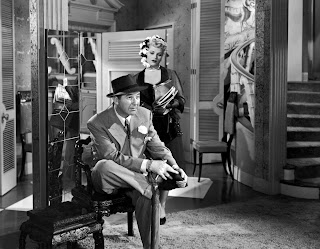
Harry Brock (Broderick Crawford) is a tyrant.  He's got power.  He's got money.  He's physically and verbally abusive.  "Do what I'm tellin' ya!" he constantly barks.  He's not in Washington, DC for honorable purposes.  He's a millionaire crook.  Billie doesn't really know what he's up to.  She's comfortable.  She seems to be doing well for herself.  He calls her a "dumb broad."  Billie may be, but she's no floozie.  When the congressman Harry will buy comes over, he chats with Harry's lawyer.  Congressman Hedges says, "...this country will soon have decide if the people are going to run the government, or the government is going to run the people."  For the last half of that statement, Cukor cuts to a close-up of a blank-faced Billie Dawn.  This comedy is a statement on American freedom.  Cukor is telling us not to be the "dumb blonde" in regards to our democracy.
Making small talk as Harry moves in to financially manipulate the congressman, Billie dizzily comments, "It's a free country."  She'll repeat that line when she and Harry play gin.  Not since Buster Keaton could anyone do so much with a stone-faced expression as Judy Holliday.  The face may not be moving but the mind is.  That's what we can see.  The gin game -- besides being a classic comedy scene -- is very important and not solely in the action for laughs.  It shows us that Billie is honest.  She plays fair.
Harry doesn't.  He aggressively limits her freedom of speech.  "It's a free country," she whines.  "That's what you think," he bellows back.  She's got furs, jewelry and she can stay in the best hotels.  But Billie Dawn is oppressed.  She doesn't have full rights and liberty in that relationship.  She's told to shut up and she's told to sign papers for Harry that, unbeknownst to her, are part of his greedy plans to exploit the country.  Refining Billie in DC is also part of Harry's manipulative scheme for more power, more money and some media control.  The owl-tutor he hires for Billie-the-pussycat is a political journalist out to uncover the real reason for Brock's stay in our nation's capitol.  Harry thinks he can buy journalist Paul Verrall too, like he did Congressman Hedges.  Paul (played by William Holden) is hip to the scheme.  He's proof that you can't judge a bookworm by his cover.  He takes the job of giving Billie a culture makeover.  "I'm stupid and I like it," Billie gleefully says to Paul.  But she's not as stupid as even she thinks she is.  As expected, she gets an immediate crush on her paid DC tutor.
Paul keeps things business-like, really more interested in getting the goods on Harry.  When he sees that Harry treats Billie like a second-class citizen,  Paul realizes he can get the story more easily from her while tutoring.  Not-so-stupid Billie figures she can make a move on him if she seems really interested in this new education.  It turns out Paul really falls for Billie and Billie really is eager to learn American history.  Her makeover doesn't come with a complete overhaul of fashion and sound, but with a simple accessory.  She starts wearing her eyeglasses so she can read.  She takes a DC tour with Paul and learns about the Gettysburg Address, the Constitution, the Declaration of Independence and the Bill of Rights.  Her transformation is definite, significant and more realistic than in, say, My Fair Lady, also directed by George Cukor.  She doesn't go from guttersnipe to belle of the ball with a new sophisticated accent.  She won't do a complete 360 in sound and behavior like Mia Farrow's poor dumb blonde in Radio Days.  But change, she does.  Billie becomes enlightened and aware.  She absorbs the words of our Founding Fathers and makes them an active bright force in her life.  At the Watergate Concerts, she reveals that her long-fractured relationship with her loving widower dad may be on the mend.  Her dad dislikes Harry.  Billie says, "He always used to say 'Never do nothin' you wouldn't want printed on the front page of The New York Times.'"  We know her dad would like Paul.
Paul tutors her on American history, art and classical music.  She inspires him to have more clarity in his political writing.  He wrote a article called "The Yellowing Democratic Manifesto."  She couldn't understand it.  Who could?  Paul Verrall wrote in a way-too-upscale National Public Radio or New York Times film critic style.  It's too intellectual for its own good.  She tells him basically to make the same points but put it in a working class voice that everyday people can understand.  Billie's right.
Still, Billie is blind to the dangerous depth of Harry's selfishness.  She's gotten used to it in their eight years together but she's never really paid attention to it.  She doesn't realize how vicious it is.  As Paul rants to her, "Sometimes selfishness can even get to be a cause, an organized force, even a government.  And then it's called fascism.  Can you understand that?"
Billie has changed from the opening scene.  She's still a shapely blonde.  She still sounds the same.  But there's no more New York burlesque chorus girl in the walk.  She's cut down on the liquor. Fashion affectations like the diamond bracelets and the cigarette holder are gone.  So is the look of stupidity in the eyes.  Billie Dawn is no longer content to be ignorant.  Now she speaks her improved mind to Congressman Hedges when, before, she could've cared less about political conversation.  She's embraced her freedom of speech.  The glasses she wears are a threat to Harry.  They represent knowledge and freedom.  She'll now painfully understand what Paul meant about Harry's selfishness.  He'll use brute force to make her sign more papers to help him in his racketeering scheme.  The minks, diamonds and fancy clothes are no longer important to Billie.  Her dignity and personal freedoms are.
Harry throws her out of their hotel rooms.  She's blacklisted, if you will.  Billie walks back to the Washington monuments she toured with Paul.  This will be her personal 4th of July as she's about to break away from the fascism of Harry.  While she walks and thinks about the state of her life, the soundtrack is a soft orchestral rendition of "America the Beautiful."  She will overthrow a menace with what she's learned and with the help of a free American press.  Judy Holliday's dumb blonde is a different take on that stock American show biz character.  Billie Dawn is not like Jean Harlow's hotsy-totsy blonde wife in Cukor's 1933 classic, Dinner at Eight.  She's not like the Marilyn Monroe blondes in Gentlemen Prefer Blondes or Some Like It Hot.  She's not like the Jayne Mansfield blonde in The Girl Can't Help It or Jean Hagen's Singin' in the Rain blonde movie star, Lina Lamont.  Holliday created a unique variation on the dumb blonde.  Off-screen, Holliday was closer to Mensa member than airhead.  Reportedly she had an IQ of 172.  Plus she was a versatile film actress as she proved again for Cukor in It Should Happen To You, in which she plays the 1950s equivalent to a reality TV show star, and The Marrying Kind.  In that film, she makes me cry with her kitchen sink performance as a Manhattan wife and mother on the brink of divorce.  Another favorite of mine is Full of Life starring Holliday as the very pregnant, college-educated, intellectual wife who bonds with her Italian immigrant father-in-law.  Also there's Vincente Minnelli's Bells Are Ringing with Holliday reprising her role from another Broadway hit of hers.  That one, a musical comedy with memorable tunes.  Often folks forget that comedy is hard work.  Born Yesterday is a comedy with a very serious political core.  The core is, as Thomas Jefferson put it, "tyranny over the mind of man."  Born Yesterday deserves more regard as a film classic.  The gifted and greatly loved Judy Holliday died in 1965 at age 43 of breast cancer.  She deserved the Best Actress Academy Award she won for the memorable character she created first onstage and then on film, an all-American character called Billie Dawn.

Colman Domingo in RUSTIN

In the first ten minutes of Steven Spielberg's LINCOLN, we see Daniel Day-Lewis as Abraham Lincoln talking to two Black soldiers on a Ci...