Sunday, November 6, 2016

Early Praise for FENCES

I got excited last night.  Let me explain.  I logged on to Twitter after the special L.A. screening of FENCES.  I wish I could have been there for it.  I was thrilled to read some critics enthusiastically tweet that Viola Davis could very well be on her way to making Oscar history.
She won a Tony for her performance in the Broadway revival of August Wilson's Pulitzer Prize-winning drama.  Her leading man, Denzel Washington, also won a Tony for the revival.  The two star in the film adaptation which was directed by Mr. Washington.
Here's some of what I read on Twitter when the L.A. screening of FENCES ended.  Anne Thompson of IndieWire (@akstanwyck):  "Denzel Washington knocks FENCES out of the park as director and actor.  Viola Davis and Mykelti Williamson will also be Oscar contenders."  Kyle Buchanan. Senior Editor at New York Magazine/Vulture (@kylebuchanan):  "FENCES, full of titanic performances...will be a major awards contender.  Viola Davis is unbeatable."  Jeffrey Wells of Hollywood-Elsewhere.com online (@wellshwood):  "...great adaptation, great play, Oscar grandeur.  Best Pic, Actor, Supporting Actress."

Variety wrote:  "Denzel Washington, Viola Davis Become Instant Oscar Frontrunners in FENCES."  The article was written by Kris Tapley (@kristapley).

I didn't see any tweets from black critics and wondered if black press had a sizeable presence at the screening.

You know that the lack of diversity, the need for equal opportunities in Hollywood, was a red hot entertainment news issue this year -- especially after the Oscar nominations came out and the Twitter hashtag "Oscars So White" was drop-dead accurate for the second consecutive year.  Nationally-known film critics took Hollywood to task for its lack of diversity.

Those same critics fail to look in the mirror and see the refection of its own diversity-lacking field.  I've written before that the field of film critics we've seen on network TV over the decades was sorely in need of race and gender diversity.  It was predominantly white male.  The same applies to the field of TV hosts on movie channels.  Remember when AMC was American Movie Classics and aired old Hollywood movies?  The only minority host on that channel in those days was Whoopi Goldberg  -- and she was there as a guest host because she's famous, she knows classic films, and she has an Oscar.  I've been a devoted TCM fan since 1999.  We occasionally -- not frequently -- see a black person in the monthly Guest Programmer spot.  I can't recall ever seeing a black solo host.  Elvis Mitchell, former film critic for The New York Times, did a series of interview specials.  That was back in 2008.  They're still in repeats.  TCM does book black guest co-hosts for theme programing that focuses on black history and/or the black experience in filmmaking, but not always.  Remember October of 2014?  Who was the host for the month-long salute to Africa?  Caucasian Canadian Alex Trebek.  I am a hardcore TCM fan.  But booking Alex Trebek to host a month-long movie salute to Africa was like something out of a Christopher Guest mockumentary. What...LeVar Burton was unavailable?

As a reminder, I started my professional TV career as a weekly film critic on the ABC affiliate in Milwaukee.  I was half of a film review team on a weekly half-hour show that aired on a different Milwaukee channel and I wrote reviews for a local publication.  That all got me contacted by PBS Chicago to come audition to be half of the new film review team when Siskel & Ebert left for Disney syndication.  That was in the early 80s, before I got and accepted a New York City TV offer in 1985.

From 1992 to 2000 when I worked on local and network TV news programs, I felt a color barrier when I wanted to review new movies and suggest classic films on the air.  Two remarks I heard from news show producers were -- "I don't think you have the skills to do it" and "Do you know anything about movies?"  I took it personally and thought it was just me.  That is..until I started sharing my experiences with other black, Latino and Asian film critics I saw at screenings in New York City.  They were frustrated too when it came to getting TV air time.  I proved to ABC News in 2000 that I did know something about movies.
I booked the job as the weekly entertainment editor on an ABC News live magazine show. I LOVED that job.  I'd love to do more entertainment contributor work for ABC.
Now that the network TV morning news shows are attached to movie studios, they don't have Friday film critics the way they did for decades.  There's no Gene Shalit on NBC, Joel Siegel on ABC, Gene Siskel on CBS.  Also, there's no syndicated Siskel & Ebert or Roger Ebert & Richard Roeper or Ben Mankiewicz & Ben Lyons or A.O. Scott & Michael Phillips.  All those couples were film review teams on national TV.  Some film critics are still seen on network news shows and on local newscasts in New York City.  The field is still predominantly white male.

Why are black people excluded from the mainstream new film and classic film conversation on TV?  And, in this movie season in which we're getting films like FENCES, MOONLIGHT and HIDDEN FIGURES (about the 3 African American women at NASA in the 1960s), why can't minority viewers look at a network or local TV news program and see a minority journalist review those films? When the network morning news programs have entertainment reporters and film critics in place minutes before the Oscar nominations are announced live, why is there never a black film critic/entertainment reporter present?

Why this lack-of-race/gender diversity?

As for Viola Davis, as I've mentioned in a short video on YouTube (YouTube.com/BobbyRiversTV), if she is nominated for FENCES, she will be the first black woman in history to have more than two Oscar nominations to her credit.

If you're on Twitter, here are some black, Latino, Asian film critics you should follow:  Wesley Morris won a Pulitzer for film criticism when he wrote for The Boston Globe.  He's now with The New York Times.  @wesley_morris was the first African American to win the Pulitzer for film criticism.  Mike Sargent is a veteran film critic and a New York City radio host.  @Mikeonscreen has broken a color barrier as the first black male to be an occasional guest critic on the NY1 weekend film review show hosted by NY1 (New York 1) film critic Neil Rosen.  Mike hosted his own weekend film review interview show for two years on TV.  Every single show, he booked female critics like Zeba Blay (@zblay) and @RaqiyahMays. There's Julian Roman (@realjulianroman) and Jack Rico (@JackRicofficial). NPR station KPCC in Southern California has a Friday afternoon hour-long film review show called "FilmWeek."  It's a great show with different guest critics every Friday at noon Pacific Time.  Two excellent gents frequently heard on the show are Tim Cogshell (@CinemaInMind) and Justin Chang, film critic for The Los Angeles Times (@JustinCChang).

There needs to be diversity and equal opportunities in the film arts and in the discussion and criticism of the film arts.  Those folks on Twitter can add fresh insight and observations to the discussion.

FENCES starring Denzel Washington and Viola Davis opens Christmas Day.


Saturday, November 5, 2016

Get Spacey with PEOPLE OF EARTH

Space creatures gave me lots of laughs on Halloween night.  PEOPLE OF EARTH premiered on TBS.  The first two episodes aired Halloween night.  I wish there had been one more episode.  Call me crazy.  But I guess I'm just a sucker for extraterrestrials who bicker like members of a garage band who've worked together for years but have never hit the big time.
One of the most fulfilling and frightening experiences of my career was the time I had the privilege to work with a PEOPLE OF EARTH actor.  I made my comic acting debut as a recurring character for THE ONION.  I played a clueless TV news pundit named Prof. Robert Haige.  He was a panelist on one of those Sunday morning MEET THE PRESS-type shows.  I was nervous about working with Brian Huskey because he's an improv comedy veteran who books a lot of work.  He's had parts in Will Ferrell comedies.  I learned so much every single day I worked with and watched Brian.  When we had scenes together -- and this is no exaggeration -- I often had to bite the inside of my cheeks hard to keep from laughing and ruining a take when he ad libbed.

He made me less nervous and he gave me confidence.  That was exactly the kind of assignment I'd long for -- to be a supporting comic player in an ensemble.  It's the kind of work I'd still love to get.  When I saw that Brian was in the promo commercials for PEOPLE OF EARTH, I made a point to watch.  I'm so glad I did.
He plays Richard, the balding and bearded member of an alien abductee support group that meets in a church basement.  The group is called StarCrossed.  A young experienced journalist whose life at his age is not where he thought it would be goes to cover the group.  He expects they'll all be loonies.  However, while driving at night, he suddenly sees a deer in his car and the deer says, "Don't get weird."  When Ozzie goes to his business office to meet with his boss, he has visions of people with deer heads instead of human heads.  Soon, the journalist feels he needs to join the alien abductee support group because of the freaky flashbacks he's having.

We then see the three extraterrestrials who give him the flashbacks.  One of them botched up an assignment and another has to don human appearance, go down to earth and try to fix it.  One alien has no desire to visit Earth America because there's no gun control.  "It's like the wild west down there," he says.  The folks in StarCrossed aren't hallucinating. There has been alien contact. But why?

Those three space creatures broke me the heck up.  Ozzie the journalist -- THAT'S the kind of role I'd love to do.  With his appropriately sad sack face and slim frame, Wyatt Cenac nails that part.  He's the perfect Ozzie.  Brian Huskey plays Richard, the guy who irritates the two women in the group who claim to have had a sexual encounter with the same alien.  Brian is terrific yet again.  Oscar Nuñez (formerly of NBC's THE OFFICE) plays the Catholic priest who loved the movie AN OFFICER AND A GENTLEMAN and the blunt, formidable leader of the support group is played by ANA GASTEYER.
For such an unusual sitcom plot, you do feel as though you know these characters.  Or you've been these characters.  Each group member truly is alienated in some way in life.  I saw so much of my occupational self in Ozzie.  And this isn't one of those shows that mostly just one liners and no character development.  You begin to see how each character relates in this small town and within the StarCrossed group.  I really enjoyed the smart writing.
So, there's a new show for you to keep in mind if you dig loopy, intelligent humor.  PEOPLE OF EARTH on TBS.  Another moment that broke me up:  the very Southern Californian-looking alien having first time sex with an earth woman.  He looks like the alien most likely to download 1970s hits by Seals & Croft when he's on Earth.
PEOPLE OF EARTH airs Monday nights at 9:00 on TBS.
Great work, Brian Huskey.  May PEOPLE OF EARTH quickly get orders for more episodes.


Friday, November 4, 2016

LOVING Joel Edgerton

This actor, Joel Edgerton, is a wonder from Down Under.  Last week, in my October posts, I blogged "I'm Ready for LOVING" because I am so eager to see this Australian's new film.  It's called LOVING and the title works more than one way.  The name of the married couple at the heart of this film is Richard and Mildred Loving.  Joel Edgerton has the lead male role.
I was a child of the Civil Rights era.  When I was a little boy, Mom and Dad had me watch Dr. Martin Luther King's March on Washington which was a live CBS News special telecast the day it happened.  Richard and Mildred Loving took their fight for Civil Rights to the Supreme Court.  They were charged with breaking the law and they were sentenced to prison because they fell in love and got married.  He was white.  She was black.
In the 1950s interracial marriage was still illegal in several American states.  Things changed in the 1960s because of the Supreme Court ruling on Loving v. Virginia.
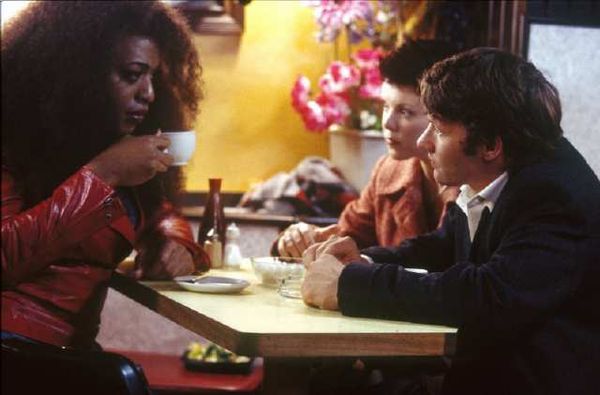
I was first charmed by Joel Edgerton's versatility when I saw him in the 2005 British comedy, KINKY BOOTS.  He played shy, conservative Charlie.  Charlie inherits a failing shoe factory.
With the help of a drag queen cabaret performer, played fabulously by Chiwetel Ejifor (later of 12 YEARS A SLAVE), Charlie learns how to turn his factory's fortune from bad to good.

He teams up with the queen to manufacture kinky boots.  The boots were the queen's idea.  Charlie becomes less straight-laced and uptight thanks to his partnership with "Lola".

The film was adapted into what is now a huge Broadway musical comedy hit.

I was lukewarm on the bloated, overly glitzed up, hollow remake of THE GREAT GATSBY in 2013. However, I wrote in a review that Joel Edgerton should've been a Best Supporting Actor Oscar nominee for his performance as the bigoted sportsman Tom Buchanan.

MIDNIGHT SPECIAL, written and directed by Jeff Nichols, was a modestly-budgeted science-fiction thriller that opened in June of this year.  I still feel it should've had better promotion and reached a wider audience.  True, it's not an excellent sci-fi thriller in a league with Steven Spielberg's best, but it was worth seeing.  What it lacked in a special effects budget it made up for in humanity and depth of feeling.  You cared about its characters.  A little boy with a special, supernatural gift is forced into silence and hiding by government forces.  Another force, a dark one hiding behind religion, also hunts the boy.  The boy's father will do anything to protect his son.  There's a mission to reunite the boy with his mother, a loving woman who has been treated like a misfit, a social outcast, and is separated from the boy and his father.

I interviewed Joel Edgerton and Kirsten Dunst, both stars of MIDNIGHT SPECIAL.  I learned then in press notes that his next film would have him playing Richard Loving.  I wanted to talk to him about that but you have only so much time in these movie junket interview opportunities.  However, I looked at the interview recently and noticed that the themes of love, faith, living in silence and hiding from outside forces, and the strength of family ties in MIDNIGHT SPECIAL also apply to LOVING from the glowing reviews I've read.  Jeff Nichols, the man who wrote and directed MIDNIGHT SPECIAL, also wrote and directed LOVING.  In both films, we see ordinary working class people dealing with something far bigger than they are.

Edgerton plays a faithful disciple, of sorts, to the father and child on the run in Texas in MIDNIGHT SPECIAL.  He's now seen as the Southern white man who falls in love with a black woman in LOVING.  Just like the comedy, KINKY BOOTS, Joel's new drama is based on a true story -- a story that's a plea for equality and understanding.  Here's a clip from LOVING with Joel Edgerton and Ruth Negga as Richard and Mildred Loving.

Here's my interview from earlier this year with Joel Edgerton and Kirsten Dunst of MIDNIGHT SPECIAL, written and directed by Jeff Nichols, the filmmaker who also wrote and directed LOVING.

You can find MIDNIGHT SPECIAL on DVD.  LOVING is now playing in theaters.

Thursday, November 3, 2016

Screenwriter & Film Director Muriel Box

Add filmmaker Muriel Box to the conversation.  When we talk of women film directors of the 1940s and 1950s, there are two names that we always mention because they were the two most widely-known women who took control behind the camera.  They were Dorothy Arzner.  Her credits include THE WILD PARTY (1929), SARAH AND SON (1930), HONOR AMONG LOVERS (1931) and MERRILY WE GO TO HELL (1932).  All four of those starred Fredric March.  SARAH AND SON made Arzner the first woman to direct a performer to an Oscar nomination.  Ruth Chatterton was nominated for Best Actress.  Arzner went on to direct films starring Katharine Hepburn, Rosalind Russell, Joan Crawford and Lucille Ball.  The other woman in Hollywood to shatter the glass ceiling and take control behind the camera was popular and acclaimed actress Ida Lupino.  She was a star who became a director and continued to act.  She made space in the glass ceiling so other actresses in the future like Barbra Streisand, Penny Marshall and Jodie Foster could also direct.
Well, there was another woman.  She was in Great Britain.  She'd won an Oscar for Best Original Screenplay and then she went on to direct films.  Her name is left out of the female directors conversation -- but I feel she should be included.  Ever heard of Muriel Box?  She was a screenwriter and director who, in her day, may have been the only Oscar winning female screenwriter to become a film director.  That's Muriel Box in the photo above this paragraph.  Here's Muriel Box (left) directing Shelley Winters in the 1954 comedy, CASH ON DELIVERY.
Did you see Hitchcock's 1948 film, ROPE, starring James Stewart?  Remember the matronly Mrs. Atwater at the beginning of the movie making chit-chat about movie star James Mason?  She loved that he looked so dangerous.  Like a handsome menace. (In the 1950s, James Mason would be dangerous for Hitchcock in the classic NORTH BY NORTHWEST).  The 1945 British drama, THE SEVENTH VEIL, is a rich example of what Mrs. Atwater meant.  This was the film that made Hollywood really notice the British actor.  He'd been a leading man in British movies since 1939.  When THE SEVENTH VEIL opened in the U.S. and qualified for the Academy Awards, it brought Oscars for Best Original Screenplay to Muriel Box and her then husband, Sydney Box.
In THE SEVENTH VEIL, Mason plays the elegant brute who helps a young woman improve and excel artistically as a pianist while he belittles her emotionally.  It's a very dark relationship in this psychological melodrama.  James Mason fans need to see this one.

By 1949, Muriel Box had become a British film director.  Her first assignment, 1949's THE LOST PEOPLE,  was a post World War 2 drama that featured a screen newcomer named Richard Attenborough.  A year after she directed Shelley Winters, she directed the exquisite screen comedienne Kay Kendall and Peter Finch in a TV satire that's perfect fare for Christmastime viewing.  It's 1955's SIMON AND LAURA.  It focuses on TV in its early days, celebrity status and marriage.  Two sophisticated actors are married.  A new BBC TV producer comes up with the idea of making their unscripted home life a show.  Yes, it's what we now call "reality television."  However, the producer doesn't know that their marriage has gone sour.  And they don't tell the producer because they really need the money. 

Kay Kendall was a luminous talent who was taken from us way too soon.  She died of leukemia.  She practically stole the 1957 MGM musical comedy LES GIRLS from Gene Kelly.  And rarely did we see Peter Finch play comedy and sport a mustache.  He did both in SIMON AND LAURA.  The comedy gave Finch his first lead role in a British film.

Of course, Simon and Laura's live Christmas broadcast experience is destined to be a holy -- and funny -- mess.  SIMON AND LAURA was based on a play by Alan Melville.
The last film that Muriel Box directed was the adaptation of hit stage comedy.  It was 1964's RATTLE OF A SIMPLE MAN starring sexy Diane Cilento and Harry Corbett.  In this romantic comedy, a group of sports fans heads to London for a soccer match.  One of the guys winds up with a sweet prostitute.  We find out that the shy, unsophisticated fellow is...a 40 year old virgin.

The Broadway production of the early 1960s play starred Tammy Grimes, the gifted Tony winning actress who died last weekend at age 82.

Writer/Director Muriel Box gave moviegoers a male 40-year-old virgin about 40 years before Hollywood did in a hit comedy starring Steve Carell.

Oscar winning screenwriter and film director Muriel Box needs to remembered and added to the Women In Film conversation.


Wednesday, November 2, 2016

Ricardo Montalban in MYSTERY STREET

If you know me or have been a fairly regular reader of my blog posts here, you know how much I loved working on VH1.  I was daily veejay and, Monday through Friday in prime time, I hosted my own half-hour celebrity talk show.  I've been a classic film fan ever since I was in the 3rd grade.  That VH1 talk show was like Christmas five times a work week for me.  Many stars of classic films from the glory days of Hollywood were guests on my show.  Kirk Douglas,  Don Ameche, Shirley MacLaine, Michael Caine, Fay Wray, Debbie Reynolds, Omar Sharif...they were some of my guests.  So was Ricardo Montalban.  Totally cool and a class act was Ricardo Montalban.  Millions of ABC TV viewers knew him as the star of FANTASY ISLAND from the late 70s through the mid 80s.  But the VH1 floor crew and I knew that Ricardo Montalban's Hollywood career went back to the 1940s at MGM.
He did dramas, he did action/adventure movies, he did westerns, he did war movies like the WW2 classic BATTLEGROUND, he did love stories and he did musical comedies.  He was Cyd Charisse's dance partner in Technicolor MGM musicals.  He introduced a popular tune that won the Oscar for Best Song.  At Christmastime, you hear the song "Baby, It's Cold Outside" by various artists.  You hear it a lot.  That song made its film debut in 1949's NEPTUNE'S DAUGHTER.  He sang that song to Esther Williams in NEPTUNE'S DAUGHTER.

Then came his stage work with an African American show biz legend.
He also sang on Broadway.  He and fellow MGM veteran, Lena Horne, were the stars of the 1957 Broadway musical called  JAMAICA.  It had a score by Harold Arlen and E.Y. "Yip" Harburg, the music men who scored 1939's film classic, THE WIZARD OF OZ.  Both stars were nominated for Tony Awards.

Montalban had an extensive list of film credits.  One of my favorite Ricardo Montalban movies is a 90-minute film noir crime thriller he did at MGM.  It's a good, tight, entertaining drama that I highly recommend.  And I feel it could have had another life.  The movie is 1950's MYSTERY STREET.  The talented Jan Sterling played the blonde floozie who discovers she's pregnant.  The father is a married man.  Not married to her.  He won't help her financially.  He won't even return her phone calls.  She wants to have a showdown with this upstanding citizen but she winds up dead.  Months later, her skeleton is found.   Enter Ricardo Montalban as Police Lt. Pete Morales.  This story takes place in the Boston area.  Lt. Morales teams up with Boston police and uses forensics to solve the crime.  The role of Lt. Morales fit Montalban like a glove made of "fine Corinthian leather" (as he said in his very popular TV commercials during his FANTASY ISLAND years).
 A heavy accent on forensics was rare in a Hollywood film at that time.  Also rare was an ethnic actor playing an upscale ethnic character like that.  Let's face it, the detectives who solved the crimes were usually white guys in the movies in those days.  MYSTERY STREET was a smaller film that had a big refreshing change diversity-wise.
When Mr. Montalban was on my VH1 talk show, he was very pleased to see me as host.  He was supportive.  He knew that kind of opportunity didn't frequently come to us people of color.  I was on national TV and I got a rave review from The New York Times interviewing the same caliber of guests that Dick Cavett had, that Johnny Carson had, that David Letterman was getting.  Off-camera, Mr. Montalban and I talked about the need for diversity and inclusion in our entertainment profession.

When you're a kid -- and when you get older -- you look for reflections of the world you know when you watch TV.  This is why Shonda Rhimes was livid during original casting sessions of her GREY'S ANATOMY.  She was sent only white actors.  I was lucky enough to grow up with Mexicans in my daily life during my South Central L.A. youth.  They were our next door neighbors, my classmates, my fellow altar boys in church, our priests, teachers, doctors, librarians, supermarket clerks -- and detectives.  One time a scam artist tried to bilk money out of Mom.  The con artist was unsuccessful.  Two detectives came to our house to get info from Mom.  I was a little boy and they both giggled when I said, "Wow. This is better than TV!"  Our block, our neighborhood, our circle of friends was diverse and multi-cultural.  But, on TV, the first show I recall having a lead Mexican character was the hit 1974 sitcom CHICO AND THE MAN starring the late, great Freddie Prinze.  In 1977, there was CHiPS with Erik Estrada as a motorcycle cop.

I still feel that 1950's MYSTERY STREET could have been adapted into a weekly TV series with Lt. Morales dealing with forensics every week -- like Jack Klugman did as QUINCY on NBC in the 1970s.  MYSTERY STREET would made a most watchable detective series.
That would have been groundbreaking to see on network TV -- a lead Latino character solving crime with science, a character played by a Latino actor.  Elsa Lanchester, as she always did, stands out in a supporting role in the film.  MYSTERY STREET also has two fine dancers in the cast, but they only do dramatic duty.  They don't dance a step.
One is Sally Forrest.  She was in the company of dancers behind Gene Kelly for his St. Patrick's Day number in TAKE ME OUT TO THE BALL GAME.  One MGM history book noted that, for a short time, she was considered to be his leading lady in AN AMERICAN IN PARIS when Cyd Charisse had to bow out due to pregnancy.
The other dancer played a diner waitress.  In real life, she was Gene Kelly's first wife.  Many classic film fans know Betsy Blair as Ernest Borgnine's shy love interest in the movie MARTY.  Blair, on the right next to Forrest in the above photo, was in the New York City production of Billy Rose's DIAMOND HORSESHOE.  She danced in the chorus of that 1940 show.  Gene Kelly worked as a choreographer.

MYSTERY STREET is available on DVD.  Check it sometime if you can.  Let me know if you share my feeling that it could've been the basis for a good TV series.

Tuesday, November 1, 2016

Under Hitchcock's Direction

I received a DVD of Alfred Hitchcock's VERTIGO as a belated birthday gift.  Love it!  What a classic.  You know what never ceases to fascinate me?  How Hitchcock could take an actor who had a warm, wholesome image and get the actor to show the dark side of it.  VERTIGO is a perfect example.  In the 1930s, James Stewart had successfully and skillfully established an "All-American" good guy image.  Look at him in BORN TO DANCE (1936), Capra's YOU CAN'T TAKE IT WITH YOU (1938) Capra's MR. SMITH GOES TO WASHINGTON (1939) and the western comedy DESTRY RIDES AGAIN (1939).  Stewart got five nominations for Best Actor in his career.  He won for 1940's sophisticated comedy, THE PHILADELPHIA STORY.  If he could've hooked another Best Actor nomination, I would have put him in the running for 1958's VERTIGO.  He's so obsessed in this movie both as a cop out to solve a crime and as a man erotically obsessed with a woman who died.  Such a complex character.
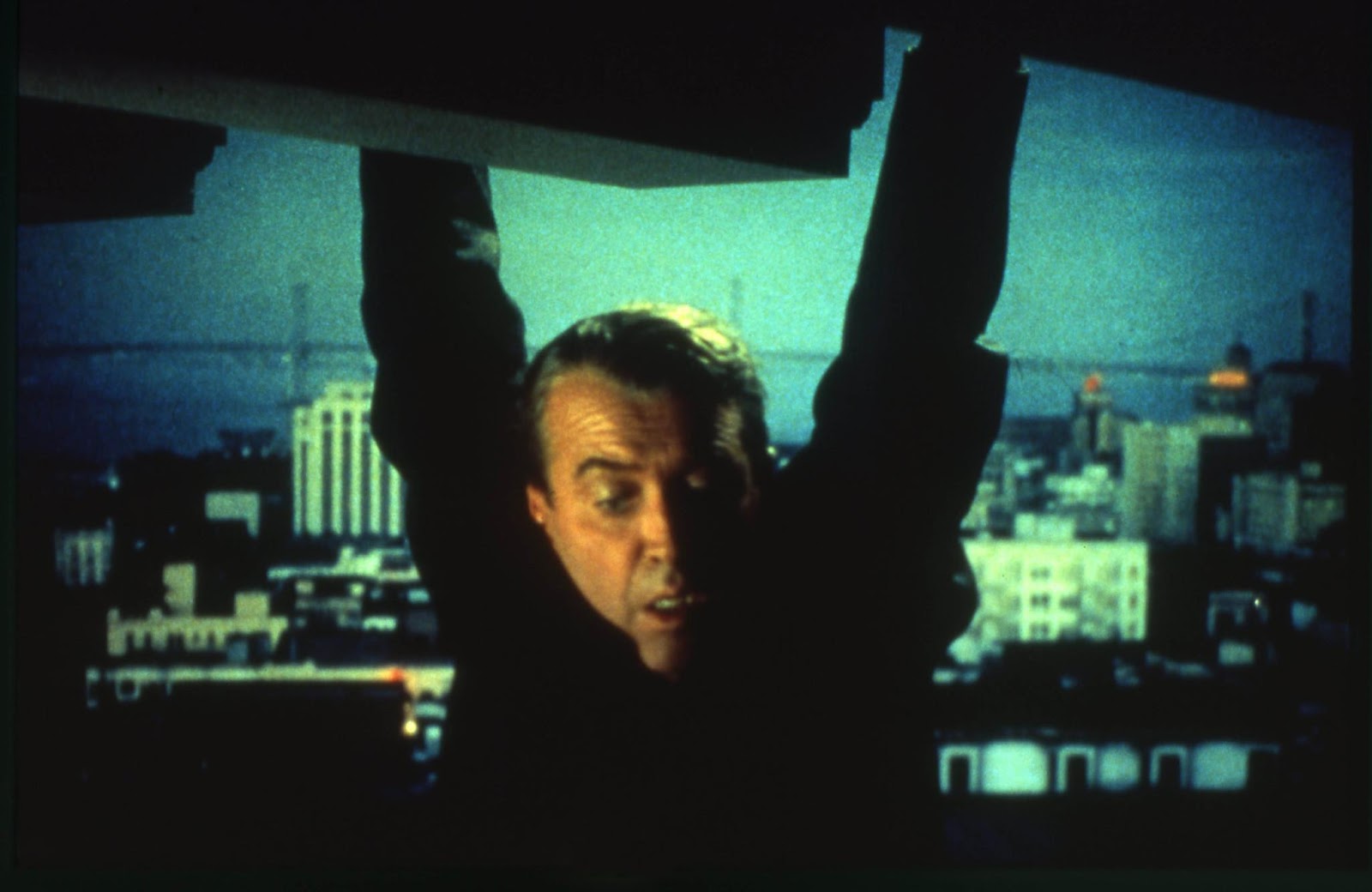
VERTIGO opens and he dangles from the top of building in San Francisco.  He slipped during the police rooftop chase of a criminal.  The detective holds on, trying not to fall.  He gets vertigo.  Later, trailing a man's wife on a case, he tries not to fall -- not to fall in love with her.
 It occurred to me that a few lead stars gave some of the best performances of their film careers under Hitchcock's direction.  Cary Grant was a big screen master of comic acting.  Look at him in BRINGING UP BABY, THE AWFUL TRUTH, HIS GIRL FRIDAY, MY FAVORITE WIFE and THE BISHOP'S WIFE.  But when he died and his death was a lead story on the network news, what famous movie clip of Cary's was the first one shown?  Cary Grant in Hitchcock's NORTH BY NORTHWEST (1959) as the Manhattan advertising executive being shot at by a killer in a crop duster plane.  That performance was one of Cary's best.
The same goes for Cary Grant's work as the emotionally conflicted government agent who recruits a woman to do espionage work for the U.S.  It's work for the untrained spy that will put her in a house full of Nazis.  He falls in love with her knowing that part of her work will require sharing a bed with the main Nazi.
As Devlin, the "fat-headed guy full of pain," Cary Grant was excellent in Hitchcock's NOTORIOUS (1946).  Cary Grant was nominated for two Oscars, both for dramatic performances.  He never won an Oscar.  Ingrid Bergman was a 3-time Oscar winner.  She wasn't nominated for NOTORIOUS but, man, she should have been.  What a performance and what a sexually mature, complicated, juicy role she was given to play.  Her character has sex for Uncle Sam but the men in the office issuing her espionage orders don't regard her as "a lady" because she's not a virgin.
Like Frank Capra, William Wyler, Mitchell Leisen and John Ford, Alfred Hitchcock was a director who made a film in the 1930s and then directed its remake years later.  Such was the case with Hitchcock's very successful 1956 remake of his 1934 original, THE MAN WHO KNEW TOO MUCH.  This is another film that starred James Stewart.  His leading lady was a woman who spoke glowingly of him in her 1970s autobiography -- Doris Day.  James Cagney, James Garner and Tony Randall were in awe of Doris Day's natural acting talent and range.  She was a singer with a band who had hit records and then was given a movie role in a 1949 Warner Bros. musical comedy.  Within five years, she was one of the studio's biggest musical comedy stars.  She sang and danced in such feel-good films as MY DREAM IS YOURS, TEA FOR TWO, ON MOONLIGHT BAY, APRIL IN PARIS and CALAMITY JANE.  Doris Day truly was a Hollywood icon for the sunny All American girl image.  Cagney did a musical with her at Warner Bros.  Later, for MGM, they starred in the gritty 1955 biopic, LOVE ME OR LEAVE ME.  That film should've brought Doris Day her first Oscar nomination.  In it, she showed the dark side of the sunny girl-next-door image in this story of real-life singer Ruth Etting.  The talented, tough, ambitious and somewhat manipulative young Etting lets a hoodlum manage her career because she knows he can get her where she wants to go.  But there will be a price to pay for that.

At Warner's, having worked with her and seen her work, Cagney urged Doris not to let the studio give her acting lessons because she naturally, instinctively had the gift.  He didn't want to the studio to process her into a copy of other contract players.
In his 1956 remake of THE MAN WHO KNEW TOO MUCH, Hitchcock gives us a look at a modern marriage in which the wife needs to find a new voice -- and the husband needs to shut up and hear it.  Jo, the wife, was a hit singer in the 1940s.  She gave up her career to be a successful doctor's wife in the Midwest.  They, with their little boy, are on vacation in Morocco.  The movie's title has two applications.  It applies to something a dying man tells the husband.  It also applies to the husband.  In the opening scene, the family is on a tour bus.  He does all the talking in a rather chauvinist way.  He's the know-it-all and makes his wife appear to be the supporting player instead of the leading lady.  She'd love to accept New York City offers to sing again.  He puts a damper on all that.  But we see during that bus ride that Jo is quick, alert and smart.  Where the husband is telling all his business to a foreign fellow passenger, Jo wants to know why the passenger is asking so many questions yet revealing nothing.  It's a good marriage but not without its occasional friction.  There's a space in between them.
Their son is kidnapped during the trip.  He's in danger of being killed.  A political figure is also in danger of being killed.  In order to cross borders and rescue their son, the arrogant husband will have to have to become humble and let his wife take the lead.  It's her fame as a singer that can open doors and give them access faster than his reputation as a doctor from the Midwest can.  Her voice as a singer will help locate their son.  He needs to acknowledge the intelligence and power of her voice as a wife and as an artist.  It will bring them closer to together.  This is the film that gave Doris Day the pop hit that became her theme song, "Que Será Será (Whatever Will Be, Will Be").
Like Cary Grant, one of her many leading men, Doris Day was a master at screen comedy.  Her one Oscar nomination was in the Best Actress category for 1959's PILLOW TALK, the first of her romantic comedies with Rock Hudson.  To me, THE MAN WHO KNEW TOO MUCH shows that the dramatic chops she displayed in LOVE ME OR LEAVE ME were no fluke. The scene that gets me every time is the one in which she has a tearful breakdown after he husband has given her a sedative in their hotel room.  He gave her the sedative because he knows she'll get hysterical when he gives her the news that their son has been kidnapped.
For a pop singer who'd never had any acting classes before Hollywood put her in the movies, that is one impressive scene she does.
I wonder if Paramount campaigned to get Doris an Oscar nomination for it.

And there was Anthony Perkins.  From Broadway, he went to movies with an All-American boy next door image.  He got one Oscar nomination -- for playing a Quaker during the Civil War in FRIENDLY PERSUASION (1956).

Then came the Norman Bates role in the 1960 Hitchcock masterpiece, PSYCHO.  No Oscar nomination for Anthony Perkins' brilliance in the role that made him internationally famous.
Hitchcock.  The Master of Suspense could really bring out the best in actors by showing another side of their screen images.

What performance in a Hitchcock film do you feel was overlooked by an Oscar nomination?

Colman Domingo in RUSTIN

In the first ten minutes of Steven Spielberg's LINCOLN, we see Daniel Day-Lewis as Abraham Lincoln talking to two Black soldiers on a Ci...