Thursday, February 7, 2013

Amy Adams and the Gang Member

Thanks to a dear longtime friend who is a respected Broadway pianist and music conductor, I had a great night in New York City early in December 2005.  Mark gave me a ticket to join some friends of his for the opening night of Chita Rivera: The Dancer's Life.  Love me some Chita Rivera!  It was such a treat to see that Broadway show with Mark's friends.  One in particular was an absolutely lovely gentleman.  Warm, witty, gracious, engaging and very down-to-earth.  He worked with current Oscar nominee Amy Adams.  His name is Harvey Evans and, if I'd been covering the Oscars telecast of 2008, I would have interviewed him.  He was in the show.  Another film Harvey worked in had earned Oscar nominations.  Did you see Amy Adams in Disney's 2007 musical comedy, Enchanted?  She played a fairytale princess hurled into the real world of New York City by a spell from an evil queen.  The sweet princess, given to song, does a number Central Park.  "That's How You Know" was nominated for Best Song.  Harvey sits next to her during the number.  He's the cool senior dude on the left holding the pen she borrows.

Harvey didn't stay seated.  Watch the clip.  See him have a musical lark in the park.

Harvey recreated his dance role for the production number when that Best Song nominee was performed during the Oscars.  Most of the people in the audience, probably millions of TV viewers, didn't know that they'd grown up watching Harvey's early dance work.  He was younger and still in the same part of Manhattan.  Look at the bottom corner on the right side of the photo below.  That's Harve against the chain link fence.
Now the top row, second from the left.  That's Harve again.  Yes, Harvey Evans was one of the Jets in West Side Story, Oscar winner for Best Picture of 1961.  It also won Oscars for Best Supporting Actor (George Chakiris) and Best Supporting Actress (Rita Moreno).
Harvey was in our party for opening night of Chita Rivera's one-woman Broadway show.  The two are longtime friends who shared a stage together.  They were both cast members in the original 1957 Broadway production of West Side Story.
He was one of the dancers lucky enough to recreate his role in the famed film version.
He was a Jet in the original 1957 cast of what became a Broadway classic.  He does the role in the Oscar-winning 1961 movie adaptation.  In 2007, he's still dancing.  He's in an original movie musical and repeats his dance character onstage at the Oscars in 2008.  That's pretty cool in my book.  When she was making Enchanted, I wonder if Amy Adams knew about the Broadway and movie history seated next to her in Central Park.  She's currently a Best Supporting Actress nominee for her performance as the hands-on wife of The Master, played by Philip Seymour Hoffman.
It's been announced that next months Academy Awards will have a salute to the movie musicals of the last decade.  That gives us Gerard Butler in The Phantom of the Opera, Dreamgirls and the Queen Latifah musicals -- Chicago and Hairspray. It also includes that simple, heartfelt, innovative gem called Once.  Sadly, it excludes all musicals starring Fred Astaire, Gingers Rogers, Judy Garland, Gene Kelly, Bing Crosby, Rita Hayworth, Frank Sinatra and Doris Day.  It cuts out all the musicals directed by Vincente Minnelli for MGM's legendary Arthur Freed unit.  It also cuts out other Oscar winning musicals like The King and I, Disney's Mary Poppins, My Fair Lady, Oliver!, Funny Girl, Cabaret...and West Side Story.

But that salute can include Enchanted -- also featuring Harvey Evans.

The Oscars® air Sunday, Feb. 24th on ABC.


Wednesday, February 6, 2013

LES MIZ vs LINCOLN: The Ladies

Anne Hathaway and Hugh Jackman are both Oscar nominees for their performances in the epic musical drama, Les Misérables.  Three of the Best Picture nominees deal with slavery.  This is one of them.  We've got slavery and showtunes back in the years leading up to the June Rebellion of 1832.  Everybody's miserable.  You could call it DJean Unchained.  (The D is silent.)  Jackman plays Jean Valjean, once a slave full of hatred. Now he struggles to do a good deed for Fantine, the lovely and gentle French peasant.  Starving Jean Valjean was made a prison slave because he stole bread to feed poor loved ones.  After his release, angry at life, he learns a lesson in forgiveness after a kind bishop gives him a pair of precious silver candlesticks.  Jean Valjean is a changed man.
Fantine is practically a wage slave.  She has a terrible, low-income job with a factory boss who wants to have sex with her.  She loses her job and endures further degradation.  She has a little girl who needs money for care.  Not only is unwed Fantine forced into a life of prostitution in order to survive, she's given a bad haircut and then needs dental care.
She sings her broken heart out.  All the French characters in Les Misérables sing their hearts out -- Jean Valjean...Javert, the obsessed prison guard who continues to hunt the ex-con...the crooked couple taking care of Fantine's child...the idealistic students who lead a revolt in Paris.  They all sing their hearts out.  But not a single one of them sounds French.  In fact, many of them sound like they fell out of the chorus in My Fair Lady.  It's like they're peasants on the Rue de Eliza Doolittle.  The candlesticks in Disney's Beauty and the Beast sounded more French than most of the actors in Les Misérables.  Couldn't director Tom Hooper have given Fantine, at least, a hint of Edith Piaf in her accent?

I know Anne Hathaway, winner of a Golden Globe and the SAG Award for this performance, is the favorite to win the Best Supporting Actress Academy Award.  I know that Oscar loves big musicals in which somebody dies -- The Great Ziegfeld, The King and I, West Side Story, Oliver! and Chicago -- but I wouldn't be surprised if there was an Oscar surprise on Feb. 24th.

If you read my November 2012 blog entry, "My Sally Field Day," you know that the former ABC sitcom star-turned-Oscar winning dramatic actress has long been a role model to me.  I have followed, learned from and been inspired by her unorthodox career during my unorthodox broadcast career as an African-American seeking the kind of TV opportunities I didn't see black talent get when I was a kid.  I'm not an actor of her caliber but I absolutely know how Sally Field felt when she repeatedly had to prove herself and fight for work that she wanted.

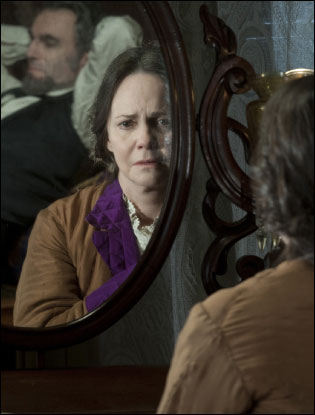
I saw her performance in Lincoln, another film that deals with slavery.  Wow.  Just...wow.  The Flying Nun was born to play this historical First Lady.  Mary is a complicated, educated Kentucky woman who is as passionate about the politics of the day as her husband is.  She is not an easy woman.  She has her emotional and physical pains.  They argue.  You have the feeling that she forges ahead with her political role at public events even when stricken with one of her many migraines.  You feel the years of their marriage.  Mrs. Lincoln has strong feelings about the abolishment of slavery.  She's also a mother.  She does not want to lose their oldest son in America's Civil War.  He wants to enlist.  They've already lost one young child.  She is not a passive First Lady to Abe Lincoln.  "You needn't tell me I'm right.  I know I am," she declares.
You feel the force that she is on him and in their political world.  Sally Field is powerful and magnetic in the role.  It's one of the strongest performances she's given in her film career.  She complements Daniel Day-Lewis' truly awesome work as Lincoln.
This marriage, with its fights and frustrations and its love, is the thing that makes Abraham Lincoln a real person in this movie and not just an iconic Great Emancipator in American history.  Sally Field as Mary Todd Lincoln keeps the president from coming off as good but unreal -- like he's the robotic Abraham Lincoln in the Disneyland exhibit.  The scenes with Mary make him a flesh-and-blood man who got support from and argued with his wife...and they show him as a father who had a fractured relationship with his oldest son.  Field has a political scene with Tommy Lee Jones.  That alone is worth the price of admission.

Don't be surprised if Daniel Day-Lewis and Sally Field both win their third Academy Awards later this month.  They are that good in Lincoln.


Tuesday, February 5, 2013

We Missed the TITANIC

Actor Victor Garber once again starred in a film that netted an Oscar nomination for Best Picture.  We saw him as the shipbuilder of an ill-fated luxury liner in the box office blockbuster, Titanic.  That movie took Hollywood gold for Best Picture of 1997.
In Milk, another film based on real-life events and real-life characters, he played the Mayor of San Francisco.  Mayor George Moscone was shot and killed the same day as Harvey Milk, the city official and gay rights activist portrayed by Best Actor Oscar winner, Sean Penn.  Milk was an Oscar nominee for Best Picture of 2008.
For a triple play, Victor hit a homer in a current Oscar nominee for Best Picture.  Movie-goers and movie critics loved Argo, based on actual people and news events from 1979.
In this crowd-pleasure, we see that Hollywood can not only entertain, but its product can also save your life.  A sci-fi action movie sequel inspires the plot to rescue hostages from a Middle Eastern political hotbed.  The hostages in Iran listened to Tony Mendez (played by Ben Affleck) and followed his lead.  They trusted his knowledge and instincts.
If only I could've had a couple of bosses who did the same when I worked on local morning TV news programs in New York City.  One thing I've learned in my broadcast career -- the folks on the entertainment (programming) side of the business tend to be more creative thinkers than news producers.  That always struck me as odd because I expected executives in news to be broad-minded considering that their work enlightens and informs and educates.  At VH1, if there was a certain actor, director or writer I wanted to interview, I'd be given the air time -- especially if I felt I had the information and passion to conduct the interview.  When I was approached to work on local news programs, the attitude was different.  Here's an example, I had taped an interview with a movie director who was promoting his new film.  I worked on WNBC/Channel 4 then.  I told the producer of our weekend local news show that the interview was good and would be a good entertainment piece.  There was room for it in the show.  Her response was, "But no one knows who he is."  I told her, politely, that I believed the movie would do well and people would know his name.  No luck.  She didn't let me put together a 3-minute package of that interview ... an interview with director Robert Zemeckis talking about his new film, Forrest Gump.  But, at one time, she let the co-anchor book Pia Zadora to come into the studio for a live 8-minute interview.  I kid you not.  Need I tell you that Forrest Gump became one of the biggest hits of 1994?  The following year, after I'd quit that show, the film won Oscars for Best Picture, Best Actor (Tom Hanks)...and Best Director (Robert Zemeckis).

I had a similar experience at the next station that tapped me to be on its morning news show.  Even though, for months, the Hollywood buzz was that it would sink upon box office arrival, Titanic did just the opposite.  It was a huge hit and critics predicted many Oscar nominations.  Good Day New York on WNYW assigned me to do live shots in the field.  Life style features.  I'd promote family events, talk to commuters and other folks on the street.  Did you ever see the live TV segments Jim Carrey's reporter character had to do in the first 20 minutes of Bruce Almighty?  That sort of thing.  I did get to do more entertainment features on WNYW/Fox5 than at WNBC.  But my goal was to do even more entertainment features in the studio.

Victor Garber was appearing in an off-Broadway play that needed publicity.  I got a press kit and the attached letter mentioned that he was very available for interviews.  He could be an in-studio guest.  I called the publicist to say that I'd gotten the information and wanted to pitch an interview to my boss.    I wanted to book Garber to be in our studio for the 8:00-9:00 hour on one day in particular when he was available.  It would be the day Oscar nominations were announced.  I'd seen Titanic and felt it had a chance of tying All About Eve in record Oscar nominations.  Victor Garber was in Titanic.  Here was my pitch to my boss -- let me interview Garber in one segment about his off-Broadway play.  Ask him stick around and he could watch with us as we cut to Hollywood for the live Oscar nominations coverage.  Then... talk to Garber again, as a cast member of Titanic, to get his reaction to the Oscar nominations just announced.  I felt this would be a win-win situation for our local show, plus it would give generous time to Garber to talk about his play and Titanic.  His soundbites could be used on the afternoon and nighttime newscasts.

My producer boss passed on that idea.  I was assigned to do a live-shot in midtown Manhattan at the grand opening of a new gourmet soup cafe.  Again...I kid you not.  So, there I am trying to fill  4-minute segments with commuters talking about soup.  Like so:

Me:  "Hi!  Thanks for stopping to talk to us on Good Day New York.  This is a new gourmet soup cafe in Manhattan opening today."

Commuter:  "Oh.  That's nice."

Me:  "Today's special is escarole."

Commuter:  "Escarole.  What's that?"

Me:  I think she played the mother on Good Times."

Commuter:  "What?"

Me:  "Exactly.  Here's a coupon.  Go in.  Enjoy the soup."

On that morning, I really wanted to be in the studio.  Well, a guest who was scheduled canceled at the last minute.  The guest was slated for the last half hour of the show in a spot that came after the Oscar nominations. This caused a problem.  In order to fix that big gap of time, what did the producer do?  Asked if I could fill from my remote by talking about...the Oscar nominations just announced.

There I was, backed up by minestrone and chicken pasta soup, telling the show's anchorman and all our viewers that James Cameron's Titanic -- which some Hollywood insiders predicted would sink at the box office -- not only sailed into colossal success....
...but it had indeed tied with director and screenwriter Joseph L. Mankiewicz's 1950 classic, All About Eve, for a record total of 14 Academy Award nominations.
And I could have been discussing this on the show with Titanic supporting cast member, Victor Garber -- if only someone had followed my lead and trusted by knowledge.  This is why I dig the entertainment side of television.  News never seemed to quite know what to do with me -- even though I tried to make it obvious to executives.

Garber is a versatile Broadway and film veteran. He started his film career as Jesus in the 1973 screen version of the stage musical, Godspell.  His hit films before Titanic include Sleepless in Seattle and The First Wives Club. Millions of TV viewers remember him as Jack Bristow on the series, Alias.  Garber played Sid Luft, Judy Garland's husband and manager, in the acclaimed 2001 TV biopic, Life with Judy Garland: Me and My Shadows starring Judy Davis.  It's based on a memoir by Garland's daughter, Lorna Luft.  Garber recently introduced press to his longtime partner.
If I ever meet Mr. Garber, one terrific actor, I must tell him that Titanic story.  Wow.  Do those two gentlemen make a handsome couple or what?  Good for you, Mr. G!


Monday, February 4, 2013

LOST HORIZON Revisited

William H. Macy is one fine actor.  He's got a face like an unpaid bill, which gives extra texture to his character performances.  Without speaking, he can convey more with a glance than some handsome younger actors can with a full page of dialogue.  This is especially true in 2003's THE COOLER starring Macy as the unluckiest man in Vegas.

For a deeper appreciation of that film, I've got another weekend DVD double feature tip for you.  Watch Macy put a big chill on gamblers' hot streaks by simply walking through a casino after you watch a classic by Frank Capra.  The movie was an Oscar nominee for Best Picture of 1937.  Ronald Colman starred as the idealistic British diplomat who seemed born with good luck.  The movie is LOST HORIZON, one of my favorites.

In THE COOLER, not only does a character refer to this movie but THE COOLER itself is an inversion of Capra's film.  Bernie Lootz (Macy) is the exact opposite of Robert Conway (Colman).  Capra's film opens with panic, chaos and danger.  There's military takeover action in China.  Westerners, white people, are privileged enough to have access to a flight out of the danger.  Conway leads their rescue.  We see his spirit.  He cared about the underprivileged minorities also in danger.  The group of evacuees on that plane, including Conway and his brother, will wind up lost in a snowbound uncharted area.
They'll be taken to Shangri-La, a mysterious utopia with a wonderful climate.
In this Shangri-La, all is restored, new, fresh, vibrant, alive.  Bernie works for a Vegas casino called Shangri-La.  It's old and baggy around the ankles.  It's seen better days.
In the hot Las Vegas climate, it's Bernie's job to freeze "Lady Luck" with his presence.
Shelly (Alec Baldwin in an Oscar-nominated supporting performance) is Bernie's host.  He hires Bernie and brings him into Shangri-La.  He's the dark version of tall, lanky Chang in LOST HORIZON.  Dangerous Shelly talks about the 1937 Capra film.
At the Shangri-La in Vegas, Buddy Stafford is the aging and unhealthy lounge singer.  He's played by Paul Sorvino.  Notice what old movie Buddy was watching on TV.
This character is the "opposites" answer to Sam Jaffe as the High Lama, the Shangri-La spiritual leader in LOST HORIZON.  The High Lama is well over 100 years old.
Bernie "The Cooler" has a brother named Mikey.  Mikey is with a young woman who is not what she seems.  This couple is to Bernie what conservative, selfish George Conway and his vain Shangri-La babe, Maria, are to Robert Conway in LOST HORIZON.
Robert falls in love with Sondra, the virginal young schoolteacher in Shangri-La who sees the goodness in him.  The romantic affection is mutual.  Jane Wyatt, who became a 1950s sitcom star as the mother on FATHER KNOWS BEST, stars as Sondra.
Her "opposites" version in THE COOLER is Maria Bello as the cocktail waitress who goes to Bernie's motel room and changes him from a jinx into a happy man with a magic touch.  But that magic touch isn't good for shady casino business.  He's now in trouble.

I won't reveal more plot details of THE COOLER.  I'll let you discover and enjoy them for yourself.  But if you know that the screenplay is a very clever twist on Capra's LOST HORIZON, it's even more enjoyable.  This is an example of why watching those old classics can pay off.  A film reviewer can have greater insight and awareness of the new screenplay if he or she has that classic film knowledge.  You'll have more of an idea of what the screenwriters seek to accomplish.  Also, you can compare and contract the visuals -- the film literature -- in Capra's LOST HORIZON and in THE COOLER, directed by Wayne Kramer.  Kramer also co-wrote the screenplay with Frank Hannah.  If you were an actor auditioning for one of the lead or supporting roles, watching Capra's classic would be essential homework in preparing for your audition.  It's more information.

Heroic Robert Conway is driven to return to uncharted Shangri-La against all odds.  It's the source of renewed life, fortune and true love.  It's his destiny.  Can Bernie Lootz have a long, happy life as an employee of the Shangri-La who has now found true love?  You have to watch THE COOLER and see for yourself.  After you see LOST HORIZON.


Friday, February 1, 2013

On KINGS ROW (1942)

"Randy!  Randy!  Randy!  Where's the rest of me?"  ~Ronald Reagan as Drake McHugh, once the local ladies' man who awakens to discover that he's now an amputee.
Before 1957's Peyton Place and decades before American Beauty, there was Kings Row.  The Academy Award nominee for Best Picture of 1942 took us to a provincial town in 1890.  It's the kind of place that prides itself on being a wholesome town with good schools, fine Christian citizens and safe streets.  As you can expect, there's plenty of darkness behind that pompous, sunny All-American facade and advertisement.
There's mental illness, child abuse, medical malpractice, murder, embezzlement and gossip.  Kings Row also presents something Hollywood rarely shows without being self-conscious.  It's a tale of deep male friendship, a love story of two men.  Not with sexual intimacy as in Brokeback Mountain but an emotional intimacy.  Foreign films show this kind of male bonding with skill, depth, bravery and wit in films like Pedro Almodóvar's Talk to Her.  That 2002 drama is about emotionally entering into another person.  A gay man and straight man do that in a very unexpected and fulfilling friendship.  In the 2006 French film, My Best Friend, Daniel Auteuil plays the cold businessman who has no best friend and needs one.  No buddy seeks his company.  Other than work, his life is pretty grey.  Here in America, that sort of storyline is usually done for laughs.  Watch Paul Rudd and Jason Segel in I Love You, Man to see what I mean.  That's a fine "bromance."  Midnight Cowboy -- that 1969 classic is a masterpiece example of male bonding and a love story between two men.  That same quality of loyality is in Kings Row -- and it stars a future President of the U.S.A.  Three friends are the heart of this film.  They're played by Robert Cummings, Ann Sheridan and Ronald Reagan.  They're excellent together.
My late father introduced me to this film. He wasn't a very outgoing person.  Not like my mother.  He'd withdraw.  His temper scared me.  It went too far sometimes.  But movies -- seeing them or talking about them -- was a thing that made for pleasant times between us.  Whenever this movie aired on local TV and he came across it, a "Wow" expression appeared on his face. Dad's eyes would shine.  More than once he mentioned how he loved seeing it at the movies when he was young.  I'm so glad he introduced me to Kings Row,  It's a fine film.  It begins by showing us a philosophy I've written in previous blogs -- that childhood is the blueprint for the rest of your life.  We meet the principal characters as they're getting out of elementary school for the day.  Their personalties, talents, traits and key friendships are already formed.  They're already present. Parris Mitchell is the warm, likable bookworm.  You could call him "a mama's boy," but his parents died.  Parris is raised by his wise and loving grandmother.  That's why his clothing has a touch of the Old World about it.  She's European and has an Old World sense of charm and values.
She teaches Parris to judge others "...by what you find them to be and not what other people say they are."  She does the best she can in caring for him.  "Growing up is so difficult" she confides to her beloved housekeeper.  When we see young Parris at the beginning, he's on his way to piano lessons.  Always the learner.  When we see his best friend, Drake, he's a handsome, assertive boy who's popular with the little girls.  He's already a player.  That doesn't change as they get older. The childhood blueprint held.
Drake is a lusty, happy-go-lucky guy.  He's a trust-fund baby with ready cash.  He loves the opposite sex.  He'd never force himself on a woman but he sure wouldn't ever turn down an invitation either.  But no pretty girl ever comes before or between his loyalty to Parris.  Someone who understands that, and has ever since they were kids, is Randy Monaghan.  She's the good girl from the wrong side of the tracks.  The poor side.  The Kings Row love theme that we'll hear during the adult Randy and Parris relationship is first heard when young Drake spots "Red" (Randy) sitting on a fence.  He likes that girl.  She's not in frilly clothing like the others who want his attention.  As he happily comments to his best buddy, "She's kinda tough though.  You ought to hear her cuss."  Drake and Parris grow up aware that some things are not quite right about their hometown but they're not quite sure what the dysfunctions are.  We're aware of it in the beginning with Kings Row children.  Drake and Parris comfort a buddy who is crying on the front steps of Dr. Gordon's place.  His father is upstairs having a medical treatment.  Then we hear a man's chilling screams of agony. Those blood-curdling screams come from inside a doctor's residence.  What's the story with Dr. Gordon and his Christian wife?  Is Kings Row really a good place to raise your children?  The boys grow up and grow even closer.
Parris is still romantically interested in Cassie, the daughter of Dr. Tower, his mentor.  But there's something odd about home-schooled Cassie.  We see her in shadow.  The camera shows her in a dark corner.  That's film literature for Cassie's true mental state.
Betty Field stars as Cassie.  Cassie's father is played by Claude Rains.  He has a great affection for Parris and for Parris' grandmother.  He inspires the boy to welcome in the new century studying a new medical field -- diseases of the mind.  Such new research is happening in Vienna.  But there's pain in the Tower home.  His work shingle is uneven in the front yard.  Rooms in the home of Parris' grandmother bloom with sunlight through open windows.  Notice the difference at Dr. Tower's place.  Shades are drawn.  Light is kept out.  He's surrounded by books, signs of knowledge.  Yet he looks blocked in his own environment.  A prisoner of it.  Not like Rains as the doctor in Now, Voyager.
Evil Dr. Gordon dominates his space.  He fills it. He repels you from it.
Charles Coburn is sadistic Dr. Gordon, the man who strikes his daughter.
Dr. Tower tells Parris how important psychiatric care is.  He states that people break down under the strain of "bewilderment, disappointment...disillusionment."
When the movie starts, with a majestic and sweeping score by Erich Korngold, Ann Sheridan gets top billing in the opening credits.  However, it's well over a half-hour before she appears.  It's well worth the wait.  Maybe Sheridan didn't have the character acting range of fellow Warner Brothers stars Bette Davis and Olivia de Havilland, but she is so right for this character.  Apparently, she went after the part with a passion and the passion shows in her performance.  Sheridan understands the roots of this smart,  working class character.  In some modern movies about male bonding, the wife or girlfriend is an interruption.  She comes in between the friendship.  Randy complements this friendship.  She supports it.  She adds to it.  She's grateful for it.  This is a good trinity.
"Red" can handle Drake's lustiness.  She knows that just about everything stirs him up.  But Randy's love is deep and true.  She sees the good in Drake, good that he may not even realize about himself.  She sees it.  Parris sees it.  When it comes to love, she's in for the long run.  She doesn't just love him because he's a hot-looking guy.  And she honors his love for Parris.  Sheridan is so vibrant in this role.  As for Reagan, a man whom I never voted for, this is his finest film performance and one that's rarely mentioned.  He was famously the gridiron star called "The Gipper" in a Warner Bros. biopic about the late, legendary football coach, Knute Rockne.  In the 1950s, he starred in a goofy comedy with a chimp called Bedtime for Bonzo.  Those movie roles of his got mentioned a lot.  Reagan didn't have the acting chops of other Warner Bros. actors such as Cagney, Bogart and Edward G. Robinson.  But director Sam Wood gets fine work indeed from Reagan in this.  He connects with the character and his co-stars.  He's confident, relaxed, and emotionally open -- as Drake would be.  His line, at the top of this blog, is the most famous line from the movie.  Parris is confused about his feelings after he unexpectedly loses his virginity on a stormy night in Kings Row while lighting cracks the darkness.  Where does he go to talk about it afterwards?  To Drake's.  When Drake awakens, financially broke and amputated, who does he cry out for?  Randy...and Parris.  His best friend is in Vienna studying medicine.  Drake McHugh is a changed man.
Randy's love for him grows stronger.  She still believes in Drake's abilities and possibilities.  However, his emotional state has been dealt a serious blow.  She contacts Parris for help and advice.  Parris returns to Kings Row after receiving Randy's letters.  He returns to help his friend and her.  When Parris bolts into the bedroom and embraces his handicapped male friend, that is a touching love scene. And Randy made it happen.
The roles are reversed now for the big sport who took care of the shy bookworm.  Now the shy bookworm takes care of the big sport who's down on his luck.  The care will be successful.  Director Sam Wood shows us that these two friends -- Parris and Randy -- are more vital to Drake than his two legs.  In fact, he can make it through life without his legs.  But he cannot make it without their love and support.  They are his legs.
One of the other outstanding elements of Kings Row is the cinematography by James Wong Howe.  I wish more of today's filmmakers had the creativity and freedom to shoot movies in black and white.  Howe's work adds depth to the film's literature.  There are times when his photography of this All-American turn-of-the-century town looks like the noir version of a Maxfield Parrish painting.  Maxfield Parrish's paintings had a pastel-filled, idealized neo-clasical look. James Wong Howe's cinematography is brilliant.
I love Ann Sheridan's work in Kings Row.  She commits to her character and triumphantly stretches her talents beyond her glamorous movie star image and studio publicity photos.
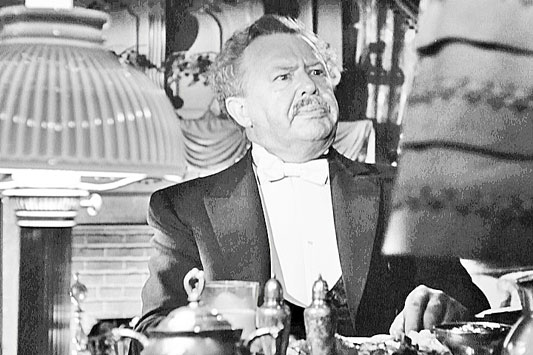
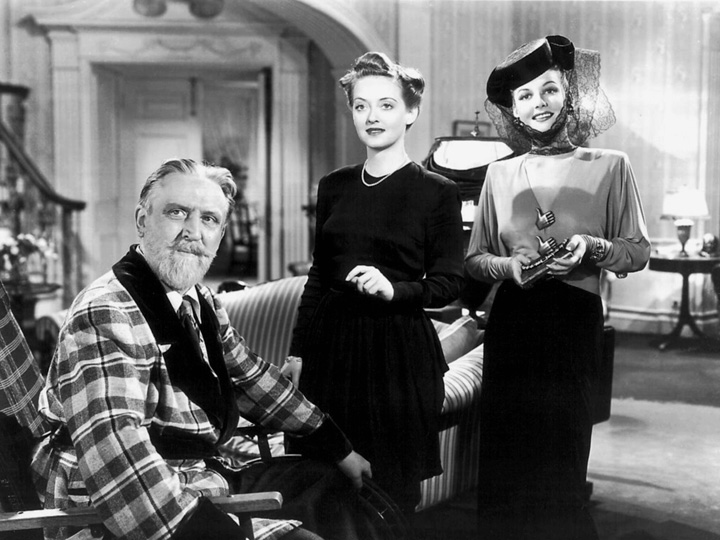
As I wrote before, she was no acting threat to Bette Davis, but Ann was one of the few actresses to steal scenes from her.  Sheridan scored as the vain mantrap of a Broadway star in The Man Who Came To Dinner.  She displayed solid comedy skills as she wore a dress with detail that made her tits look like they were trying to hitch a ride.
Ann Sheridan got "two thumbs" up on her bustline.

With Kings Row, Sheridan proved to the studio that she was more than the "Oomph Girl," a nickname given to the vivacious and sexy babe.  Besides its nomination for Best Picture, the movie brought James Wong Howe a nomination for Best Cinematography and Sam Wood a nomination for Best Director.  Wood's other two nominations in that category came for Goodbye, Mr. Chips (1939) and Kitty Foyle (1940).

Kings Row was one of my dad's favorite films.  It's become one of mine, too.  See it.  I think you'll be moved by its look at male-bonding.  The stars are Ann Sheridan, Robert Cummings, Ronald Reagan.  And Howe.


Colman Domingo in RUSTIN

In the first ten minutes of Steven Spielberg's LINCOLN, we see Daniel Day-Lewis as Abraham Lincoln talking to two Black soldiers on a Ci...