Wednesday, January 23, 2013

On THE THREE STOOGES (2012)

I don't mean this to be sexist, but here goes:  It's usually difficult for us men to make women in our lives  watch and appreciate The Three Stooges.  Most women would rather let Stevie Wonder do their hair.  Guys, getting a woman to watch The Three Stooges with you is like a woman wanting you to watch a Lifetime TV movie on Super Bowl Sunday.  I admit it. Those comedy shorts made me laugh when I was a youngster and watched them on TV.  (My sister usually didn't watch them with me.)  A couple of years ago, I rented a DVD of the restored, remastered shorts featuring that trio and laughed again.  I especially loved the original trio in its early 1930s years for Columbia Pictures.
They had a look and a style of physical comedy that made them easy to caricature in Hollywood satire cartoons of the 1930s.  Slapping, pulling and poking were part of their routine.  They were very visual, very physical, very prop-happy comics.
Even though I have enjoyed Moe, Larry and Curly, I had absolutely no interest whatsoever in seeing The Three Stooges, written and directed by the Farrelly Brothers.  That's the team that gave us There's Something About Mary, Dumb and Dumber and the weird-yet-sweet Stuck On You starring Matt Damon and Greg Kinnear as conjoined twins.  Stuck On You also has fabulous cameos by Cher and Meryl Streep.  I like the Farrelly Brothers, but I started to feel that they were an acquired taste you outgrow.  Like The Three Stooges.  I got that feeling because of seeing them do local and network TV interviews in New York promoting previous films.  I noticed that they seemed to have a planned "outrageous" behavior, probably to make them seem edgy.  For no good reason, they worked the term "rat bastard" into interviews as if they were trying to prank local live newscasts.  That can be cool on MTV but, for news folks, that's annoying.  I emceed a celebrity awards luncheon one year.  Meryl Streep attended.  So did the Farrelly Brothers.  They did that sort of "hipper-than-you" frat boy routine again when they took to the microphone.  The thing is -- they're smart filmmakers and they're beyond college age.  They didn't need to do that.  I heard them do radio interviews for The Three Stooges.  How refreshing!  They sounded like mature, likable, experienced filmmakers with good stories to share.  THEN...I started to hear reviews for the movie.  Another surprise.  They were good.  I expected to hear that it was basically Dumb, Dumb and Dumber.  No.  KPCC FM news radio out of Southern California has a film review hour every Friday.  One critic praised it as the kind of comedy film that could have been made had Columbia Pictures "ever spent more than a nickel" making its Three Stooges productions.
I saw The Three Stooges...and I agree with that film critic.  In fact, I've seen it twice.  He admitted he only saw the movie because it was an occupational requirement.  He had to review it.  He was pleasantly surprised.  He also raved about the performances.
For all the trio's popularity and instant recognizability, Columbia Pictures kept the act in low-budget short features.  The Three Stooges were never given the love and star treatment that MGM gave The Marx Brothers, Universal gave Abbott and Costello or that Paramount gave Dean Martin and Jerry Lewis in the 1950s.  This silly, entertaining comedy does indeed show us what could have been -- and it shows us with three of the most amazing performances to highlight a comedy that came out last year. Those three gentlemen are why I had to see the movie a second time and why I may see it again.
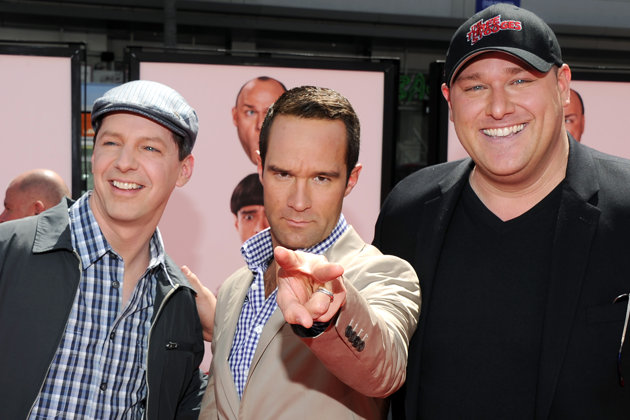
Sean Hayes, formerly "Jack" on Will & Grace, plays wire-haired Larry.  Chris Diamantopoulos, "Julian" on NBC's Up All Night, plays bossy Moe.  Will Sasso, forrmerly a member of the MADtv sketch comedy show, plays Curly.
You will be slack-jawed at how good these actors are as the comedy trio.  They're not made-up to resemble the Stooges and copy their broad physical comedy.  Each actor is recreating the actor who played his assigned Stooge with expert attention to that particular actor's mannerisms, vocal pitch, vocal cadence and carriage.  They also get each Stooge's timing.  This is especially true of Diamantopoulous as Moe.  He nails Moe Howard's gimlet eye and foreman-like scowl.  Sasso's physical work is terrific.  The part isn't easy.  Curly was the most animated Stooge.  There was a hyper man-child choreography to his zaniness with a very specific rhythm and timing that Sasso recreates quite well.  Hayes again proves that he's more than "just Jack" from Will & Grace.
These three actors are Meryl Streep-good as The Three Stooges.  They are as committed to playing each Stooge actor as she was in her Oscar-winning performance as Margaret Thatcher in The Iron Lady.  I saw a couple of the vintage Three Stooges shorts on television one weekend before I saw the movie.  I saw the film in flight on my way to a job interview.  There were so few folks on the flight and we'd waited so long for weather to clear for take off that we got free headphones.  When I saw the acting trio in action, I was hooked.  It was as it the old Columbia shorts with the original three had been colorized.  The critics were correct.  The actors were that pitch-perfect in their portrayals.
The plot is slight.  The movie is done in episodes, like the original shorts.  It opens with three orphan babies being abandoned on the front steps of a convent.
They're found by a strict senior nun named Mother Mengele, played...by Larry David.
I'm a Catholic.  I survived years of parochial school.  At some point in our scholastic lives, we all had a nun Mother Mengele.  The other nuns were sweeter.  Jane Lynch and Jennifer Hudson plays fellow nuns at the Sisters of Mercy Orphanage.
Larry, Moe and Curly try to save the orphanage.  They come across a murder plot.  Sofia Vergara and Craig Bierko play bad guys.  Some MTV reality show stars are tossed into the mix.  Yeah, it's goofy.  But fairly innocent.  No American Pie-type crude humor.  And the lead actors are not just saying "Nyuk, nyuk, nyuk," dressed up like The Three Stooges and giving us hipster slapstick.  They're not commenting on, making a gag of and altering a previous work -- like Ben Stiller and Owen Wilson as Starsky and Hutch.  The Farrelly Brothers wrote and directed this as if The Three Stooges were alive to star in a PG-movie.  That means, the actors cast as the late comic trio had to treat this basically as a biopic.  It's a silly movie with three lead actors who took the characters seriously.  Comedy is hard work.  I wish Hollywood honored comic acting more than it does in Academy Award nominations.  These actors made hard work look easy.
The Three Stooges by the Farrelly Brothers, Bobby and Peter, makes a good guilty pleasure weekend movie rental.  Probably more so for the guys.


Tuesday, January 22, 2013

I Miss Heath Ledger

I'd heard of Heath Ledger but I hadn't seen him onscreen until I had to see The Patriot, a 2000 film starring Mel Gibson.  I was the movie critic on the ABC News weekday magazine show, Lifetime Live, every Friday.  That ABC News production aired on Lifetime TV.  The Patriot put Mel Gibson in colonial drag.  We go back to the days of the American Revolution.  He's a peaceful family man forced to fight the British.  As I said on the show, I thought two things as I sat through the movie:  1. "Why is it taking Mel Gibson nearly three hour to play a Minute Man?" and  2. "That Heath Ledger is really good."
Heath played Gabriel, the good son who joins his father in fighting for America's freedom.
Heath was just a fraction or two off from having the "hottie" looks to make him a movie heartthrob and be thrown like a javelin into romantic comedies and syrupy love stories aimed at the hearts and wallets of young female moviegoers.  He wasn't a Josh Hartnett, Channing Tatum or Gerard Butler.  Hollywood tried to put him over in "teen hunk" roles but Heath Ledger was more substantial than that.  And he wasn't a handsome off-screen bad boy like Colin Farrell.  He was a disciplined young performer.  Had he lived, he'd have matured into a Robert Duvall, Meryl Streep quality of character actor.  He showed that kind of versatility and commitment to his craft in his all-too-brief years.  After The Patriot, I started checking out of his other films.  I attended a critics' preview of the big screen 2002 remake of The Four Feathers.  The previous version had been one of those many fine films released in Hollywood's legendary golden year of 1939.
Ledger co-starred with Wes Bentley (who was the neighbor in American Beauty)....
...and Kate Hudson in this epic tale of British friendship, love and desert war.
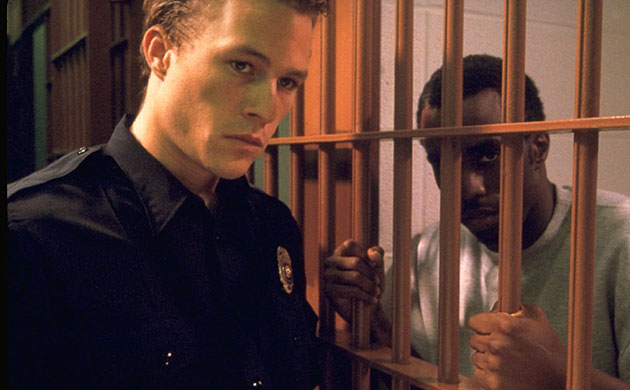
Again, Ledger did fine work.  It was his supporting role as the son and grandson of white Southern racists in Monster's Ball that really wowed me.  The role of Sonny had been slated for Wes Bentley.  Bentley had to drop out.  Ledger replaced him and that small role changed his career in a very big way.  Sonny wants to escape from the racial bigotry that's been taught by the men in his family.  He does not hate black people.  Sonny works in the prison system.  It's been a family occupation.  He's kind to a black Death Row inmate (played by music star Sean "P Puff Diddy Daddy" Combs).
Sonny's soul is in prison because of the culture of hate in his family.  This 2001 film brought a historic Best Actress Academy Award to Halle Berry.  Billy Bob Thornton co-starred.  Ledger disappears into that troubled Louisiana character.  He's excellent.  Your heart aches for Sonny.  Yes, Hollywood, Heath Ledger was more than a "teen hunk."
Another indie movie gave me the feeling Heath Ledger was on his way to becoming a male Meryl Streep.  The Australian actor totally nailed the Southern California body rhythm, personality vibe and accent of a dude by the beach in the 1970s.  I grew up in Los Angeles.  I can confirm that Heath nailed it.  The movie is Lords of Dogtown.
Southern California is known for Disneyland and Knott's Berry Farm.  Back in the 1960s and '70s, during my childhood, there was also Pacific Ocean Park -- more commonly known as P.O.P.  This amusement park was popular with the Venice crowd.  P.O.P. was sort of the Coney Island of the Southland.  In that Venice, California crowd were The Z-Boys.  In the '70s, they revived the fading skateboard fad, jazzed it up and made it a sport with their mad skills.  True story.  Catherine Hardwicke directed a sharp, smart, raw movie about these teen celebs in a low-rent section of Southern California.
They're tough.  They're talented.  They really have no patience for scholastic duties.  They love to hang out in a surf shop run by Skip. He loves the surf.
Skip always hooks them up with new gear at the shop.  This sly movie is about sudden celebrityhood and marketing.  The boys aren't as smart as they think they are.  Skip is a surfer dude but he's not an idiot.  Ledger shines in 2005's Lords of Dogtown.
Then came...the now-iconic Brokeback Mountain.  This heartbreaking tale of emotional deprivation cast Heath Ledger as ranch hand Ennis Del Mar.  He's conflicted.  The big love of his life is another man -- cowboy and former co-worker Jack Twist, played by Jake Gyllenhaal.  Ledger got this part because of his strong showing as Sonny in Monster's Ball.  Ledger's dramatic work here won him international acclaim.
It was another brilliant inner and outer transformation.  Ennis walked in a certain way.  He seemed always to squint as if he had trouble with light.  His voice was low and had a twang.  He was no stranger to fist fights.  He's a tough country man of few words.  Ledger created a memorable screen character for this 2005 Oscar nominee for Best Picture.  Ennis seems only to be at peace with the world during his clandestine times with Jack.
If Philip Seymour Hoffman had not won the Oscar -- and just about every other entertainment prize short of the Soul Train Music Award -- for his performance as Capote, the Best Actor Oscar should've gone to fellow nominee Ledger for Brokeback Mountain.
For a deep impression of his versality, watch this movie right after watching Lords of Dogtown or his Medieval History-meets-MTV comedy adventure, A Knight's Tale.  He has a hard day being a knight.  There's a bad guy to fight (played by Rufus Sewell)...
....there's a fair maiden to love (played by Shannyn Sossamon)...
...and there's a couple of Medieval Bros who've got his back.  (They're played by Alan Tudyk, now a regular on ABC's Suburgatory, and bearded Brit bear Mark Addy).
Start with the Middle Ages and then go to Brokeback Mountain.  You will be stunned at Heath Ledger's acting skills.  He released another film the same year as Brokeback Mountain that also proved his range.  As Ennis, he's an emotionally repressed, introverted, masculine ranch hand.  He's has a wife and kids.  He's afraid of living his true self openly, afraid of anyone discovering his intimate feelings for another man.
As Casanova, he wears the kind of puffy shirt they talked about on Seinfeld.  He wears wigs, fancy jackets, he's chatty -- and he can't keep his hands off the ladies.
This was not a widely-seen movie.  I paid to see it and laughed a lot.  Ledger also had definite comedy chops.  He's so animated, so much fun as the fabled babe-chaser.
The best scenes in Casanova are those he has with Oliver Platt.  Platt was a hoot as a lovable fop. What a shame they could not have done another comedy together.
Heath Ledger did give an Oscar-winning performance.  Like Peter Finch for Network, he won his Academy Award posthumously.  If any critics wondered how he could match the excellence of his performance in Brokeback Mountain, they got their answer when they saw him as The Joker in The Dark Knight.  He was frightening and funny and unpredictable as Batman's psychotic nemesis. As a criminal, he stole the movie.
He burned up the screen with that 2008 supporting role performance.
The Joker is part master-mind, part dangerous canine on the loose.  Watch how he holds his head out of the car window like a dog.  Such creative acting.  Ledger died in New York City on this day in 2008.  He has two Academy Award nominations to his history.
He could've gone so far had he lived.  But...in his short time...he did the work, he was serious about his craft, he took risks.  His main objective was not getting on the Red Carpet, making a fabulous fashion statement and going to the party.  He did his homework.  He got two Oscar nominations and leaves behind more than two exceptional performances for us to appreciate.  He was 28.  Heath Ledger was a damn good actor.


Sunday, January 20, 2013

MLK on NBC Late Night

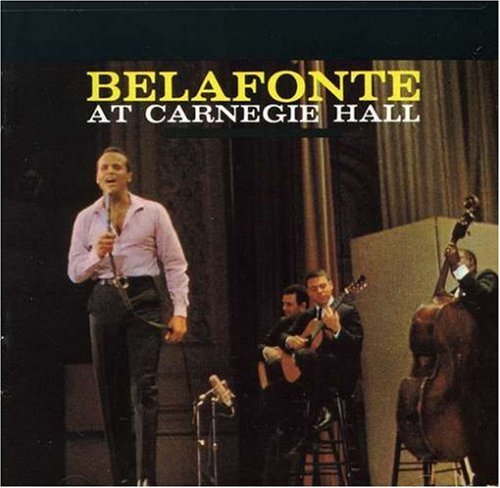
I've told this story about Dr. Martin Luther King, Jr. before, but now there's a very cool update.  It's about the battle Harry Belafonte had with network brass to get Dr. King on late night entertainment TV as a guest.  Did you know that Dr. King was on The Tonight Show?  Johnny Carson was the host back then and the show was broadcast from 30 Rock in New York City.  Dr. King had already made international headlines and modern American history with his March on Washington for Civil Rights.
The March on Washington with the now-famous "I have a dream" speech was in the summer of 1963.  In 1964, King was awarded the Nobel Peace Prize.  In 1968, some NBC executives didn't think he'd be a good booking for The Tonight Show.  I got this story from Charles "Chiz" Schultz, a film and TV producer who happened to be a Tonight Show production staff member at the time.  That job marked the beginning of a beautiful friendship with Belafonte.  After my VH1 years, in 1991, I was a occasional host on CNBC's Talk Live.  I had Chiz on as a guest and we talked about this.
Belafonte was a big recording star in the 1960s  He'd done movies and TV specials.  He was a popular singer on variety programs like The Ed Sullivan Show, also out of New York City.  Johnny Carson was on vacation for a week.  Carson tapped Harry Belafonte to be fill in for him.  That was major for black viewers.  You didn't see black performers host a late night network entertainment show.  (Come to think of it, you still don't)  This was during the Civil Rights era and Carson's embrace of diversity was most generous.  And wise.  Belafonte had A-list guests that week -- actors, singers, comedians, newsmakers.  He and Dr. King were friends.  When he made it known that he wanted to book Dr. King on the show, reportedly NBC brass got nervous.  They felt that having one black person (Belafonte) on the show was enough.  They saw King as too radical and were afraid of losing sponsors.  Belafonte did not back down.  He booked his friend on the show.  Today, we honor his friend's birth with a federal holiday in his memory.

Here's Belafonte telling PBS talk show host Tavis Smiley about Dr. King's arrival to NBC.

Not only was it a great booking, it was the first and only appearance Dr. King made on a late night network entertainment talk show.  He was casual, amusing, warm, relevant.

Harry Belafonte was Johnny Carson's substitute host one week in February 1968.  Sadly, in early April 1968, our Dr. King would be gone -- felled by an assassin's bullet.
Through the decades, a clip of Dr. King on The Tonight Show has been played.  He tells a story and the camera is just on him in the clip.  So folks assumed Carson was at the desk.  When Johnny Carson died in 2005, movie critic and entertainment contributor Jeffrey Lyons did a tribute piece on the late night superstar for NBC News.  He credited Carson with interviewing Dr. Martin Luther King.  Wrong.  It was guest host, Harry Belafonte.

In 2011, HBO premiered an excellent documentary on the singer/actor/activist entitled Sing Your Sing.
I was thrilled to see footage from his week subbing for Johnny Carson in the documentary.  Hallelujah! Now he will get credit where credit is due.  He pushed to book Dr. King.  He did the interview.  Chiz Schultz backed him up on the booking.  NBC is lucky to have the historic appearance in its archives.  Chiz went on to do film work.  Norman Jewison's 1984 film, A Soldier's Story, has Charles Schultz in the credits as a producer.
This film adaptation of Charles Fuller's 1982 Pulitzer Prize winning play about racial segregation in the troops during World War II and a murder investigation co-starred current Best Actor Oscar nominee, Denzel Washington.
Jewison directed 1967 Best Picture Oscar winner In the Heat of the Night, Fiddler on the Roof, Steve McQueen in The Thomas Crown Affair and Oscar-winner Cher in Moonstruck.  He'd direct Denzel Washington to one of his Best Actor Oscar nominations for 1999's The Hurricane.

Said director Norman Jewison:  "No one really wanted to make this movie" because it was an African-American story.  He and many actors worked for less money in order to have the budget to make it.  The cast included Howard Rollins, David Alan Grier and Robert Townsend.  Adolph Caesar would capture an Academy Award nomination for Best Supporting Actor...
...and the movie would be an Oscar nominee for Best Picture of 1984.  Jewison wasn't nominated for Best Director.  (Did you read that Ben Affleck and Kathryn Bigelow?)

Friends Chiz Schultz and Harry Belafonte did a project together.  Schultz produced the 1970 urban satire, The Angel Levine.  Zero Mostel plays an old Jewish tailor who's out of work and has an ailing wife.  One day, a tough-talking black man appears in his kitchen claiming to be angel sent from Heaven to help.  The angel's name is Alex Levine.

Only in New York.  Mr. Belafonte, thank you for getting Dr. King on The Tonight Show.  Happy Martin Luther King, Jr. Day, everybody.  Keep the dream alive.


Saturday, January 19, 2013

Overlooked by Emmys

Let's talk about three big oversights in Hollywood's history of awarding those on the small screen.  In my previous blog, I wrote that I would love help motivate the entertainment industry to start a "Women in Film" award and/or scholarship in the name of pioneer actress and film/TV director Ida Lupino.  Not only did she slam across some solid movie performances in films like High Sierra with Humphrey Bogart...
....she showed great range.  In 1941's High Sierra, she's touching as the loyal waitress who's had hard times.  She helps an ex-con try to go straight even though society seems determined to make him a criminal again.  They're two losers seeking something better in life.  Critics raved about her ruthlessness in 1943's The Hard Way.
In that, she's the frustrated mill town wife determined not to be poor anymore.  She becomes obsessed with turning her younger, pretty sister into a Broadway star.
In the 1950s, she kept acting and she directed movies.  While acting, she'd watched and learned what the boys did behind the cameras.  Then, one day, she did it too.
She directed tough black-and-white dramas with Oscar winning stars that took on taboo social issues.  One example, 1953's The Bigamist starring Joan Fontaine and Edmond O'Brien.  Ida directed and co-starred.  This was groundbreaking pioneer filmmaking -- and a major new chapter for women's Hollywood history.
The films she directed did good business at the box office.  As I wrote in my previous blog, she opened the door for women like Penny Marshall, Barbra Streisand, Jodie Foster and even Kathryn Bigelow, director of The Hurt Locker and Zero Dark Thirty.  In the 1950s, just like Lucille Ball and Desi Arnaz, the actress/director starred on a sitcom with her real-life husband. Ida Lupino and Howard Duff did the series Mr. Adams and Eve.
Ida got 1958 and 1959 Emmy nominations for Best Actresss in a Comedy Series.
Starting in 1956, she used her pumps to kick open the door to the Hollywood boys' club of television directors.  She became a respected director of episodic television.  Ida guided actors and called the shots behind the camera for the top westerns, dramas, thrillers, cop shows and sitcoms on network TV.  Have Gun-Will Travel, The Rifleman, The Fugitive, Dr. Kildare, Alfred Hitchcock Presents, 77 Sunset Strip, Honey West, The Donna Reed Show and Bewitched.  Her extensive list of TV director credits goes up to 1968.  Her acting credits go to 1978.  Ida Lupino never got a special Emmy for her trailblazing TV work behind the camera.  She deserved one.  So did another movie and TV veteran.

He was a Broadway, movie and TV veteran.  He was also a musician/recording star.  He went to Hollywood to recreate his role in the 1940 film version of a hit Broadway musical comedy.  That's where he met the RKO star who would become his wife and co-star.
Apparently it was love at first sight.
The Broadway musical and the movie were called Too Many Girls.  And, yes, the RKO movie star was Lucille Ball.  Zesty brunette tap dancer Ann Miller co-starred in the film.
By the time Desi Arnaz and Lucille Ball made Vincente Minnelli's 1953 hit comedy movie The Long, Long Trailer, they were two of the biggest stars in the country.
I Love Lucy was the revolutionary TV sitcom that made them show biz superstars.
Desi Arnaz -- excellent sitcom actor, an innovative television producer and a broadcast visionary. Growing up in Southern California, I couldn't wait to get home from school and see those episodes in syndication on KTTV/Channel 11.  As a minority kid in South Central L.A., it made me feel so significant to see a Latino male -- the native Cuban Mr. Arnaz -- in a good upscale role as one of the best TV dads in sitcom history.  This was an ethnic character in a positive role.  Ricky Ricardo was a very professional working class entertainer, a devoted family man and a great friend.  For corporate network television, this was new turf -- a bi-lingual household and an interracial marriage.
Behind the scenes as executive producer, he started a 3-camera technique for shooting the show before a live studio audience.  That style is still utilized today.  One example of his being a visionary was his insistence on shooting the show on film.  Other sitcoms of the 1950s that weren't put on film didn't hold up as well.  Those I Love Lucy episodes look fresh.  Desi, with Lucille Ball, co-founded Desilu Productions.  In addition to I Love Lucy, he was executive producer of another hit series, The Untouchables.  Ida Lupino directed episodes.  Robert Stack had been making movies since 1939.  He was Best Supporting Actor Oscar nominee for 1956's Written on the Wind.  But nothing made him a bigger star than 1959's debut of The Untouchables starring Stack as Eliot Ness.  He became such a big star that he's even mentioned by a character in Billy Wilder's The Apartment.  In later years, Desilu Productions gave us The Andy Griffith Show, The Dick Van Dyke Show and Star Trek.  Desilu Productions and I Love Lucy made television history all over the world.  Lucy and co-star Vivian Vance ("Ethel Mertz") won Emmys for their work.
William Frawley ("Fred Mertz") received Emmy nominations for the sitcom.  Lucy received one of the Kennedy Center Honors.  Desi Arnaz was never nominated for an Emmy nor did he ever receive a special Emmy for his groundbreaking, successful work as a TV actor and TV producer.  That totally stuns me.  That needs to be rectified.  There needs to be a post-humous honor accepted by his children, Lucie and Desi Arnaz, Jr.

Another actor who did movies and television also had legendary work to his credit.  He never received a lifetime achievement honor either.  Millions of us around the world didn't see him doing his brilliant work most of the time.  He shared screen time with Betty Garrett in the 1949 MGM musical comedy, Neptune's Daughter.
Maybe folks couldn't place the face but they knew the voice.  Or voices.  He did all the speaking for these two characters....
...and these two characters....
....and this little guy, Barney Rubble, on TV's The Flinstones....
...and this other little guy, Mr. Spacely, on TV's The Jetsons.
There were more voices inside of him.  Mel Blanc was like a cartoon feature cast unto himself.  Beginning with the Warner Brothers cartoon characters who went from the big screen to TV airings that delighted millions of us young babyboomers, on to the cartoon characters created for network TV, Blanc proved to be a brilliant vocal actor.  His talent was extraordinary.  Each of his characters had a distinct personality.  Each one sounded different. It was remarkable character acting with his voice.  Today, three actors would be needed to voice three roles in this one cartoon.  Back in the day, you just needed Mel Blanc to do Daffy Duck, Sylvester the Cat and Porky Pig in The Scarlet Pumpernickel.
It's a classic.  For 50 years, Mel Blanc had us laughing with his magnificent acting gifts.  He was a unique talent.  There simply was no one else like him.  When he died in 1989, some of the most famous cartoon characters of our lives were as this illustration says -- Speechless.
Blanc, the creator and performer of those iconic cartoon voices, never got a special Emmy or a special Academy Award.  He never received a Kennedy Center Honor.
Imagine all those classic Looney Tunes without his voices.  Can you?  I can't.
I say honor him with a special post-humous Emmy accepted by his son, Noel Blanc.
There you have it.  Three superior talents, three unique artists whose accomplishments contributed greatly to television.  Yet they didn't quite get the Hollywood recognition and appreciation they deserved, in my humble opinion.


Colman Domingo in RUSTIN

In the first ten minutes of Steven Spielberg's LINCOLN, we see Daniel Day-Lewis as Abraham Lincoln talking to two Black soldiers on a Ci...