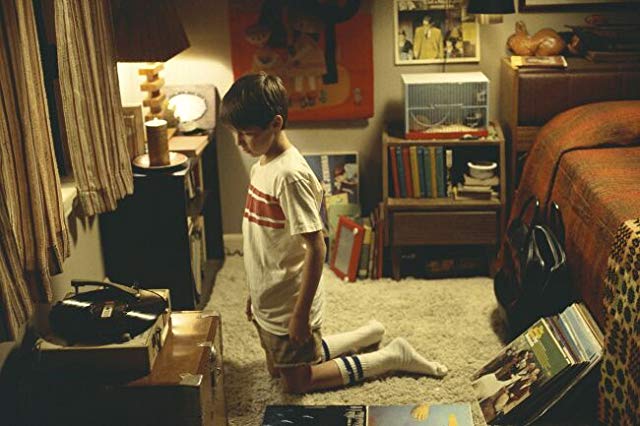
It was one of my favorite films of 2000. A number of reputable film critics put it on their lists of favorites of that year too. ALMOST FAMOUS brought Cameron Crowe an Oscar for Best Original Screenplay. I still feel that he should have received more than that one Oscar nomination. ALMOST FAMOUS should have been an Oscar nominee for Best Picture and he should have been a nominee for Best Director. I love that movie so much. First of all, it accurately and lovingly reflects the world of rock music as it was when I landed my first professional broadcast job after I graduated from college. I worked as a newsreader on WFQM Radio, an FM rock radio station in Milwaukee. This was when we young people still listened to rock radio, had record players, hung out at record stores and could get a good ticket to a rock concert for under $20.00. Cameron Crowe was a young, smart and passionate writer for Rolling Stone magazine, a publication that the DJs at WQFM considered to be as important as the Bible. Crowe's screenplay is a valentine to those days and to the world of rock music before it became a corporate product, if you will.
I first saw ALMOST FAMOUS at a preview screening in a packed New York City theater. The audience was so vibrantly connected to it. Being in that audience was a thrill and a reminder that seeing a movie is often best when enjoyed on a big screen with an audience that is emotionally invested and giving the film its full attention. When seeing a movie is a community experience like that, it's rich. You could feel the audience fall in love with the "Tiny Dancer" bus scene, one of the highlights of the film. The applause and cheers the end from that New York City audience made me sure the film company had something very special in its possession.
Frances McDormand played the mother of the teen journalist. Marvelous. She hit a home-run in her every scene as the widowed school teacher mother in Southern California who states that "Adolescence is a marketing tool." She is a force. She's forthright, fearless and, above all, loving. I nearly gasped when first I saw her. I had a high school teacher exactly like that. Mrs. Ogren taught History. She was a "civilian" teacher at our all boys Catholic high school in Watts. She was a fascinating character who dressed just like Frances McDormand did in ALMOST FAMOUS. Remember the funny confrontation the schoolteacher mother had with her outspoken teen daughter about Simon & Garfunkel? My divorced mother and my sister had the same argument about the same Simon & Garfunkel album the schoolteacher mom holds up. Frances McDormand and Kate Hudson were both in the Best Supporting Actress Oscar race. Has Kate Hudson had another role as good, a role that brought out her radiance the way the Penny Lane role did in ALMOST FAMOUS? Has she?
I did a one-hour interview of Cameron Crowe before a live audience before ALMOST FAMOUS opened nationwide. We did that in New York City which is why I attended the preview. By the way, I paid to see the movie at least three times again after it opened. That's how much I loved it.
I once read an interview of the famed writer/director Billy Wilder. He said that if a screenwriter wrote one line that audiences could remember and quote through the years, then the writer had done the job well. He then went on the make his point with high praise for CASABLANCA. Needless to say, Billy Wilder was also a master at that job. Wilder was a hero and mentor to Cameron Crowe.
ALMOST FAMOUS is not only a valentine to a golden age of rock music and its fans, it's also a valentine to Billy Wilder's art -- especially his classic, THE APARTMENT. In Crowe's trailer before the interview, we met and I went fan-boy on him with my affection for his film. I also remarked, "Penny Lane has Fran Kubelik quality about her." Fran Kubelik is the character Shirley MacLaine played in THE APARTMENT. A big smile broke across Cameron's face and he replied, "That's what I was going for."
If you watch ALMOST FAMOUS again, notice that it does have a strong similarity to Billy Wilder's THE APARTMENT. Two guys want the same girl. Heartbreak triggers her to take a handful of pills. One of those guys must learn to become "a mensch." Shirley MacLaine stars with Jack Lemmon and Fred MacMurray in THE APARTMENT.
Cameron Crowe wrote a book about his conversations with Billy Wilder. In our on-camera conversation, Cameron told that the late, legendary Hollywood filmmaker, then in his 90s, saw ALMOST FAMOUS.
I'd love to interview Crowe again. I read in entertainment news reports that he is now writing the book for a stage musical version of his 2000 Oscar-winning movie. There's no word on casting yet, but reports project that the stage musical version will be Broadway-bound.
He turned 92 last week and he's done the show for over 20 informative and entertaining years. James Lipton, thank you for bringing us INSIDE THE ACTORS STUDIO since 1994. For all of us who are passionate in our love and respect for the performance arts, especially in film and TV, Lipton's show was a rich oasis in what was becoming a cultural desert of entertainment reporters making the first and most important question "Who did your dress?" followed by other questions of little or no homework. Lipton understood and respected the actor's craft. He was a definite fan. He did his homework. James Lipton looked like a true academic, a university professor with a certain demeanor and cadence of speech that could be imitated by his students having a few beers at a local campus pub. In fact, he was imitated by comedian Will Ferrell on TV. Lipton has a delightful sense of humor about himself. His award-winning show became part of our pop culture viewing habits.
One thing that disappointed me about Bravo, the channel that's aired INSIDE THE ACTORS STUDIO, was that promotion of the show decreased the more Andy Cohen's Real Housewives franchise gained in popularity. Now Bravo seems pretty much "All Andy, All the Time" with flashy, gossipy shows that are extensions of his sharply marketed Gay White Male fabulousness. But, let's face it, they don't have the substance of INSIDE THE ACTORS STUDIO. The actor interview show is relocating over to the Ovation channel -- and James Lipton is retiring. I loved watching him and it was obvious that the stars he interviewed loved being with him.
INSIDE THE ACTORS STUDIO will continue with a rotating group of hosts. If those hosts have yet to be chosen, I am throwing my hat in the ring for consideration. That's the kind of work I'd love to do and have done. I hope Ovation embraces diversity and inclusion.
Here are samples of my interview, research and writing skills. (None of the phone numbers you'll see are still in effect. You can contact me on Twitter @ BobbyRiversTV or BobbyRiversTV on Facebook.
Michael Shannon now has two Best Supporting Actor Oscar nominations to his credit. I interviewed him about MIDNIGHT SPECIAL In that 2016 sci-fi drama, he played the divorced father on the run with his little boy who has a supernatural spiritual gift that dark forces want to catch and control.
Here's a clip reel of some of my other interviews, mostly from my post-VH1 years.
Here's a promo reel for my VH1 talk show. It was a prime time Monday through Friday show called WATCH BOBBY RIVERS.
Mel Gibson was also a guest on my VH1 talk show. He told me about a popular role he rejected.
VH1 flew me to London for a special one-hour chat with Paul McCartney. He told me about a famous role that he politely declined.
In 2000, I was the entertainment editor on an ABC News/Lifetime TV joint production called LIFETIME LIVE. Working with Dana Reeve will always be one of the great joys of my career.
He was one of the most powerful and one of the most feared men in Hollywood. Not bad, I guess, for a guy who went to high school in Van Nuys, California back in the early 60s. (I think Robert Redford attended high school in Van Nuys too. In the 50s. I heard Redford recently on CBS TV say that he grew up in a tough neighborhood. The blackness in me said, "Bitch! You grew up in Santa Monica in the 1950s. I grew up in South Central L.A. in the 60s and went to high school in Watts. You know what black folks in Watts called a weekend in Santa Monica? A vacation." But I digress.) The once powerful and feared super-agent, Michael Ovitz, has been on TV talking about his newly-published memoir. Ovitz co-founded Creative Artists Agency (CAA).
The book reliving his ruthless Hollywood reign of the 1980s and 90s is titled WHO IS MICHAEL OVITZ? He's 71 now and looks good. I saw him on two CBS interviews and he came off as forthright, polite and a bit contrite. He started in an agency's mailroom then worked his way up to become a top agent. Today, that's kind of a trope for the veteran male agent.
Something about the extraordinary roster of talents that he represented made me think of the current "Oscars So White" diversity/inclusion issues that have been red hot in Hollywood the last three years and the recent annual list in The Hollywood Reporter of the "100 Most Powerful People in Entertainment."
Only two were Latino: Oscar winning Mexican director Guillermo del Toro and New York Puerto Rican golden boy, Broadway's Lin-Manuel Miranda. In an online article I read on Twitter from @ Remezcla, Kristen Lopez reported that the two Latino talents were listed in the bottom 20. Three Asians made the list. Fifteen African Americans made the list. If you're on Twitter, find Remezcla and look for the item "The lack of Latinos on the list is a result of a much larger problem."
Kristen Lopez, I feel like I've grown up watching that problem and wondering why it still exists. I'm very proud to say that Mexicans were part of my everyday life growing up in South Central L.A. They were our next door neighbors, my classmates, teachers, priests, our local merchants, family friends and my parents co-workers who visited our houses...they were in my community. A Mexican teacher at school realized I was attracted to the fine arts. With my parent's permission, he took me to see Ballet Folklorico downtown at our Music Center. I loved it! In high school, we all knew that Ricky Perez was a great friend to have. Not only was he one of the smartest guys in the class, he was one of the most down to earth. Teachers and students dug Ricky Perez. And he'd help a guy out in a heartbeat. We were altar boys together. Ricky Perez had your back in the classroom, on the altar and on the playground.
So when I watched TV shows, why wasn't I seeing representations of our next door neighbors, guys like Ricky Perez, women like our Auntie Jean -- Jean Garcia, mom's longtime best friend and fellow registered nurse -- and the teacher who introduced me to Ballet Folklorico? Why were we just seeing CHICO AND THE MAN starring the late and terrifically talented Freddie Prinze? Nowadays I say. "Why the hell isn't Michael Peña a star yet? He's excellent at drama and comedy and he has work in 5 Best Picture Oscar nominees to his credit -- MILLION DOLLAR BABY, CRASH, BABEL, AMERICAN HUSTLE and THE MARTIAN.
Michael Peña can even be good in a dog of a comedy like 2017's CHIPS.
Another thing -- my parents embraced the arts. Mom took us to see a lot of children's theater. There were annual classic plays performed in our high school, which was a Catholic school with a predominantly black and Chicano student body. Mexican actors were in productions at our Music Center and in other entertainment venues in L.A. In short, there never has been a shortage of Mexican talent in Southern California. Not then. Not now. The same goes for Latino talent I love in New York City where I lived and worked for 20 years.
But only two Latino talents are on that list of the 100 Most Powerful for 2018.
Michael Ovitz was the super-agent for Tom Cruise, Dustin Hoffman, Barbra Streisand, Meryl Streep, Martin Scorcese, Steven Spielberg, Sydney Pollack, Tom Hanks, Sylvester Stallone, Michael Douglas, David Letterman … and Michael Jackson. That's a partial list. Also, it's not a very racially diverse list. One black superstar.
I had my first meeting with an agent at a powerhouse agency in 1990 in New York City. The last time I met with an agent at a top agency was in New York City in 2008. In between those years, I have several meetings with agents in Manhattan and a couple in LA. In all that time, I saw only one black agent -- and she worked at the first agency I met with in 1990.
At all those agencies, the people who knew my work when I showed up were the black and Latino employees working the reception desk and the mailroom. The white agents usually had not bothered to read my resumé or watch my demo reel before our scheduled meetings. They knew clueless to my credits.
After VH1, I had to hustle up my own TV host/performer work because the white broadcast agents turned me down. I called in to a KNX live radio show a couple of years ago that had a special devoted to "Hollywood So White" and the need for diversity going from onscreen opportunities to the Academy's minimal minority membership. I mentioned that I've met with several agents at agencies over quite a few years and I saw only one black agent. All the rest were white. I asked if having more racial diversity in the agencies would help minority actors.
A rep from a Hispanic Actors Organization loved my question. He said that most L.A. agents are white and stay within their comfort zone. They won't drive to areas outside of Beverly Hills and Brentwood to see good local Mexican talent in places like Long Beach or Burbank. They're more likely to sign someone they saw while vacationing in Madrid.
I did sign with a few agents for TV work but I noticed that I got myself more work than they did. They would submit me only if a request for "African American talent" came in. The work I got myself on VH1, on Lifetime TV and on Food Network... the agents would not have submitted me for those auditions because "African American" was not specifically requested. They didn't think outside the racial box.
With all the current talk about the need for diversity and inclusion -- which thankfully now includes the major need for people of color as film reviewers and correspondents -- there should be a report on how racially diverse the roster of representatives in top agencies are. Just a thought. You can go to my previous blog post (about HOLLYWOOD SHUFFLE), scroll down and see the demo reel from my VH1 talk show that stymied white agents. I do believe that my TV career could have benefitted greatly from black/Latino agents pushing for me -- if any had been employed back then. White agents have bluntly said to me, "I just wouldn't know what to do with you." I doubt Tom Bergeron or Rosie O'Donnell ever heard an agent say, "Gee...we just don't get a lot of requests for Caucasian talent."
Are there black, Latino, Asian agents in Hollywood and New York City now? Did a person of color ever do like a Michael Ovitz -- start off working in the mailroom then escalate to becoming an agent? Just wondering.
In 2008, I met with an agent in New York City. This is hand-on-a-Bible true: I sent her my resumé and this demo reel one week before our scheduled meeting. She opened our meeting with "Have you ever done any on-camera TV work?" And there you have it.
A major Hollywood studio should have offered actor/director Robert Townsend a 3-picture deal after the release and reviews of his hilarious, accurate and warm-hearted satire of the limited work for black actors in 1987's HOLLYWOOD SHUFFLE. He used his credit cards and other guerrilla movie-making methods in order to get his indie comedy made. Townsend stars in, co-wrote and directed HOLLYWOOD SHUFFLE. I was lucky enough to have him as a guest on my VH1 talk show when the movie opened. He lampooned the constant humiliations black actors endure when trying to get work and all that's available to them are stereotypical roles that some folks in the industry want played in stereotypical ways. It is time to re-appreciate Robert Townsend's HOLLYWOOD SHUFFLE. Especially now in this age of "Oscars So White" and calls for more diversity and more inclusion -- in the categories of actors and film critics alike. HOLLYWOOD SHUFFLE airs on TCM (Turner Classic Movies) Tuesday, September 25th. His comedy represents some color barriers we black performers had to break through in order to keep our dreams from dying on the vine. The Hollywood and Vine.
Robert Townsend was in the fine cast of Norman Jewison's A SOLDIER'S STORY. The screenplay was adapted by Charles Fuller, the African American talent who won a Pulitzer Prize for writing the play. However, Jewison, whose IN THE HEAT OF THE NIGHT won the Oscar for Best Picture of 1967 along with Rod Steiger winning for Best Actor, was stunned when Hollywood would not give him money to produce his new film. Why? He was told that "black stories don't sell." That was code for "We don't support films with a predominantly black cast that do not have a white actor as the hero." Jewison got his film made, with a smaller budget than some of his films after IN THE HEAT OF THE NIGHT such as THE THOMAS CROWN AFFAIR, FIDDLER ON THE ROOF and JESUS CHRIST SUPERSTAR. He got A SOLDIER'S STORY made and it was nominated for Best Picture of 1984.
The Hollywood films and the TV practices that Townsend poked in 1987 still need poking. Ironically, this includes a channel like TCM. This month, September, TCM has devoted Tuesdays and Thursdays to "The Black Experience On Film." The hosts are members of the AAFCA, the African American Critics Association. Watching has been a monumental joy to me -- because the last time I saw a black host on TCM was trailblazer DAUGHTERS OF THE DUST director Julie Dash in December 2016.
Seeing black critics as guest hosts on TCM this month has been not only refreshing, it's been long overdue.
When I had my VH1 talk show, not only was it extreme fun but it was also a privilege for which I am still grateful. I got a great review from the New York Times, People Magazine and TV Guide. I still did not have a broadcast agent. Agents said they wouldn't know what to do with me. One said that if I did weather, he could get me local TV news jobs in a heartbeat. I don't do weather. Here's what I showed to the agents back then.
In 1990, right after my VH1 contract ended, I had a meeting with an agent at a very famous agency in New York City. I was thrilled and positive I'd be on my way to the next phase of my career that I had planned. I told the agent that I wanted to do another talk show, or host a smart game show or do supporting roles in good comedies -- like the role Bill Murray did in TOOTSIE.
The agent replied, "But that wasn't a role for a black actor." By the way, the agent was about as white as winter in Minnesota. Look at TOOTSIE again. Bill Murray's character could've been Bill, or a John Leguizamo or a Randall Park (the dad on the ABC sitcom, FRESH OFF THE BOAT). The roommate role in TOOTSIE didn't just have to be played by a white actor -- but that's how agents thought. And that's what has frustrated we people of color who perform and seek work for a long, long time.
I signed with that agent, then parted company after one year. I never had a meeting about hosting another talk show. I had auditions to play either inner city homeboys, prison inmates or thugs. I left the agent after he submitted me to play a knucklehead thug in 1993's WEEKEND AT BERNIE'S 2. The sequel's script called for the two black simple-minded crooks to perform a voodoo dance with the Bernie corpse in a Times Square X-rated movie theater men's room using a boombox and a bucket of fried chicken.
I was appalled at the script's images of black men from a white writer. But to refuse the audition could've labeled me as difficult. Difficult AND black. I kept my audition appointment. I was told by the three white men in the audition -- the writer/director and a couple of others -- to make any kind of choice I wanted when I entered the room to read for the part.
So...I played him like Zero Mostel's high energy, desperate theatrical loser Max Bialystock in Mel Brooks' THE PRODUCERS. I gave them Zero Mostel. The three white men were slack-jawed. I made a choice without giving them the expected stereotype they wanted to see. Nothing against the actor who did book the part. I knew I wouldn't get it -- and I was glad I wouldn't. The thug in the red jacket is the character my ex-agent submitted me to play. This is the exact audition scene I was given. It's in WEEKEND AT BERNIE'S 2. To see a clip, just click onto the link:
That was my HOLLYWOOD SHUFFLE moment in a New York City casting session. And that is why I am so passionate about diversity, inclusion and equal opportunities in the arts. To keep things like that from happening to the new generation. Representation matters.
HOLLYWOOD SHUFFLE airs Sept. 25th at 8p Eastern on TCM.
This is the Shirley Temple fantasy movie that could've been called I KNOW WHY THE CAGED BIRD FLOPS. That's just what it did with critics and moviegoers. If you're a classic film enthusiast, you probably know that MGM sought to borrow 20th Century Fox's top star, Shirley Temple, to play Dorothy in THE WIZARD OF OZ. Temple was the right age for Dorothy, as she is in the book. But Fox would not loan out its star. Which turned out to be a blessing in disguise. Temple was a major Hollywood star before she was 10. She brought in big money for Fox. Her look, her screen image, truly became the icon for the Hollywood child star. She acted, she danced, and she sang. She introduced songs that went on to become standards played and sung by top jazz artists. But newcomer Judy Garland, although technically a few years too old for the role, had the extraordinary singing voice that Shirley Temple didn't and she, as an actress, had a soulfulness and depth that little Shirley didn't. Judy Garland became Hollywood's newest teen star with THE WIZARD OF OZ and it started her on her way to becoming a Hollywood legend. 20th Century Fox came up with a Technicolor fantasy for Shirley Temple, one with household pets taking human form and accompany her on a spiritual journey somewhere over the Eastern European rainbow. THE BLUE BIRD was based on a 1908 play by Maurice Maeterlinck. Bothersome little Mytyl and her younger brother Tyltyl are peasant kids who live with their peasant parents in the woods. Mytyl wants to find the Blue Bird of Happiness she tells her mother about. When she and her brother are asleep, a fairy appears and takes them on a journey to find the Blue Bird of Happiness.
This hunk o' celluloid cheese didn't work in 1940. It didn't work in 1976 when George Cukor directed a remake starring Elizabeth Taylor, Ava Gardner, Jane Fonda and Cicely Tyson. The remake is, in so many ways, brilliantly bad. It demands you watch it with a couple of gay male buddies and pitchers of Margaritas. I remember reading newspaper reports about behind the scenes difficulties. The main one being that no one seemed to listen to Cicely Tyson when she kept telling Mr. Cukor that he could not put her in the same lighting he was giving Taylor and Fonda because she was several shades darker than Taylor and Fonda, two Caucasian movie stars. Cicely, of course, was right. Cicely Tyson played the cat.
Elizabeth Taylor has four roles in the fantasy. Her best costume is when she plays Light. Taylor's first scene is --- are you ready? -- as the peasant Mother. Elizabeth Taylor as a peasant woman making gruel for her kids. In lederhosen territory. That is when you knock back the first Margarita. She should've gotten an Oscar nomination for that instead of BUTTERFIELD 8. This film probably marks one of the few times Elizabeth Taylor was ever seen doing any kind of kitchen work in her adult life.
Another scene that requires a Margarita is Elizabeth Taylor as Witch and Ava Gardner as Luxury. Ava looks like she was glued onto the saddle of the horse she's riding and the expression on her face says "That check better be on my agent's desk tomorrow" coupled with "When the hell is lunch?"
In the 1940 version, there is one sequence that fascinates me. The fairy takes the two youngster to the Land of Unborn Souls. They're all waiting for their turns to head to earth and be born. There's sort of a Grecian temple set design and dozens of white kids in togas are playing, lounging or creating. This film has an all-white cast. Shirley goes up to one adolescent fellow who's mixing liquids with his chemistry set. She tells her that he's inventing anesthetic drugs so people can have broken limbs operated on without pain. Mytyl (Shirley) enthusiastically replies, "Do hurry and get yourself born."
There's a toddler girl who tries to sneak onto the Ship to Earth but she's politely told yet again that it's not her time yet. She sneaked onto the ship twice before, was found, and quickly returned to the temple. She's probably Miscarriage.
There's a slim, tall boy leaning again a column and looking forlorn. He tells Mytyl what he knows about life on Earth. "There's too much unhappiness...So many are born into slavery...That's what I'm going to fight."
Mytyl (Shirley) cheerfully tells him he should look forward to being born so he can help. With a grim expression, he predicts "They'll destroy me."
Every time I see that scene in 1940's THE BLUE BIRD, I always feels that it would have had an even stronger emotional punch if the part had been played by a black teen actor. It's a small but substantial role that could've made a jarring yet accurate social statement, one that definitely would've resonated when looking back on the film come the end of the 1960s, a decade of the turbulent Civil Rights Movement. And it would've been the best part of the movie. An African-American teen actor as Studious Boy (played by Gene Reynolds) would have been a bold, strong, dramatic casting decision for that good bit part -- in my opinion.
Here's a taste of THE BLUE BIRD. I'm going to go watch THE WIZARD OF OZ again.
There were some golden moments -- one involved a surviving cast member of THE GOLDEN GIRLS -- and the show ended on time. Unlike the Oscars, the Emmys telecast didn't go over three hours. However, I do hope that the writers, producers and director all recorded the Emmys show and will watch in real time like we viewers had to do last night. That way, they can see for themselves why the telecast mostly sucked. The opening musical number satirizing networks' lack of diversity in shows and casting was pretty ho-hum and eventually unfortunate. Unfortunate because there were so few winners of color that CBS star James Corden, when he got up to be a presenter, requested the show be called "Emmys So White."
The absolutely terrific Regina King won and Emmy. So did Thandie Newton. But, at a certain point in the show, we saw more black people in the In Memoriam package that we did making acceptance speeches.
The hosts were Colin Jost and Michael Che from SATURDAY NIGHT LIVE. The Emmys aired on NBC. Later in the show, Che did a taped comedy feature called "Reparation Emmys." THAT was funny. He took an Emmy and presented it to black actors who were overlooked by the TV academy decades ago. We saw Marla Gibbs, Jimmie Walker, Jaleel White and the inimitable John Witherspoon. That piece should have opened the show instead of the lame "We Solved It" diversity crisis number.
Betty White made a special guest appearance. She looked marvelous, a radiant 96. Henry Winkler was the show's first winner and his Emmy was very well-deserved. The role of the Southern California acting class teacher on HBO's BARRY is the best one he's had in decades. The teacher has no idea one of his new students is a hired killer. The problem with the Emmys was evident during Winkler's acceptance speech. The actor became a huge TV star on HAPPY DAYS back in the 1970s. He'd never won an Emmy. He had about 40 seconds to make an acceptance speech after a much too-long and moderately funny opening monologue by the SNL host couple. Time should've been whacked off that monologue in rehearsals and allotted to the night's first winner. Winkler's acceptance speech and the love he got from the audience was a show highlight.
About love … the peak memorable moment of last night's show was true love and the live marriage proposal made by Emmy winner Glenn Weiss during his acceptance speech. Glenn is pretty much the annual director of the Oscars and the Tony Awards. The audience went wild with applause. A fabulous unexpected moment. The girlfriend loved it too. She didn't see it coming either.
I had several fun days working with Glenn Weiss back in the early 90s. After my contract with VH1 expired, one of the gigs I booked was as host of a relationship game show called BEDROOM BUDDIES, directed by Glenn Weiss. Think THE NEWLYWED GAME only, on our show, couples didn't have to be married. It's a long, loopy story but I wound up getting that job thanks to Broadway Tony winner and film/TV actress Joanna Gleason. The show was a 4-week summer replacement late night game show. The four weeks were a test to see if we'd get picked up for syndication.
We didn't. Everyone on the crew, except for the show's executive producer/creator, knew that it wouldn't get picked up because it was cheesier than a Wisconsin fondue. We knew that critics would hate it. Which they did. One TV critic wrote "Not since Chernobyl..." They hated the suggestive contest questions about the couples' love lives. Our game show was a spin-off from one called STUDS which had bachelors looking for love.
Critics hated the show but the experience of working with Glenn Weiss, the writers and the rest of that crew was one of the most fun work experiences I ever had in my career. I loved every single day. Our motto was, "Let's do our best, keep a good sense of humor, then take the money and run."
Mazel Tov, Glenn Weiss. You deserve happiness.
Other than that -- the Emmy comedy bits with Maya Rudolph and Fred Armisen, two comedy performers I totally dig, all fell flat over and over again. Will Ferrell....why was he there? His bit was funny … only to Will Ferrell.
My biggest disappointment with last night's Emmys? Sandra Oh didn't win an Outstanding Actress award.
We didn't hear any Emmy winner say "It's an honor just to be nominated," nevertheless I'm positive that's how many of them felt. Oscar winner Sally Field has been on network TV promoting the publication of her memoir, IN PIECES. I've been lucky enough to interview her three times on TV. The first piece I ever did that aired nationally was a 6-minute interview of Sally Field when she was promoting her 1981 comedy film, BACK ROADS. She'd won her first Oscar by then. In 1988, she was a wonderful guest on my prime time VH1 talk show. When I worked on WNBC local news, I interviewed her when she was promoting 1994's FORREST GUMP.
I have never, ever been nominated for either a local or national Emmy in my entire career. If I was to hear my name in years to come as an Emmy nominee, I'd probably break out crying and I truly would feel that it's an honor just to be nominated.
This fiery, sexy performance by the late, great Dorothy Dandridge made Hollywood history. The Best Actress of 1954 Oscar race became one of the most famous in that award's history. Judy Garland was the favorite to win for her magnificent screen comeback in the first remake of A STAR IS BORN, one that made the unknown performer a singer with a band who gets discovered and discovers the dark side of Hollywood fame while starring in sunny musicals. Garland's main competition was new Hollywood Golden Girl, Grace Kelly, a sophisticated lady who went drab and dramatic in THE COUNTRY GIRL. Dorothy Dandridge broke through the Hollywood color barrier and became the first black woman to be an Oscar nominee for Best Actress thanks to her work in the musical drama, CARMEN JONES directed by Otto Preminger. Dorothy Dandridge worked hard at her craft. She was a serious student in classes and truly had star quality. But Hollywood was restricted back then. Black actors could move up only so far. Even the most talented would not get equal opportunities and respect.
Dandridge deserved to be in that Best Actress category. She burns up the screen with charisma, sex appeal, glamour...and talent. This story is a modern day take on Bizet's opera CARMEN. We'd seen the tale of the doomed temptress before and she's a character who seems to work when viewed through different racial lenses. Rita Hayworth, then at the height of her Hollywood stardom, was Latina and so was her Carmen in the 1948 Technicolor melodrama, THE LOVES OF CARMEN set in 19th century Spain. Rita Hayworth is at her vivacious best as the lusty gypsy romanced by a young, naïve soldier (played by Glenn Ford.) Next came Dorothy.
CARMEN JONES is modern day with modern day soldiers and updated original lyrics to Bizet's operatic melodies. CARMEN JONES has an all-Black cast that includes Diahann Carroll, Pearl Bailey and Brock Peters. Harry Belafonte was Dorothy's leading man.
Dandridge could sing but she was not an operatic singer so her singing is dubbed by Marilyn Horne. Dandridge was a Hollywood veteran by that time. She, like other Black actresses, had played maids and went uncredited in some roles she did. You can spot her with her sister in the Marx Brothers comedy, A DAY AT THE RACES (1937). She's in the "All God's Children Got Rhythm" swing number set in the black folks section of town. She's an African princess opposite another screen beauty, Gene Tierney, in 1941's SUNDOWN. Also in 1941, she had a musical number with the Nicholas Brothers in 20th Century Fox's SUN VALLEY SERENADE.
I've written before that, if Hollywood had not been so racially unenlightened, Dorothy Dandridge should have been able to play characters like Lana Turner did -- gorgeous young women who were restless, not content to settle for the traditional married life without having a taste of something better. Maybe a bite of some sweet forbidden fruit just to see how it tastes. And she should've played the gorgeous young woman at war with herself until she wins the battle and finds self-esteem and independence. Think of the Lana Turner characters in ZIEGFELD GIRL, JOHNNY EAGER, THE POSTMAN ALWAYS RINGS TWICE and THE BAD AND THE BEAUTIFUL. It would've been great to see Dorothy do those kind of roles.
High praise George Cukor had for Judy Garland's acting skill during production of A STAR IS BORN made me think of Dorothy Dandridge in CARMEN JONES. Pay attention the next time you see that Otto Preminger musical. In A STAR IS BORN, Judy Garland introduces the blues song "The Man That Got Away" and it's one of the most dynamic, thrilling numbers in Hollywood movie musical history. It's a long number. It runs at four and a half minutes. Garland sings this torch song in one continuous take. Not a single cut or edit. She's onscreen in a wide shot for the entire performance. Cukor said that it takes a strong actress to carry a scene that long without a cut. Garland was a sensational, soul-touching singer and a strong actress. Also, she didn't lip sync. She sang along to her playback full out and often topped it in volume.
Dandridge was the third woman in Hollywood history to be nominated for an Oscar. The first was Hattie McDaniel for 1939's GONE WITH THE WIND. Hattie won for Best Supporting Actress. Singer/actress Ethel Waters was nominated in the same category for the 1949 race drama, PINKY. Both actresses were hefty women cast as domestics, uneducated but wise women, outfitted in sexless and plain dresses. In Dandridge's Carmen, we see a talented woman slapping white Hollywood in the face with the realization that a black actress can be just as sexy and alluring as a Rita Hayworth, a Lana Turner and an Ava Gardner. Her Carmen is not only sexy, she's smart. There's an intelligence in Dandridge's performance that's always at play. As she teases and tempts the soldiers on the base, we see that her Carmen is a shrewd captain in the Battle of the Sexes. She constantly advances. She understands the politics of sex. For her, sex is not just pleasure. It's also power. She's honest about her sexuality and realizes that it may be the sole currency a black woman alone has in life. She may not know where she's going, but she's determined to chart her own course. In this performance, Dorothy Dandridge challenged previous images of black women presented onscreen by white Hollywood. Within her work and within the Hollywood studio system, for the time she was given, she was a rebel.
Dorothy Dandridge, whose career was painfully crippled after her groundbreaking Oscar nomination because of her race, was also a strong actress. Watch her musical numbers. Maybe because this project sported an all-Black cast, it didn't get the budget the "usual" musicals got. For someone who was a screen beauty, there's never a close-up glamour shot in any of Dandridge's numbers, not like you'd traditionally see in movie musical songs being done by an Alice Faye, Betty Grable, Rita Hayworth, Dorothy Lamour, Doris Day or Ava Gardner and Judy Garland at MGM. Although her talents were under-utilized at MGM because of her race, singer Lena Horne did get glamorous close-ups in her musical numbers. Dandridge in CARMEN JONES is in shots for a long time singing and -- like Garland belting out "The Man That Got Away" -- she can hold the scene without a cut or edit.
She and Judy Garland both lost the Oscar. Grace Kelly won for THE COUNTRY GIRL.
Dorothy Dandridge reminded people of her impressive acting talent, her true movie star glamour and undeniable screen charisma in another Otto Preminger musical drama, 1959's PORGY AND BESS co-starring Sidney Poitier. It was her next Hollywood leading lady script offer for a film shot in Hollywood after her 1954 breakthrough performance. 1954 to 1959. And it was her last film role. Racism robbed us of more great work from the gifted star Lena Horne lovingly called "our Marilyn Monroe."
CARMEN JONES airs on cable's TCM (Turner Classic Movies) at 8p Eastern on Tuesday, September 18th. CARMEN JONES airs as part of TCM's month-long salute to the Black Experience On Film.