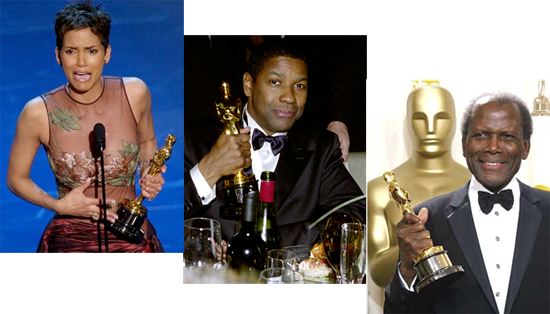
I write this as former ABC News talent who talked about movies every week on national TV. Films are my passion. I love classic Hollywood film history and I love watching the Oscars. I love those moments that made us gasp with glee -- like Sidney Poitier winning the Best Actor Oscar, Halle Berry winning for Best Actress -- and gasp with surprise -- like Ingrid Bergman announcing the Katharine Hepburn and Barbra Streisand had tied for Best Actress. I love those unexpected heartwarming and heartbreaking moments -- like Lady Gaga's reverence and affection when she beautifully sang "The Sound of Music" last year and then handed the spotlight over to the star of The Sound of Music, Julie Andrews. The sweet sentiment of that was so heartwarming. Sunday night, when Gaga sang a Best Song nominee, "Til It Happens To You," I was glued to the TV screen. It's from a documentary about campus sexual assaults. When the curtain parted and young adults, female and male survivors of sexual assaults, appeared and stood powerfully by Lady Gaga as she sang, I admit that tears started rolling down my face. Such a moving moment, one that got a well-deserved standing ovation. There have also been plenty of Oscar "What the heck?" moments -- like co-host James Franco coming out in drag and Neil Patrick Harris doing a host bit in his underwear to poke a Michael Keaton scene from Birdman. That was more an arthouse film than a mainstream, nation-wide hit movie like Maleficent starring Angelia Jolie...so many viewers probably didn't get Harris' visual gag.
Sunday night's Oscar telecast came on with social tension, the tension of racial exclusion and the lack of equal opportunities within the entertainment industry system of hiring and marketing. And not just for actors. This goes for the tradespeople too -- editors, cinematographers, costume designers, directors and such. The Academy became a symbol of this lack of diversity but the real problem is within the branches of the entertainment industry that help put together the work that gave birth to the idea of the Academy Awards. Those branches are the studios and the talent agencies.
Host Chris Rock took on the "Oscars So White" controversy in his opening monologue and added America's race issues like "Black Lives Matter" into his performance. CBS and NPR film critic David Edelstein called it a "touchstone" monologue that made some excellent points. I agree. All the points he needed to make were made in the opening monologue. The issues needed to be raised. They've infected Hollywood for a long time. There needs to be diversity in the film arts. The art of film itself can promote and inspire diversity in the world.
If I was on the Oscars' telecast production team, what ideas would I have pitched for this year's show? What would I have added to the red carpet coverage had I been hired?
Honor Oscars Past with the presentation of Oscars Present. For example, showing a clip of Broadway, film and ABC hit sitcom star Miyoshi Umeki (The Courtship of Eddie's Father)winning the Best Supporting Actress Oscar for 1957's SAYONARA...a film about racial acceptance and embracing diversity...
...and then introduce award presenters such as George Takei and BD Wong (Jurassic Park and 2015's Jurassic World) or Ming-Na Wen of 1993's THE JOY LUCK CLUB and the ABC series AGENTS OF S.H.I.E.L.D.
Another example. They could've is shown an Oscar moment clip of 2-time Oscar winner and Mexican-born actor Anthony Quinn plus the Best Supporting Actress Oscar victory for WEST SIDE STORY star, Rita Moreno and then introduce a new Oscar presenter such as Michael Peña. This young Mexican-American dude is one seriously good and versatile actor with an impressive list of credits. He was in Clint Eastwood's MILLION DOLLAR BABY, the movie that won the Oscar for Best Picture of 2004. He had a key role in CRASH, the movie that won the Oscar for Best Picture of 2005.
Actor Michael Keaton starred in last year's Best Picture Oscar winner, BIRDMAN and this year's Best Picture Oscar winner, SPOTLIGHT. Michael Peña is able to point to work in two consecutive Best Picture Oscar winners before Keaton.
Peña is very funny in AMERICAN HUSTLE, another Best Picture Oscar nominee on his resumé. He starred in the 2014 biopic CESAR CHAVEZ with actress America Ferrera, former star of the hit ABC sitcom,UGLY BETTY. Peña played a member of Matt Damon's space crew in THE MARTIAN.
With that role, Michael Peña added his talents to yet another movie that was an Oscar nominee for Best Picture. I would've booked Michael Peña and America Ferrera as presenters and introduced him as an actor in four Best Picture Oscar nominees, two of which won the Oscar consecutively. Here are Peña and Ferrera in Cesar Chavez, the bio of the famed labor organizer and civil rights activist in California.
I loved seeing Lou Gossett on Sunday night's Oscars. I watched him on ABC's red carpet coverage one hour before the awards telecast. February is Black History Month and that was an opportunity to blend some black history into the Oscars talk. Mr. Gossett worked with the late, great playwright Lorraine Hansberry. She was the young, gifted and black woman who wrote the groundbreaking 1950s Broadway hit, A RAISIN IN THE SUN. Gossett, along with fellow cast members Sidney Poitier and Ruby Dee, recreated his role in the 1961 film version. Gossett was the first black actor to take home the Oscar for Best Supporting Actor. As for this year's diversity issue, Gossett won his Oscar for a role that was originally slated for a white actor. The movie was 1982's AN OFFICER AND A GENTLEMAN. When I interviewed Lou Gossett in his Malibu home a couple of years ago, he told me that producers wanted Scott Glenn (Urban Cowboy, The Right Stuff, The Silence of the Lambs). Gossett got the role and got an Oscar. He also told me that winning the award didn't really change his career. It was still a struggle to get other juicy film roles because of the studio system of hiring in Hollywood. This is something Viola Davis mentioned. Gossett was also in the acclaimed TV ratings champ, ROOTS. That ABC mini-series made broadcast history.
In our on-camera interview, Gossett told me a great stories about Marilyn Monroe. They were students together at the Actors Studio and she asked him to be her scene partner. He saw her do scenes from Tennessee Williams classics in the class. He told me that, had she lived, Monroe definitely would have been an Oscar winner for dramatic work. Also, I asked him who should play Lorraine Hansberry if the life of the civil rights and gay rights advocate playwright was turned into a biopic. His immediate answer was "Taraji P. Henson."
I wish I could've worked on the "In Memoriam" segment. The death of Abe Vigoda made national headlines. In the video package of the people who passed, we saw of clip of the late Alex Rocco saying a line as Moe Greene in THE GODFATHER. I would've followed that with Abe Vigoda doing a line as Tessio in the same classic film. Mr. Vigoda, who went on to years of ABC sitcom fame on theBARNEY MILLER New York City copseries, was not in the memorial segment. He should've been. You know who else should've been included? World famous Hollywood novelist, Jackie Collins. She was a tremendous Hollywood insider. Mr. and Mrs. Sidney Poitier were two of her best friends. She loved Hollywood and helped launch careers of such actors as Sandra Bullock with the TV adaptations of her novels. One of her screenplays helped Joan Collins, her actress sister, land the role that made her a bigger star than movies ever had -- the role of Alexis on the hit ABC series, DYNASTY. The kind of diversity that actors of color want from the Hollywood system now had long been a staple of the best-selling Jackie Collins novels. She embraced diversity. Jackie purposely wrote strong, vivid black and Latino characters into her novels -- classy characters that male and female actors of color could've auditioned to play had the novels been adapted into movies. Jackie knew the game and knew that a major way for minority actors to get cast in roles was to make them obviously present on the page. You had to be blunt for clueless Hollywood executives and agents until they got hip to the modern art of color blind casting, the kind you see on TV in Shonda Rhimes productions. Jackie was very dear and a great help to me at times in my career from my VH1 days in the late 1980s up to last summer. I spent an hour with her just a couple of months before her death shocked us all. We fans had no idea she'd secretly been battling breast cancer.
Novelist, screenwriter, producer and occasional actress Jackie Collins showed more love for Hollywood than Kirk Kerkorian did, in my opinion. He made the "In Memoriam" segment. Overall, the memorial packages seen at the end of the year on TCM are usually better. I have a feeling the TCM production team putting it together remembers more golden era folks who may have passed than the Oscar team does. The Oscars package also left out Dickie Moore, a very popular and busy child/teen actor of the 1930s & 40s who grew up and was the longtime husband of Jane Powell. Moore was also a longtime spokesman for AFTRA. Also left out the Oscars package was Joan Leslie. Onscreen she starred opposite Humphrey Bogart, Gary Cooper in Sergeant York (the film that brought him the Best Actor Oscar for 1941) and James Cagney in the musical biopic Yankee Doodle Dandy (the film that brought him the Best Actor Oscar for 1942). She was Fred Astaire's leading lady and dance partner in The Sky's the Limit. Both Dickie Moore and Joan Leslie acted opposite Gary Cooper in Sergeant York, which was also nominated for Best Picture.
Before Sergeant York, Dick Moore was in the entertaining Our Gang comedy shorts of the 1930s that many of us baby boomers grew up watching on TV right along with Saturday morning cartoons.
I would've given a tip o' the hat to the new generation. Two of most remarkable and memorable performances in 2015 films came from juvenile actors who played youngsters surviving horrors in their childhoods. I would've had the audience give a hand to the extraordinary work done by Abraham Attah in BEASTS OF NO NATION (opposite Idris Elba) and little Jacob Tremblay in ROOM (opposite Brie Larson) when they came on as presenters. They did their difficult roles brilliantly. They were on as presenters. The movies they did were not mainstream popular cineplex fare -- like Jurassic World and Trainwreck -- so the TV audience needed to know those two kids' significance and what brought them to the Hollywood Prom Night awards party.
Jodie Foster would've been invited by me to be a presenter. She grew from successful child actress into a 2-time Best Actress Oscar and has become a fine director (Little Man Tate, Home For The Holidays and episodes of TV's Orange Is The New Black).
On Sunday night, there were some sophisticated and substantial Oscar acceptance speeches from the actors and the director. The speeches were not laundry lists of managers, publicists, hairstylists and agents. Leo DiCaprio, Best Actress Brie Larson and Best Supporting Actor Mark Rylance were most gracious and composed accepting their Oscars. The control room needs to chill with musically cuing the top winners to wrap it up. Alejandro Iñarritu was making an intelligent, wise point about racial acceptance and the arts when he accepted his Best Director Oscar for THE REVENANT. The music piped in and, to me, made the control room look bad. Wisely, the volume on the "bum's rush in melody" music was lowered as Inarritu continued his inspirational speech.
One of the biggest frustrations in the diversity issue is that actors and production craftspeople of color are invisible when it comes to equal opportunities in employment. I'll put it like this: If a movie was being made about Hollywood and there was a major scene at the Oscars with parts for the Oscars telecast director in the control room, the winner for Best Director making an acceptance speech and a network morning news show talent in a backstage green room asking a publicist if he can get a short interview for his show with the Best Director winner afterwards, a majority of white male actors would be submitted to audition for those roles. Very few -- if any -- women would be submitted to play the director making an Oscar acceptance speech. That kind of "tribal" thinking that Iñarritu referred to in his acceptance speech is what needs to change.
I would've made minority actors visible as presenters, honored minority talent that broke through race/color barriers in Hollywood history with clips of Oscars Past, respectfully acknowledged members of Old Hollywood, welcomed fine work done by members of film's new generation andnoted work some stars had done on ABC as ABC is the network that presented the Oscars.
In 2000, I was the entertainment editor on the weekday hour-long magazine show, LIFETIME LIVE. I reviewed movies and gave film history every Friday on that ABC News production which aired on Lifetime TV. The show lasted almost one year. Although I wanted to, I was not asked to do more entertainment reports for ABC on other shows after the cancellation. Here's a trailer from a thriller that opens in May. MONEY MONSTER stars George Clooney and Julia Roberts. It was directed by Jodie Foster.
To see my celebrity interviews and film-related features, plus some personal comments on the need for diversity in film and TV, visit my YouTube page and click on the videos: www.YouTube.com/BobbyRiversTV.
I have been a Kim Cattrall fan since the 80s. She is a good actress who has paid her dues and totally deserved the stardom she won on HBO's SEX AND THE CITY. She was my favorite member of the Sex and the City quartet. The talented Cattrall stars in a new series on Netflix called SENSITIVE SKIN. This skin is smooth and appealing.
I watched the first three episodes of this hour-long show and intend to watch more. Wow. Cattrall is so good in this new role. Not only is it different from her most famous TV role, it shows how she's matured as an actress and how gifted an actress she is. This character, Davina Jackson is in her 50s. When first we see her, she's in a drugstore and looks like a dwarf in a land of pharmaceuticals. Davina wants something for her hormones. She has a rather bookish husband ("I prefer John Updike to sex"). They're in Toronto and they've been married to for 30 years and they have a grown son. The husband writes a popular humor column. She's a former model who acted occasionally but was mostly a model. Sensitive Skin shows Kim Cattrall in fantastic form. She shines in this role of a woman find a new meaningful path in her life as she navigates through menopause. The humor is smart, mature and insightful. There's a touch of the James Thurber in the scripts. In the first episode, Davina has a conversation with herself. She's at a function and sees herself. The two Davinas have a conversation that no one else can hear. Or see. This adaptation is based on a British series that starred Joanna Lumley, the actress who played tall, blonde Patsy from Absolutely Fabulous. This Sensitive Skin is a perfect fit for Kim Cattrall. She makes a mid-life crisis look good. Here's a trailer.
Kim Cattrall's Sensitive Skin deserves a better trailer and more publicity than it's getting. I love the tone, writing and the freshness of this comedy/drama. Davina's son is the kind of pretentious hipster that colonized and drove up rents in the once-afford sections of Brooklyn. He asks his parents to watch his little dog while he's gone. Of course, his upscale dog can't eat Alpo and Milk-Bone doggie treats. He eats prey. The son tells dad that the dog will need "guinea fowl or rabbit" to eat. Dad is Al Jackson, played nimbly by Don McKellar. McKellar and Cattrall are also executive producers of the show. Al has a touch of hypochondria about him. Don McKellar has the hairiest chest this side of Alec Baldwin. You could comb McKellar's chest and probably find loose change.
At first sight, these two married people seem to be an odd couple. But as the episodes progress, we see how they do complement and love each other. We see how they deal when approached by outside sexual temptation.
I love the occasional James Thurber-like delusional moments. The theater scene at the Chekhov play is priceless. I've seen some 2-hour movies that weren't as good as that female-driven theater scene. I also love how the show honors women and women's self-images. Notice the interaction when Davina runs into a woman who was a high school classmate and followed Davina's career as a supermodel. Sensitive Skin is a blessing for middle-aged and senior age actresses because it gives them work and meaty material to play. Notice the hospital scene where Davina visits her elderly and ailing mother. There's a great scene with the mother's also elderly roommate.
My Sex and the City interest started to wane after a couple of seasons because I really knew nothing about the characters' background and I couldn't really believe Carrie as a writer About the characters on Sex and the City...yes, they had boyfriends and lovers. But did the have families? Did they have parents and siblings? Grandparents, aunt and uncles? They never talked about their families. In that sense, they seemed so rootless. As for Carrie Bradshaw -- I've had a number of women friends in New York City who were magazine columnists, newspaper reporter and published authors. We'd make plans. Inevitably, one of our dates would have to be canceled and rescheduled because they were on deadline, they had to do last-minutes or some critical research. That was understandable. Carrie would relax on her cute bed and knock out a column in one draft as easily as if she was writing a postcard to a friend while on vacation. I've seen high schoolers put more toil and research into a writing a term paper than Carrie Bradshaw did her columns. But that's just me.
Cattrall's character here has family, family members that she loves keeps in her life. These family members have helped form her current life, a life that needs to expand, a life that needs to find new meaning.
I mentioned that Kim Cattrall has paid her dues. Remember the bawdy 1982 loss-of-virginity comedy called Porky's? It was cheesy fun and a big box office hit. Cattrall played the babe who howled like a collie during sex. She was also in 1987's romantic comedy Mannequin. She played the mannequin. Ah....the 80s.
There was a excellent series on NBC in the late 1980s called The Days and Nights of Molly Dodd. If you remember and liked that show, I think you'll dig Kim Cattrall in Sensitive Skin.Elliott Gould plays Al's doctor and Joanna Gleason is her usual fabulous self as Davina's older sister.The sister is married and has a financially comfortable life. However, she's been disappointed by life. She's angry because she's heartbroken.Season One has six episodes.The depth and wit of Cattrall's performance hooked me right away.Check out Sensitive Skin on Netflix.
TO SIR, WITH LOVE. That title of his 1967 box office hit applies to the feelings millions of us have today as we wish Sidney Poitier a very happy 89th birthday. How often I've dreamed of having the opportunity to interview him. If I got only the privilege to meet him and shake his hand, I would do so with tears of joy streaming down my face. That's how significant his work has been and continues to be to me. I was born and raised in South Los Angeles when it was still called South Central. Some of my favorite memories of family time involve Sidney Poitier. I guess it's no surprise that whenever one of his new movies was out, we'd get into the Plymouth on a Friday night and head for the nearest drive-in movie theater so we could see movie star actor Sidney Poitier on the big screen. How proud we all felt to see him up there.
My little sister and I would be in the back seat with our pajamas on underneath our clothes while our parents, of course, sat in the front seat. I also remember how we all sat anxiously looking at the big box of lights and wires called a "television" in our living room and how Mom and Dad whooped with glee and pride when Anne Bancroft read that Sidney Poitier was the winner of the Best Actor Academy Award for 1963's LILIES OF THE FIELD.
Bancroft was so thrilled that she gave him a congratulatory kiss right then and there on live network television! That was big deal back then, a time in which TV execs were neurotic and nervous about interracial moments of physical affection for fear of losing sponsors. Seriously.
Sidney Poitier had already made Hollywood history as the first black man to be nominated for the Best Actor Oscar thanks to his performance as the tough escaped convict handcuffed to a racist white convict in 1958's THE DEFIANT ONES. Our family also gathered at that same TV to watch a special network news telecast one day. It was Dr. Martin Luther King's March on Washington -- and Sidney Poitier was there with his dear friend, Harry Belafonte.
Here's Dr. King, Harry Belafonte, civil rights activist Asa Philip Randolph and Sidney Poiter.
By the time the 1966 western DUEL AT DIABLO rolled in, our family had grown. My sister and I had a little brother. When Mom and Dad felt he was old enough to handle a walk-in movie theater instead of being in the backseat of our Plymouth, we went to see Sidney Poitier and James Garner in Duel at Diablo on a rainy Sunday afternoon. What a fun experience, the five of us seated in a movie theater row and enjoying that action-packed western.
Sidney Poitier didn't just act. He became a film director. He directed two friends who were with him at Dr. King's March on Washington -- Harry Belafonte and actress Ruby Dee. She was Poitier's leading lady in the original 1959 Broadway cast of the landmark play, A RAISIN IN THE SUN. They recreated their roles in the 1961 film adaptation. Ruby Dee got her one Oscar nomination for a film released in 2007. It was American Gangster starring Denzel Washington. She was nominated for Best Supporting Actress. Poitier directed the 1972 western, BUCK AND THE PREACHER. Poitier played a wagon master and Belafonte co-starred as a con man Bible thumper with some funky teeth. You need to see Ruby Dee in this movie. She's the wagon master's wife who wants to just leave and ride to Canada where black folks can live in peace. She should have been a Best Supporting Actress Oscar nominee for Poitier's Buck and the Preacher.
In the turbulent 1960s, Mr. Poitier was a major box office star. The first black film performer to crack that color wall with lead roles. People of all colors went to see movies that starred Sidney Poitier. He starred in two of the five movies that were Oscar nominees for the Best Picture of 1967 -- GUESS WHO'S COMING TO DINNER and IN THE HEAT OF THE NIGHT. Both were big hits with critics and moviegoers alike. The other nominees were BONNIE AND CLYDE, THE GRADUATE and DOCTOR DOOLITTLE. Guess Who's Coming To Dinner earned 10 Oscar nominations. Katharine Hepburn won the Best Actress Oscar for her performance in it. In The Heat Of The Night won the Oscar for Best Picture and Rod Steiger, Poitier's co-star, won the Oscar for Best Actor. Beah Richards, with a sophisticated role in Guess Who's Coming To Dinner, became one of the first black women to get a Best Supporting Actress Oscar nomination for a role in which she did not play a maid. She and Poitier had scenes together in Guess Who's Coming To Dinner and in the racially-charged Southern murder mystery, In The Heat Of The Night.
I've long felt that In The Heat Of The Night should've brought Mr. Poitier his third Oscar nomination for Best Actor. He is absolutely outstanding as Detective Virgil Tibbs. Here's some other Oscar history: The night those Oscars were given out, the ceremony had been postponed for the first time ever. The ceremony and telecast were postponed two days because of the assassination of Dr. Martin Luther King.
1949 was a good year for Joseph L. Mankiewicz. He won Oscars for directing and writing 1949's A Letter to Three Wives. 1950 was also a good year for him. Mankiewicz won two more Oscars -- this time for directing and writing All About Eve. His All About Eve also took the Oscar for Best Picture of 1950. Mankiewicz got another Oscar nomination for that year. He was nominated for writing 1950'sNO WAY OUT, a groundbreaking racial drama starring Sidney Poitier as a hospital doctor. The doctor is conflicted because the job demands that he care for a racist wounded criminal (played by Richard Widmark). Movie audience of the 1930s and 40s had not been used to seeing a black actor as an doctor in an urban hospital with white fellow doctors. According to an interview Sidney Poitier gave to the Los Angeles Times last year, some Southern areas refused to show the film. Some. Not all.
Although they did not get screen credit, Ruby Dee and Ossie Davis also appear in No Way Out as two of the doctor's relatives.
It's February 20th, 2016. No Way Out airs at 8p Eastern tonight on Turner Classic Movies (TCM). See the screen legend early in his film career. Before he made Hollywood history with his Oscar win. Before he got a special lifetime achievement Oscar in 2002 -- the same year Denzel Washington and Halle Berry took home Oscars for Best Actor and Best Actress.
Again...Happy Birthday to actor, director and social activist Sidney Poitier. Thank you, sir, for reflecting the best of us.
Fred Astaire would so dig Ted's number. There's one thing we can say about actor, singer, writer and producer Seth MacFarlane: He loves Broadway showtunes and classic MGM musicals. You can tell that when you watch hisanimated TV series, The Family Guy. There's a visual nod to the Broadway classic, A Chorus Line, in the credits. In one episode, Baby Stewie recreates the Jerry the Mouse and Gene Kelly song and dance from MGM's 1945 musical, Anchors Aweigh.
2015 saw the release of TED 2, MacFarlane's sequel to his fantasy comedymovie, TED, in which we follows the misadventures of a potty-mouthed by adorable talking teddy bear.
Mark Wahlberg plays Ted's owner and best friend. In Ted 2, the bear settles down and marries his hot blonde girlfriend (a human). But Ted's best buddy is blue because he's been lonely for the six months following his divorce. Then Ted has a civil rights issue regarding his marriage in Boston. OK, that's enough of the plot. But, if you've seen the totally inappropriate but often hysterically funny animated stuff on The Family Guy and American Dad!, you know not to be shocked by the bear and his buddy accidentally wrecking a sperm bank storage room. Ted and John stick, not just to the floor, but through thick and thin.
A friend rented the DVD this week and urged me to watch with him because he felt I needed the laughs. I was not prepared for the absolutely fabulous musical number for the opening credits that comes about five minutes into the movie during the wedding reception.
I took the DVD the next day and watched that number about a half dozen times and, man! It slayed me! The whole deluxe production number with showgirls and men in Fred Astaire-like tuxedos with top hats is like something out of a Freed Unit A-list MGM musical of the 1940s. If you loved those musicals as much as I do, you will gasp at the class, wit, choreography and execution. Rob Ashford choreographed it and a magnificent job he did. Ted is in the number. A dancing bear with all those terrific couples. If the music sounds familiar that's because it's from a Freed Unit A-list MGM musical of the 1940s. It's the "Steppin' Out With My Baby" number from Irving Berlin's Easter Parade starring Fred Astaire and Judy Garland. If you have the CD soundtrack, you've heard that complete orchestra instrumental arrangement for the jazz dance performed by Fred Astaire. The arrangement onscreen in Easter Parade is a bit shorter for Astaire's number. Ted dances to the complete version heard on the CD soundtrack. And the number is shot the way Fred Astaire and Gene Kelly numbers were shot in MGM musicals directed by Vincente Minnelli and Charles Walters. We see the dancers full frame and the camera stays on them. There's no manic cutting every three seconds, a style that goes back to MTV music videos.
For as lewd, crude and juvenile as the Seth MacFarlane comedy can get, he can give us something as swingin' and sophisticated as that opening number to an Irving Berlin tune. MacFarlane directed Ted 2.
MacFarlane, by the way, has a rich singing voice and he cut a CD of vocals. On Music Is Better Than Words, it is no surprise that he sings a couple of tunes from MGM musicals.
This is a new original series, based on popular books, that premieres Wednesday night, March 2nd, on SundanceTV. The story takes places in 1980s Texas. The idealism of the 1960s is being mowed by the growing corporate mentality of the 1980s. Press materials describe HAP AND LEONARD as being "swamp noir" and that's accurate. There's an innocent guy who's described as "always the noble one, ready to make a stand." There's a femme fatale working as a waitress in a diner. There's a case with a whole lot of cash money in a swamp. It's been there for years and some folks are hungry to get their hands on it. By the way, Christina Hendricks, the actress who played Joan on Mad Men, stars as Trudy, the femme fatale waitress.
Not only is Ms. Hendricks the Big Ben of the hourglass figures (as someone once wrote a long time ago about curvaceous Hollywood sex symbol/writer Mae West), she is one mighty fine actress.
I saw the first three episodes and here's one thing I really dig about it. We focus on the two best friends, Hap and Leonard. Hap, the idealist, was against the war in Vietnam when he got drafted. He didn't serve. Leonard is a Vietnam veteran. Hap is white. Leonard is black. Hap is straight. Leonard is gay.
Leonard is not closeted. And he's not a victim. Mess with him or someone close to him and he can open up a whup-ass on you in a heartbeat. He's got more a temper than Hap. Hap and Leonard -- and Trudy -- have known each other for a long time.
In fact, Trudy and Hap were a romantic item way back when he got drafted. Yep, they've known each other a long time. And, even though she went on to other men, she still knows how to get to Hap.
The main thing that hooked me into the episodes right away as the central friendship. TV rarely gives us a show with a look at a straight/gay male friendship. We've seen it in sitcoms like Happy Endings, the sitcom on ABC that was pretty bright and fresh but, unfortunately, yanked by the network. I loved the Chicago friendship between gay Max, the bear who was no slave to fashion, and straight Dave, his best buddy. Happy Endings had a cast of characters. As said in its promos, it was "Like Friends -- only with black people." I liked that sitcom. I can think of other TV shows that had gay characters -- a barrel full nowadays -- but I cannot think of one that focused on a straight/gay male friendship. Especially one that showed that the two characters really need this friendship and take care of each other. They accept each other as they are. I'm personally interested in this because I had a couple of straight roommates back in the 80s who continue to be two of the most special people in my life.
Leonard knows all about Hap's romantic past with Trudy. Hap knows about Leonard's romantic past. I could see some of my friendships with straight men in the Hap and Leonard friendship.
I like it when I watch a show that gives me that zing of recognition and realness. There are quirky characters and a couple of straight-up psycho killers on the loose while the two best friends and Trudy try to get their hands on the loot. This series is based on books by Joe. R. Lansdale.
Leonard, the gay Vietnam vet, is played by Michael Kenneth Williams. Cable TV viewers will recognize him as the actor who played Omar on HBO's The Wire. He was later in the cast of HBO's Boardwalk Empire. Hap is played by James Purefoy. Once again, TV gives us a British actor who absolutely nails an American accent. As for Hendricks, she's doing sort of a Barbara Stanwyck turn here. In her classic films, Stanwyck was the ambitious woman who knew herself and could be a player in the boys' game. Stanwyck could play that kind of woman for laughs in The Lady Eve and Ball of Fire, she could play her with a sense of righteousness as in Meet John Doe and she could play the dark side of the ambitious woman as she did brilliantly in Double Indemnity. Christina Hendricks is again playing a woman who's ambitious, who knows herself and who's in a game with the boys. But she's in the backwoods of Texas in the 1980s this time. Not in the concrete jungle of 1950s/60s New York City. Here's a trailer for SundanceTV's Hap And Leonard.
The CEO of Apple, hailed as the pioneer of the personal computer revolution, died in 2011 at age 56 of cancer. After that, he died twice at the box office. The first time was when his 2013 biopic, JOBS starring Ashton Kutcher, flatlined at the box office. The same thing happened with the 2015 biopic, STEVE JOBS, a film that some top critics loved. Two performances in the flop biopic took it to this year's Oscars face. Michael Fassbender is a Best Actor nominee for his portrayal the late billionaire and Kate Winslet is in the Best Supporting Actress Oscar category for her work as Apple marketing executive Joanna Hoffman. Fassbender is seen here in the white shirt standing next to Winslet in a shot from the film.
Fassbender and Winslet are extremely talented, versatile, strong actors. Do they give Oscar nomination worthy performances in this film? Yes. Especially considering there vocal work. Fassbender is a German-Irish guy who was raised in Ireland. He does sound like a Northern Californian in this Bay Area-based drama. Winslet is a Brit doing a Polish-American accent. However, you must admit he's an odd choice for Jobs. He doesn't resemble Jobs.
The biopic flashes back to computer giant's days as a young man working in a garage and takes us to the height of his fame before illness struck.
There's no obvious cosmetic attempt to make Fassbender resemble Steve Jobs.
They get the wardrobe right but not the physical characteristics. The film opens with an actor who does not look like Steve Jobs playing Steve Jobs as he prepares for one of his major 1980s presentations. Within the first five minutes, Jobs strikes you as being brilliant but a prick. Twenty minutes later, you just want to slap him for his rudeness, selfish, arrogance, his lack of gratitude and his cheapness. He's upset that he's not on the cover of TIME magazine. He's in a legal dispute with his ex-girlfriend who is also the mother of his little girl. Mother and child are on welfare. The mother is begging him for money. He's made $441 million. The first 20 minutes needed a strong "Rosebud" moment...like in Citizen Kane.
I have the DVD of this film and took three attempts at watching it straight through to the end. The third time worked. I dozed off in the middle the first two times. It's not bad movie. It's just that this talky screenplay full of arguments didn't really make me care about Jobs. What was the Aaron Sorkin screenplay trying to say? What did he want to tell us? Was this supposed to be a cautionary tale of how not to behave? This glossy, quick-paced production reminded me of a line from 1939's The Wizard of Oz that's said by Tin Man: "The tinsmith forgot to give me a heart." Steve Jobs, the movie,doesn't have a heart.
Fassbender is in fine form. Winslet, as the voice of reason who sees the mess he's made of friendships and family relations ultimately orders him to "Fix it!," We like her. Winslet bites into this role like it's a thick, juicy T-bone steak. My favorite parts of the film are their scenes together. It's like watching two tennis greats in a championship match.
There's a very impressive dramatic performance from Seth Rogen as the mistreated Apple co-founder Steve Wozniak. We usually see Seth in broad comedies but, wow, he's quite strong here in a serious role. You care about him because -- like millions of us -- all he's asking for is acknowledgement of his hard work. A thank you. And Jobs refuses to give it. You wait for Wozniak to call Jobs on his crappy behavior.
Because the screenplay portrait made Jobs such a wealthy and driven jerk, I loved the scene near the end where the now college-aged daughter tells him off backstage in front of people moments before he's scheduled to go onstage to a theater packed with cheering fans and devoted followers. Jobs philosophy is "...as long as you have control." He can control his brand and his image. He needs to learn self-control when it comes to the cold way his treats the people closest to him. The daughter's verbal roasting makes him realize he needs to, as Joanna ordered, "fix it."
I like Fassbender. I thought of other 2015 performances by men in films with more satisfying screenplays that I would've put in the Best Actor Oscar race. Men like Benecio Del Toro as the Mexican drug war federal agent in Sicario, Ian McKellan as the older and infirm Sherlock Holmes solving one last mystery in Mr. Holmes and the late Robin Williams as the closeted married man whose infatuation with a young street hustler shakes up his life in Boulevard. Tom Hanks was in peak form for Bridge of Spies. He's excellent in it.
Remember the over-caffeinated way the characters delivered dialogue on Sorkin's NBC series, The West Wing, coupled with those "walk and talk" scenes? There's a lot of that in Steve Jobs. But there's not much heart. I felt it's a somewhat hollow movie. Did you see it? If so, what's your opinion? Steve Jobs was directed by Danny Boyle, the man who gave us Trainspotting and Slumdog Millionaire.
His writing excites me. He's so passionate about films. Have you ever seen him on TV shows do film reviews? Probably not. He's Justin Chang and he writes film reviews forVariety.
Have you ever seen this gent reviewing movies weekly on a network morning news show? Probably not. He's Wesley Morris. He now writes for the New York Times. When he wrote for The Boston Globe, he won the 2011 Pulitzer Prize for Film Criticism. He was the fifth film critic to win the prize and the first black journalist to do so. One of the previous winners was the late Roger Ebert.
A New York City talent, Mike Sargent is a film critic, an indie filmmaker and he has a WBAI radio show. On TV, he was the host of Arise On Screen on cable's Arise TV. On this smart weekend film review & interview show, he invited two guest critics to come on with him to review Hollywood fare, indie movies and foreign films. Here's a photo from one taping with Mike on the far left, film reviewer Raqiyah Mays in the middle and yours truly on the far right.
Arise On Screen presented black female film critics on a regular basis. It put a regular spotlight on women directors and gay & lesbian filmmakers. The show went off the air in 2015 after a 2-year run. TV columnists in New York City's top newspaper never gave Mike's show a review or mention.
Have you ever heard of the African American Film Critics Association?
This organization has been around a few years and it hands out awards.
Now think of the movie critics you've seen on TV and play my short piece on diversity.