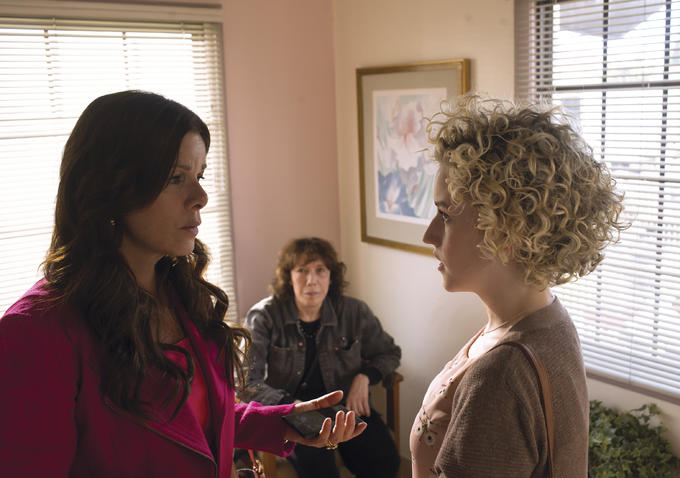
She's wonderful in it. Lily Tomlin should prepare to get award nominations for her performance. As a big screen movie in which all the action takes place in one day, there's not a whole lot going on. It's a multi-generational story populated mostly by women, like Steel Magnolias which had more drama going on than GRANDMA does. But with Lily Tomlin at the wheel in this indie drama, you're in for quite an unusual ride.
Grandma runs only about 1 hour and 20 minutes. It's like one of the best of those ABC Movies of the Week. Remember those made-for-TV movies back in the 1970? For a story that focuses on a grandmother whose candor and independence make her a heavy piece of furniture to deal with, Grandma doesn't have that little something extra to make it a memorable classic -- like Terms of Endearment starring Shirley MacLaine as the persnickety yet devoted mother and grandmother Aurora Greenway. But Lily Tomlin delivers a terrific performance and that makes it worthwhile to spend some time with Grandma. This is the kind of crusty female character role that automatically has gone to Shirley MacLaine since her Oscar-winning turn in 1983's Terms of Endearment. Think of 1989's Steel Magnolias to 1994's Guarding Tess to 2011's Bernie. Tomlin got Grandma and it fits her like a glove. The comedian/actress is now married to her very longtime partner in love and writing, Jane Wagner. Grandma marks the first time that Lily Tomlin has played an openly lesbian character. On her current sitcom, Grace and Frankie, she plays a straight woman whose husband wants a divorce because he's come out and is in love with another man -- his longtime law office partner.
Grandma is a road movie and road movies are about discoveries along the way -- self discoveries and discoveries about one's traveling partner. Tomlin plays Elle, a feminist poet who has a cult following and lives in Southern California. The film opens and she's breaking up with her younger girlfriend, Olivia (played by Judy Greer). You get the feeling Elle's not totally honest for the reason they're breaking up. Olivia seems truly to be in love with Elle and Elle seems to be pushing her away for some reason. The poet had a longtime partner who died. They'd raised a daughter together. Elle's daisy-like granddaughter comes over early in the morning with a problem. A major problem. She got pregnant by her loser boyfriend and she needs $600. Sage, the granddaughter, booked an appointment at an abortion clinic for late that afternoon.
Why didn't Sage go to her mother? Well, mother and daughter aren't speaking. Mother and grandmother aren't speaking. But all three will have speak to each other later that day. Elle has just broken off a romantic relationship, she's broke financially and she doesn't have a credit card. Two out of those three are my life right now. And I wish I was in a romantic relationship.
Elle tells Sage to get in the car. Grandma drives and they visit people Elle thinks may be able to help her out with cash. Sage will learn a helluva lot more about her grandmother. She will see her as a woman who had a life before she became a grandparent. Elle did not get quiet simply because she's over retirement age. She's still vital and forceful and relevant.
The scene in the coffee shop with the anal retentive clerk (played by John Cho) is a perfect example. I wrote on Twitter months ago that I wished Gloria Steinem would burst onto the scene in an episode of ABC's The Bachelor and hand each bachelorette a copy of Betty Friedan's The Feminine Mystique. Elle can't get over the fact that her granddaughter has never even heard of the book.
The last person visited for cash is Sage's mother. Played by Marcia Gay Harden, she's a caustic executive whom you just know has robbed her poor assistant of the will to live. We immediately see why Elle and Sage don't talk to her. Sage's mother is a multi-tasking nightmare.
Before that, Elle visit Karl. He's played by Sam Elliott and this is one of the juiciest roles Elliott's had in a long time. The visit to Karl's deluxe house is the electric charge of the movie. Elliott is now in his silver-haired cool senior daddy years. And there's that deep sexy voice of his. He's perfect to play this smooth survivor of the 1960s.
That's all I going to write. I want you to experience what happens in that section for yourself. The movie is presented in chapters. That's fitting because Elle is an author.
Grandma opens with two women wanted to end something. Elle is ending the relationship with Olivia. Sage wants to end her pregnancy. Through their journey, something will be lost and something will be gained. There were times when I felt I was Tomlin's character and times when I felt I knew her character personally. I felt like Elle was women I've known. Through the movie, you see that her heart is still so full of the partner who passed away. And maybe that's why she wanted Olivia to leave.
Some of us may feel like we've grown up watching Lily Tomlin. She was hit when she joined the cast of Rowan & Martin's Laugh-In on NBC in the early 70s. That comedy show was a huge hit -- funny, goofy, edgy, hip, satirical and topical. Tomlin created characters that she did on NBC and on hit record albums. She won a Grammy, Emmy awards and she graduated from TV to a Best Supporting Actress of 1975 Oscar nomination for Robert Altman's Nashville. She also won a Tony for Best Actress of 1985. The Search for Signs of Intelligent Life In The Universe was such an outstanding one woman show on Broadway that I saw it twice. Tomlin was brilliant in that show written by Jane Wagner. Tomlin also received a Kennedy Center Honor. She's in her 70s now and still at the top of her game.
Grandma is a must-see for Lily Tomlin fans.
Monday, September 7, 2015
Saturday, September 5, 2015
The Hit and Myth of STAR WARS
The Disney corporation now owns the STAR WARS franchise. The upcoming new adventure, Star Wars: The Force Awakens doesn't open until December 18th. But Disney made September 4th it's Force Friday by putting film-related toys on sale. Of course, there was a fan frenzy of Star Wars toy purchases. A marketing score for Disney.
I come from a family of STAR WARS fans. I was the first. Star Wars premiered in 1977 when I had my first full time professional broadcast job after college graduation. Because I did entertainment reports on an FM rock radio morning show, I got a pass for two to a preview of Star Wars before it opened. I could not get a date to go with me even though there had been lots of buzz about this new sci-fi adventure. Gay men are finicky that way. They couldn't get pass the fact that I'm not physically Mr. Dream Date. So I found a non-gay male date to go with me and we were thrilled. The packed audience of that big Milwaukee movie theater gasped and broke out into gleeful cheers and wild applause as soon as we heard the now-familiar John Williams downbeat to the now-famous overture as we saw "Episode IV, A New Hope" appear onscreen. Those words headed the legend that would crawl slowly up the screen. This movie was going to be fun.
But Star Wars and its following two episodes would prove to be more than just fun. In addition to becoming an international box office powerhouse, it created new movie characters that became part of our pop culture. Iconic? Yes, they and the movies are. Star Wars was more than we movie audiences hoped it would be in 1977. I was working in Milwaukee when it opened. Mom and my younger brother were still in Los Angeles. They waited in a long Hollywood line to see Star Wars. They saw it more than once at Grauman's Chinese Theatre. To this day, when I talk to Mom and she senses that I have a worry or a big question mark in my soul about a situation, she says "Use the Force, Luke." That's her way of telling me to have faith and let go.
Years later, Bill Moyers interviewed Star Wars filmmaker George Lucas. They discussed mythology and Joseph Campbell. Listen to this clip.
I come from a family of STAR WARS fans. I was the first. Star Wars premiered in 1977 when I had my first full time professional broadcast job after college graduation. Because I did entertainment reports on an FM rock radio morning show, I got a pass for two to a preview of Star Wars before it opened. I could not get a date to go with me even though there had been lots of buzz about this new sci-fi adventure. Gay men are finicky that way. They couldn't get pass the fact that I'm not physically Mr. Dream Date. So I found a non-gay male date to go with me and we were thrilled. The packed audience of that big Milwaukee movie theater gasped and broke out into gleeful cheers and wild applause as soon as we heard the now-familiar John Williams downbeat to the now-famous overture as we saw "Episode IV, A New Hope" appear onscreen. Those words headed the legend that would crawl slowly up the screen. This movie was going to be fun.
But Star Wars and its following two episodes would prove to be more than just fun. In addition to becoming an international box office powerhouse, it created new movie characters that became part of our pop culture. Iconic? Yes, they and the movies are. Star Wars was more than we movie audiences hoped it would be in 1977. I was working in Milwaukee when it opened. Mom and my younger brother were still in Los Angeles. They waited in a long Hollywood line to see Star Wars. They saw it more than once at Grauman's Chinese Theatre. To this day, when I talk to Mom and she senses that I have a worry or a big question mark in my soul about a situation, she says "Use the Force, Luke." That's her way of telling me to have faith and let go.
Besides its plentiful action/adventure, the original trio of Stars Wars movies released also had a strong spiritual core. There was something more going on that just special effects and outer space chase scenes of bad guys chasing the heroes.
In 1988, PBS had a special that made you fall in love with the Star Wars trilogy all over again. Host/journalist Bill Moyers interviewed mythologist and writer Joseph Campbell.
Campbell enthusiastically talked about the mythology of Star Wars. So wise and passionate was this conversation that it made you want to rent the three movies and watch them all over again. Which I, for one, did.
Look and listen to this clip from the classic PBS special.
The conversation between Bill Moyers and George Lucas is on DVD.
The Power of Myth interviews are also on DVD. I highly recommend them to Star Wars fans. Be reminded of the spiritual and philosophical center of the original movies before the whole franchise got turned into a mighty engine to drive toy sales. I'm praying that Star Wars: The Force Awakens gives me the same kind of thrills and awe I got back in 1977. I can't wait to see it. I'm still a big fan. May the Force be with you.
Friday, September 4, 2015
Kid Actor with Sylvia Sidney
STREET SCENE. AN AMERICAN TRAGEDY. DEAD END. Three of her early films. The 1930s. America is in the tight grip of the Great Depression. At the movies, no one played a poor New York City girl with more soulfully than lovely Sylvia Sidney. She was like an American beauty rose blooming in an ashcan. Her low income neighborhood characters worked hard to get out of miserable surroundings to something better. Life knocked her down but this sad-eyed beauty would get back up and carry on. She'd try to help someone else knocked down by life get back up and carry on too.
Sylvia Sidney distinguished herself in a long career that covered Broadway, film and TV. She started making movies just a few years after they'd learn to talk. Street Scene and An American Tragedy (remade by director George Stevens 20 years later as A Place in the Sun) were released in 1931. Sylvia Sidney did a good amount of TV work in the 1980s plus a popular movie. Many recognize her as Juno in Tim Burton's Beetlejuice (1988). Her last film was 1996's Mars Attacks!, also by Burton. She played Grandma Florence. She worked with top directors from Hollywood's golden age such as William Wyler, Fritz Lang (the above pic is from Lang's Fury), Josef von Sternberg, Dorothy Arzner and Alfred Hitchcock. She did not like Hitchcock. I did a short interview of Sylvia Sidney for morning radio in the late 1970s. It was my first broadcast job fresh out of college and she was doing a celebrity appearance to promote her popular needlepoint book. Sylvia Sidney said that Hitchcock was "just a cutter." He cared more about how he'd edit a scene later than he did about his actors. Their film together was 1936's Sabotage. Another of her tenement heroine roles was in a 1939 film that I saw recently.
It was ...ONE THIRD OF A NATION... It's a social issue movie about the deplorable living conditions many New York renters had. The same angle about poverty and tenements was done better by William Wyler in 1937's Dead End. But Sylvia Sidney, who'd mastered and become a star playing that kind of character, is terrific to watch and she speaks out against squalid conditions that her relatives and neighbors must endure. Her character, Mary, has a kid brother who becomes a victim of the plague of poverty. There are no fire safety codes. Landlords are derelict in upkeep. A blaze starts in the building. Her brother, Joey, has to jump to safety and is crippled as a result of the jump. But he's alive. Others aren't. It's hard for Joey to accept that he may always need crutches.
He's angry at the cycle of poverty he and his family live in.
Joey rants at the tenement. The building talks back and mocks the boy, telling him that it's been there for a long, long time and no one's done anything so far. The building teases the boy by telling him that it'll remain standing to make even more lives miserable in New York City. Joey is mad as hell at the building.
The young actor was 15 when he gave that passionate, moving performance. He held his own opposite a pro like Sylvia Sidney. It was his only feature film acting role.
Yet, he had an extensive and acclaimed film career. He got four Oscar nominations. The nominations came for 12 Angry Men, Dog Day Afternoon, Network and The Verdict. His other film credits include The Pawnbroker, Fail-Safe, Serpico, Murder on the Orient Express starring Albert Finney, Equus starring Richard Burton and 2007's Before the Devil Knows You're Dead. Yes, that kid actor was future film director Sidney Lumet.
Lumet was a director known for taking on social issues in some of his finest films and for making films in which New York was his best set and location. Look at his 1957 courtroom drama 12 Angry Men, The Pawnbroker (1964), Serpico (1973), Network (1976) and Prince of the City (1981). In ...One Third of a Nation..., that 1939 movie scene in which crippled Joey is as mad as hell and confronts the awful tenement building reminded me of Howard Beale in 1976's Network hearing voices in his head that drove him to extreme behavior. I thought of the apartment buildings in Network that had desperate New Yorkers going to their windows and connecting to Beale's pain and rage by yelling "I'm as mad as hell and I'm not going to take this anymore!"
The teen actor in ...One Third of a Nation... grew up to become a one of kind film director.
Lumet died in 2011 at age 86. He did receive an honorary Oscar for his extraordinary body of work.
Wednesday, September 2, 2015
Sean Connery in THE OFFENCE
"It's possible, see. Just possible that I've killed a man tonight." So rants an angry veteran police detective when he gets home to his emotionally beaten down wife. If you're a Sean Connery fan, you must promise me that you will rent this movie. Then you must tell me if you agree that his performance in it tops the one he gave in The Untouchables, the 1930s gangster drama that brought him the Oscar for Best Supporting Actor of 1987. Connery had already skyrocketed to fame as Agent 007. THE OFFENCE, directed by Sidney Lumet, is a 1973 psychological thriller. In it, Sean Connery gives a blistering performance, one of the best and most complex of his screen career.
This is a Sidney Lumet cop-in-moral crisis story -- like Serpico and his under-appreciated Prince of the City. Those two were stories set in New York City. The Offence takes us to Great Britain, which explains the film title's spelling. Thick-skinned, tough Detective Johnson starts to crack from the horrors of his job, the reality of seeing how inhuman humans can be to each other. He never talks about the darkness he sees in his work, the darkness now corrupting his soul. He's currently on the case of a child molester.
Lumet opens the film with a slow-motion scene of an emergency inside a police station. The setting is gray and sterile. Det. Johnson is seen at the center of the crisis. Then we're in real time at a hillside school when classes are done for the day. Parents wait for their kids at the fence. There's no chatter, no laughter, nothing jovial about the moment. The sky is overcast and it appears to be autumn. All is somber. Kids exit the school and parents quickly claim them. Det. Johnson observes with other cops. One girl, of about middle school age, walks home alone. She wears a light-colored coat and long white socks. The cops don't see anything suspicious. But, from a distance, we see the girl take what may be a short cut and head towards a tunnel. A male figure in a black coat approaches. We can't see his face.
At night, in the woods, Det. Johnson finds the scared girl. She's been molested but she's alive. In the ambulance, she's covered with a dark red blanket and rests her head on a white pillow. She wears the detective's coat. He speaks kindly to the traumatized girl.
These colors are important. About 40 minutes into the story, we see all of what we got a slow-motion glimpse of at the beginning of the story. The 20 years of wicked behavior he dealt with on the job have eaten away at his heart and soul. The rapes and the murders. Wicked behavior in him erupts when a suspect is taken into custody. Johnson goes wild in the interrogation room. The suspect is hit. Johnson also hits another officer. When other cops rush in to control him, we see rage, then remorse and then a void in Johnson's eyes. A police lieutenant, played by Trevor Howard, calls Johnson on his police brutality.
On his way home, images of crimes flash through Det. Johnson's mind. He arrives at his building and gets out of the car. Lumet has the camera low and it follows Connery's character is if it's a molester, a predator. In his apartment, one of the most intense and revealing scenes of The Offence unfolds. The wife is in bed asleep. Her husband enters in a brutish way. He pretty much pushes the door opens as if charging into a suspects home. He angrily opens cabinet doors. He makes noise and makes a drink. The wife enters the room. Their marriage has been one long wooden experience. He's verbally abusive to her. He calls her "a bloody mess." She follows after him in the apartment trying to clean up after him and fix things. He continues to harshly criticize her.
The protector has become the abuser. We learn that the cop and his wife have a sex life that is quick and mechanical. He's very frustrated but keeps everything bottled up. He never talks. "Choose to talk to me," she pleads. In one shot, he's got a drink going and she, in her robe, looks boxed in. She's in the distance in the kitchen. Her robe matches the color of the blanket the molested girl had in the ambulance and the background white in the kitchen matches the white of the pillow. The brown of the shelves boxing her in resemble the brown of Johnson's coat that he put on the traumatized girl. The wife is a victim of the cop's dark inner self. Connery has a long monologue delivered while the wife is at his feet. He holds her hand. He reveals in detail the crimes he's seen. The revelations are disturbing. He grips the wife's hand too tightly and hurts her. Connery is brilliant in this scene. You feel sorry for the detective yet he's also frightening. Matching Connery's brilliance is Vivien Merchant as the wife. Her other credits included Hitchcock's Frenzy and an Oscar nominated performance in Alfie starring Michael Caine.
The one person who readily recognizes the darkness in Johnson and can maybe help him is the molester in custody. Their scenes together are equally tense. Ian Bannen plays the taunting suspect who sees the cop's weak spot. Here's a trailer for the film.
With director Sidney Lumet, Sean Connery and Ian Bannen also made The Hill, an exceptional movie set in a British army prison in North Africa during WW2. There's a fine line between prison abuse and military objective. Connery's character challenges the authorities and the abuse. I highly recommend that 1965 drama too. Connery also starred in Lumet's Manhattan crime caper story, 1971's The Anderson Tapes.
Unfortunately, The Offence didn't click at the American box office. Maybe audiences still wanted Sean Connery as a James Bond type of guy and avoided this drama with its smart and unsettling screenplay by John Hopkins. Hopkins, by the way, was a co-writer on the 1965 James Bond thriller for Connery, Thunderball. Audiences missed this remarkable performance by Sean Connery in The Offence. Months later in 1973, another cop-in-moral crisis movie from Sidney Lumet opened. Moviegoers and critics loved Al Pacino as Serpico. The film earned Pacino an Oscar nomination for Best Actor.
If you can, rent The Offence and let me know if you agree that this performance by Connery surpasses his Oscar-winning work in The Untouchables. Sean Connery and Sidney Lumet were in fine form with this one, a film that is often overlooked.
This is a Sidney Lumet cop-in-moral crisis story -- like Serpico and his under-appreciated Prince of the City. Those two were stories set in New York City. The Offence takes us to Great Britain, which explains the film title's spelling. Thick-skinned, tough Detective Johnson starts to crack from the horrors of his job, the reality of seeing how inhuman humans can be to each other. He never talks about the darkness he sees in his work, the darkness now corrupting his soul. He's currently on the case of a child molester.
Lumet opens the film with a slow-motion scene of an emergency inside a police station. The setting is gray and sterile. Det. Johnson is seen at the center of the crisis. Then we're in real time at a hillside school when classes are done for the day. Parents wait for their kids at the fence. There's no chatter, no laughter, nothing jovial about the moment. The sky is overcast and it appears to be autumn. All is somber. Kids exit the school and parents quickly claim them. Det. Johnson observes with other cops. One girl, of about middle school age, walks home alone. She wears a light-colored coat and long white socks. The cops don't see anything suspicious. But, from a distance, we see the girl take what may be a short cut and head towards a tunnel. A male figure in a black coat approaches. We can't see his face.
At night, in the woods, Det. Johnson finds the scared girl. She's been molested but she's alive. In the ambulance, she's covered with a dark red blanket and rests her head on a white pillow. She wears the detective's coat. He speaks kindly to the traumatized girl.
These colors are important. About 40 minutes into the story, we see all of what we got a slow-motion glimpse of at the beginning of the story. The 20 years of wicked behavior he dealt with on the job have eaten away at his heart and soul. The rapes and the murders. Wicked behavior in him erupts when a suspect is taken into custody. Johnson goes wild in the interrogation room. The suspect is hit. Johnson also hits another officer. When other cops rush in to control him, we see rage, then remorse and then a void in Johnson's eyes. A police lieutenant, played by Trevor Howard, calls Johnson on his police brutality.
On his way home, images of crimes flash through Det. Johnson's mind. He arrives at his building and gets out of the car. Lumet has the camera low and it follows Connery's character is if it's a molester, a predator. In his apartment, one of the most intense and revealing scenes of The Offence unfolds. The wife is in bed asleep. Her husband enters in a brutish way. He pretty much pushes the door opens as if charging into a suspects home. He angrily opens cabinet doors. He makes noise and makes a drink. The wife enters the room. Their marriage has been one long wooden experience. He's verbally abusive to her. He calls her "a bloody mess." She follows after him in the apartment trying to clean up after him and fix things. He continues to harshly criticize her.
The protector has become the abuser. We learn that the cop and his wife have a sex life that is quick and mechanical. He's very frustrated but keeps everything bottled up. He never talks. "Choose to talk to me," she pleads. In one shot, he's got a drink going and she, in her robe, looks boxed in. She's in the distance in the kitchen. Her robe matches the color of the blanket the molested girl had in the ambulance and the background white in the kitchen matches the white of the pillow. The brown of the shelves boxing her in resemble the brown of Johnson's coat that he put on the traumatized girl. The wife is a victim of the cop's dark inner self. Connery has a long monologue delivered while the wife is at his feet. He holds her hand. He reveals in detail the crimes he's seen. The revelations are disturbing. He grips the wife's hand too tightly and hurts her. Connery is brilliant in this scene. You feel sorry for the detective yet he's also frightening. Matching Connery's brilliance is Vivien Merchant as the wife. Her other credits included Hitchcock's Frenzy and an Oscar nominated performance in Alfie starring Michael Caine.
The one person who readily recognizes the darkness in Johnson and can maybe help him is the molester in custody. Their scenes together are equally tense. Ian Bannen plays the taunting suspect who sees the cop's weak spot. Here's a trailer for the film.
Unfortunately, The Offence didn't click at the American box office. Maybe audiences still wanted Sean Connery as a James Bond type of guy and avoided this drama with its smart and unsettling screenplay by John Hopkins. Hopkins, by the way, was a co-writer on the 1965 James Bond thriller for Connery, Thunderball. Audiences missed this remarkable performance by Sean Connery in The Offence. Months later in 1973, another cop-in-moral crisis movie from Sidney Lumet opened. Moviegoers and critics loved Al Pacino as Serpico. The film earned Pacino an Oscar nomination for Best Actor.
If you can, rent The Offence and let me know if you agree that this performance by Connery surpasses his Oscar-winning work in The Untouchables. Sean Connery and Sidney Lumet were in fine form with this one, a film that is often overlooked.
Sunday, August 30, 2015
Compton, Viola and DWTS
STRAIGHT OUTTA COMPTON took hip-hop to the top of the box office again. The N.W.A. rap group biopic was number one at the box office for the third consecutive weekend. Does NBC's TODAY Show know about this hit movie? Here's why I ask. Universal has had a good summer. The Today Show is a product of NBCUniversal. But the network morning news show seems to be treating this Universal release like its a casual acquaintance instead of a popular member of the Universal family.
I didn't see Today Show features on Straight Outta Compton like I did on other Universal releases. Check for yourself. Google "Jurassic World The Today Show" and see how many Today segments pop up. Then do "Minions The Today Show." Google "Trainwreck The Today Show."
Universal's Jurassic World, Minions and Trainwreck got a generous amount of airtime and promotion on Today. There were celebrity appearances and interviews. Now Google "Straight Outta Compton The Today Show."
See? Just a couple of box office news mentions. If I was an entertainment news columnist, I'd be curious about that exclusion. Especially in a year such as this in which diversity has been such a hot topic. A hit Universal movie with black actors in the lead roles and a black director got nowhere near the attention as the yellow Minions did from that animated Universal hit. What kind of message does that send out to African-American viewers from NBCUniversal's Today Show? I'm just curious.
Great news a few days ago came from Broadwayworld.com and The New York Times. Tony Award winner and 2-time Oscar nominee Viola Davis will star in a film adaptation of August Wilson's Pulitzer Prize winning play, FENCES. The movie will be directed for 2-time Oscar winner Denzel Washington.
La Davis currently stars on the ABC hit drama series, How To Get Away With Murder.
Thank you, Lord! It's about time we saw a film adaption of Fences. The fact that we haven't highlights Hollywood's need to get it together and embrace diversity. Acclaimed African-American playwright August Wilson won TWO Pulitzer Prizes. Fences won the Pulitzer Prize in 1987 for drama and it won the Tony Award for Best Play of 1987. August Wilson's play The Piano Lesson won the 1990 Pulizer Prize for drama. Neither play ever got a big screen Hollywood treatment. Compare that to August: Osage County by Tracy Letts. It won the 2008 Pulitzer Prize for Drama and the Tony Award for Best Play. In 2013, we saw the movie version starring Meryl Streep, Julia Roberts and Benedict Cumberbatch.
James Earl Jones won the Tony for Best Actor in the original production of Fences. Broadway's hit 2010 revival starred Denzel Washington and Viola Davis.
Viola Davis and Denzel Washington each won a Tony Award for the production and it won the Tony for Best Revival of a Play.
Yes. It's about time that at least one of the Pulitzer Prize winning plays about African-American family life written by August Wilson made it to the big screen. Fences and The Piano Lesson are vehicles with choice, intelligent roles for black actors.
Viola Davis and her husband started their own production company. Reportedly, she will play Harriet Tubman in a project for HBO. Tubman was the abolitionist and humanitarian who was born a slave. She escaped slavery and was one of mighty forces of the Underground Railway. Also, it's been reported that Tony Kushner -- Pulitzer Prize winner for the play Angels in America -- is writing a movie project for Davis that has already gotten a greenlight from Fox Searchlight. She'd play Barbara Jordan, the first African-American congresswoman from the deep South and the first woman ever elected to the Texas Senate.
I've written before the Whoopi Goldberg and Viola Davis have made Hollywood history as the only black actresses to have two Oscar nominations each to their credit. In the entire history of the Oscars, no black actress has been nominated more than twice. To me, that's a major statement on the lack of script opportunities for good black actresses as compared to white actresses.
I believe that Viola Davis will make history as the first black actress to get a third Oscar nomination.
A new season of ABC's DANCING WITH THE STARS will be upon us.
Us Weekly reported that Paula Deen, the former Food Network cook who got herself in hot water with some old school racial insensitivity matters, will join the cast for the 21st season. If DWTS had a member of the controversial Duck Dynasty family on the dance floor, it's no surprise that Paula Deen will be on tap. She will attract viewers, y'all. She can use the dance floor to repair her image and prove that she embraces racial diversity. How? By dancing with a buffed, cute black man.
The DWTS casting format has been as follows: Someone gay, someone with a physical disability, someone well into his or her senior years, a black pro athlete, a "sassy" black female celebrity, a celebrity hunk who will look good dancing shirtless and someone connected to a Disney-owned production because Disney is the parent company to ABC. The dance show reportedly has already booked singer Chaka Khan to work you with her "sassiness." Love me some Chaka Khan!
Other contestants booked so far are Bindi Irwin whose late father was Steve Irwin, "The Crocodile Hunter." Nick Carter, formerly of The Backstreet Boys, will dance. Also in the cast this year is Victor Espinoza, the Mexican jockey who rode American Pharoah to Triple Crown history.
For the gay contestant, my guesses are: Frankie Grande, a YouTube personality who's shown up on ABC's Good Morning America recently. He's the brother of singer Ariana Grande. If he dances, she'd be in the audience.
Mario Cantone, comedian and frequent guest co-host on The View. But I don't think he's been on The View lately. Maybe he's been taking dance lessons?
Olympics swimming champion Greg Louganis would be great. I'm surprised DWTS hasn't contacted singer Randy Jones, the cowboy of The Village People disco music group. Randy is fit, handsome and would be willing to dance.
EJ Johnson, the son of Magic Johnson, has the festive vibe DWTS loves. He lost weight and looks fabulous. And, if he was a contestant, his proud papa would be in the audience.
Country singer Chely Wright is a possibility. She came out and energetically promoted her coming out on Twitter by contacting other gay celebrities. I think the DWTS producers probably would've loved Andy Cohen but he's attached to NBC/Universal right now and preparing the launch of his radio show on SiriusXM. Their big "get" would've been Caitlyn Jenner -- but Caitlyn was not interested.
There you have it. My guess for new season contestants on Dancing With The Stars. All the new season contestants will be announced this coming Wednesday, Sept. 2nd, on ABC's Good Morning America. One thing's for sure -- I will be totally unfamiliar with a few of those people trotted out as "stars."
Saturday, August 29, 2015
Marvelous Ingrid Bergman
CASABLANCA is the first film mentioned by many when asked to name a movie starring Ingrid Bergman. Can you blame them? The word "iconic" is overused nowadays but that film truly is iconic in the history of Hollywood's golden age of movie studios. When the camera rests on that face of hers with its natural beauty as Sam plays "As Time Goes By," we watch emotions drift across it. We feel the melancholy in her heart. We know how deeply Rick fell in love with her because -- in that moment -- we have fallen in love with her too.
Ingrid Bergman was an extraordinary actress and a passionate, intelligent woman. I've seen her speak Swedish, German, French and -- of course -- English in her film performances, domestic and foreign. Aspects of Ingrid Bergman's story came full circle. She was introduced to American audiences as a piano teacher, a charming young lady who plays classical music and falls in love with a married man who's a famed violinist. The hit film was 1939's Intermezzo: A Love Story co-starring Leslie Howard. It was a Hollywood remake of a film Bergman made in Sweden in her native language. Her final big screen film role brought her a final Best Actress Oscar nomination. She played a concert pianist in Ingmar Bergman's Autumn Sonata (1978). She was born in Stockholm, Sweden on August 29th and she died on August 29th of breast cancer when she was only 67. This weekend marked the centennial of her birth. She earned a total of 7 Oscar nominations and took home the prize three times. She was Best Actress for Gaslight (1944), Anastasia (1956) and Best Supporting Actress for Sidney Lumet's Murder on the Orient Express (1974). Personally, I think she should've gotten a Best Actress Oscar nomination for her brilliance in Alfred Hitchcock's Notorious (1946). She's redeemed by love in this thriller in which her character is asked to sacrifice her sexuality for the sake of helping Uncle Sam in a secret mission. This complicated character was, I bet, more of an acting challenge to play than Ilsa in Casablanca was. Especially in those days of the Hollywood Production Code. Movie heroines usually had to be virgins. They weren't self-loathing women who drank and had numerous love affairs. Yes. In my opinion, this performance should've brought Ingrid Bergman another Oscar nomination.
If you've seen her in that Hitchcock classic, you know exactly what I mean.
There are other films of hers not usually mentioned when folks talk or write about her ten most essential film performances that you need to see. I'd like to recommend five of my not-usually-mentioned Ingrid Bergman favorites that are now available on DVD.
A WOMAN'S FACE (1938): This is one of the films she made in Sweden before David O. Selznick introduced her to American audiences in Intermezzo. The Swedish title of this movie is En Kvinnas Ansikte. George Cukor had the right stuff for directing remakes. His Holiday (1938) starring Katharine Hepburn and Cary Grant was a remake of a 1930 Holiday starring Mary Astor. He directed Judy Garland and James Mason to Best Actress and Best Actor nominations in the 1954 remake of the 1937 classic, A Star Is Born. He directed Ingrid Bergman to an Oscar victory in Gaslight, an MGM remake of a 1940 British film. George Cukor directed Joan Crawford in MGM's 1941 Hollywood remake of this 1938 Swedish film. Bergman is not at all like the lovely Ilsa of Casablanca. She's a tough criminal whose facial scars have hardened her heart. Will a change of the outside change her inside? Only time will tell. Here's a clip.
The original Swedish version of A Woman's Face is available on Kino.
The Ingrid Bergman in Sweden DVD set of three films also includes her 1936 original Swedish version of Intermezzo. Check out the website: KinoLorber.com.
Ingrid Bergman did not get as many comedy scripts as she should have. Yes, she was a master at dramatic roles but she also had quite a playful side as we saw in films like the 1958 romantic comedy Indiscreet co-starring Cary Grant and 1969 romantic comedy Cactus Flower co-starring Walter Matthau.
ELENA AND HER MEN (1956): Directed by Jean Renoir and set in the late 1800s, this gives us a saucy and spirited Bergman as a Polish princess having romances in Paris. One may lead a wealthy suitor proposing marriage. That's a good thing because the princess' family is broke. Of course, romantic complications ensue. Ingrid Bergman looks delicious in this French film.
Elena and Her Men co-stars Mel Ferrer and is now available on The Criterion Collection.
THE VISIT (1964): This is based on an old play, one that served as the basis for a Broadway musical that starred Chita Rivera this year. I saw The Visit on CBS when I was a youngster and I was glued to the TV set. The plot fascinated me. Bergman plays Karla, an outrageously wealthy woman who returns to the town she had to leave in her youth. The guy she loved got her pregnant but refused to marry her. She had to leave the town in shame. The town is now pretty much a dump. It's poor and she returns for a visit. The townspeople think she will financially rejuvenate the town. Her old lover is still there. Well, she returns -- looking fabulous -- and will financially help the town...if they will execute the man who jilted her years ago. This is a tale of greed, revenge and corruption. You may be able to find it on 20th Century Fox DVD or it may air on the Fox Movie Channel. Here's a trailer.
THE YELLOW ROLLS-ROYCE (1964): The imbalance of movies in which in which a younger man falls in love with older woman versus the number of times we've seen older actors opposite much younger leading ladies is still an issue in Hollywood. Ingrid Bergman was nearly 50 when she made The Yellow Rolls-Royce -- and still lovely. Her leading man, Omar Sharif, was a younger actor who was fresh off major success and a Best Supporting Actor Oscar nomination for 1962's epic, Lawrence of Arabia.
The Yellow Rolls-Royce is a series of vignettes. We see what happens when the classic automobile wheels into the lives of three different owners. The movie has an international cast of stars that includes Bergman, Rex Harrison, Jeanne Moreau, Shirley MacLaine, George C. Scott and Art Carney. In the Ingrid Bergman and Omar Sharif section, she plays a bossy and chatty American widow on holiday in Europe. The year is 1941 and Nazis are gobbling up Europe. Sharif plays Davich, a resistance fighter who takes her Roll-Royce to sneak into Yugoslavia and escape the Nazis. At first, you think this woman with the fury little dog is just a rich American dame who's clueless as to what drama is seizing Europe. But watch. Davich is surprised at her strength and wit. Gerda (Bergman) is not a woman who can be stereotyped and defined by her social class.
In those dangerous times and in dangerous situations, you see him gradually and quietly start to fall in love with her. Just like in Casablanca, you see and understand why the man fell in love with this woman. I totally dig her section of The Yellow Rolls-Royce.
A WOMAN CALLED GOLDA (1982): In this TV mini-series, Ingrid Bergman played Golda Meir, called "The Mother of Israel." Meir was a Russian Jewish activist who lived in Milwaukee, Wisconsin and went on to make history and headlines as Israel's first female Prime Minister. For this amazing performance, Bergman won an Emmy and a Golden Globe. Leonard Nimoy, Ned Beatty and Judy Davis co-starred. Bergman died for months after A Woman Called Golda premiered on American TV. Check Paramount Home Entertainment for the DVD.
Ingrid Bergman was a unique and gifted actress. There was and never will be another like her.
Ingrid Bergman was an extraordinary actress and a passionate, intelligent woman. I've seen her speak Swedish, German, French and -- of course -- English in her film performances, domestic and foreign. Aspects of Ingrid Bergman's story came full circle. She was introduced to American audiences as a piano teacher, a charming young lady who plays classical music and falls in love with a married man who's a famed violinist. The hit film was 1939's Intermezzo: A Love Story co-starring Leslie Howard. It was a Hollywood remake of a film Bergman made in Sweden in her native language. Her final big screen film role brought her a final Best Actress Oscar nomination. She played a concert pianist in Ingmar Bergman's Autumn Sonata (1978). She was born in Stockholm, Sweden on August 29th and she died on August 29th of breast cancer when she was only 67. This weekend marked the centennial of her birth. She earned a total of 7 Oscar nominations and took home the prize three times. She was Best Actress for Gaslight (1944), Anastasia (1956) and Best Supporting Actress for Sidney Lumet's Murder on the Orient Express (1974). Personally, I think she should've gotten a Best Actress Oscar nomination for her brilliance in Alfred Hitchcock's Notorious (1946). She's redeemed by love in this thriller in which her character is asked to sacrifice her sexuality for the sake of helping Uncle Sam in a secret mission. This complicated character was, I bet, more of an acting challenge to play than Ilsa in Casablanca was. Especially in those days of the Hollywood Production Code. Movie heroines usually had to be virgins. They weren't self-loathing women who drank and had numerous love affairs. Yes. In my opinion, this performance should've brought Ingrid Bergman another Oscar nomination.
If you've seen her in that Hitchcock classic, you know exactly what I mean.
There are other films of hers not usually mentioned when folks talk or write about her ten most essential film performances that you need to see. I'd like to recommend five of my not-usually-mentioned Ingrid Bergman favorites that are now available on DVD.
A WOMAN'S FACE (1938): This is one of the films she made in Sweden before David O. Selznick introduced her to American audiences in Intermezzo. The Swedish title of this movie is En Kvinnas Ansikte. George Cukor had the right stuff for directing remakes. His Holiday (1938) starring Katharine Hepburn and Cary Grant was a remake of a 1930 Holiday starring Mary Astor. He directed Judy Garland and James Mason to Best Actress and Best Actor nominations in the 1954 remake of the 1937 classic, A Star Is Born. He directed Ingrid Bergman to an Oscar victory in Gaslight, an MGM remake of a 1940 British film. George Cukor directed Joan Crawford in MGM's 1941 Hollywood remake of this 1938 Swedish film. Bergman is not at all like the lovely Ilsa of Casablanca. She's a tough criminal whose facial scars have hardened her heart. Will a change of the outside change her inside? Only time will tell. Here's a clip.
The Ingrid Bergman in Sweden DVD set of three films also includes her 1936 original Swedish version of Intermezzo. Check out the website: KinoLorber.com.
Ingrid Bergman did not get as many comedy scripts as she should have. Yes, she was a master at dramatic roles but she also had quite a playful side as we saw in films like the 1958 romantic comedy Indiscreet co-starring Cary Grant and 1969 romantic comedy Cactus Flower co-starring Walter Matthau.
ELENA AND HER MEN (1956): Directed by Jean Renoir and set in the late 1800s, this gives us a saucy and spirited Bergman as a Polish princess having romances in Paris. One may lead a wealthy suitor proposing marriage. That's a good thing because the princess' family is broke. Of course, romantic complications ensue. Ingrid Bergman looks delicious in this French film.
Elena and Her Men co-stars Mel Ferrer and is now available on The Criterion Collection.
THE VISIT (1964): This is based on an old play, one that served as the basis for a Broadway musical that starred Chita Rivera this year. I saw The Visit on CBS when I was a youngster and I was glued to the TV set. The plot fascinated me. Bergman plays Karla, an outrageously wealthy woman who returns to the town she had to leave in her youth. The guy she loved got her pregnant but refused to marry her. She had to leave the town in shame. The town is now pretty much a dump. It's poor and she returns for a visit. The townspeople think she will financially rejuvenate the town. Her old lover is still there. Well, she returns -- looking fabulous -- and will financially help the town...if they will execute the man who jilted her years ago. This is a tale of greed, revenge and corruption. You may be able to find it on 20th Century Fox DVD or it may air on the Fox Movie Channel. Here's a trailer.
THE YELLOW ROLLS-ROYCE (1964): The imbalance of movies in which in which a younger man falls in love with older woman versus the number of times we've seen older actors opposite much younger leading ladies is still an issue in Hollywood. Ingrid Bergman was nearly 50 when she made The Yellow Rolls-Royce -- and still lovely. Her leading man, Omar Sharif, was a younger actor who was fresh off major success and a Best Supporting Actor Oscar nomination for 1962's epic, Lawrence of Arabia.
The Yellow Rolls-Royce is a series of vignettes. We see what happens when the classic automobile wheels into the lives of three different owners. The movie has an international cast of stars that includes Bergman, Rex Harrison, Jeanne Moreau, Shirley MacLaine, George C. Scott and Art Carney. In the Ingrid Bergman and Omar Sharif section, she plays a bossy and chatty American widow on holiday in Europe. The year is 1941 and Nazis are gobbling up Europe. Sharif plays Davich, a resistance fighter who takes her Roll-Royce to sneak into Yugoslavia and escape the Nazis. At first, you think this woman with the fury little dog is just a rich American dame who's clueless as to what drama is seizing Europe. But watch. Davich is surprised at her strength and wit. Gerda (Bergman) is not a woman who can be stereotyped and defined by her social class.
In those dangerous times and in dangerous situations, you see him gradually and quietly start to fall in love with her. Just like in Casablanca, you see and understand why the man fell in love with this woman. I totally dig her section of The Yellow Rolls-Royce.
A WOMAN CALLED GOLDA (1982): In this TV mini-series, Ingrid Bergman played Golda Meir, called "The Mother of Israel." Meir was a Russian Jewish activist who lived in Milwaukee, Wisconsin and went on to make history and headlines as Israel's first female Prime Minister. For this amazing performance, Bergman won an Emmy and a Golden Globe. Leonard Nimoy, Ned Beatty and Judy Davis co-starred. Bergman died for months after A Woman Called Golda premiered on American TV. Check Paramount Home Entertainment for the DVD.
Ingrid Bergman was a unique and gifted actress. There was and never will be another like her.
Subscribe to:
Posts (Atom)
Colman Domingo in RUSTIN
In the first ten minutes of Steven Spielberg's LINCOLN, we see Daniel Day-Lewis as Abraham Lincoln talking to two Black soldiers on a Ci...
-
I discovered this documentary series about a year and a half ago on TPT , the Twin Cities PBS station. It immediately became weekend viewin...
-
If you have not seen the short animated feature called HAIR LOVE , a few minutes of gorgeous joy are missing from your life. When I first s...
-
Christina Hendricks was a standout as statuesque, savvy and sophisticated Joan in the MAD MEN television series. She had, what a man once wr...