He had an intense screen charisma, a masculine grace and a compassion for moviegoers. He cared about social conditions and the world around him. Burt Lancaster believed that movies could entertain and also make a point. They could enlighten and educate. This dude was cool. He was born on this day in history.
He challenged himself and his audiences. He respected the audience's intelligence.
If Burt Lancaster was starring in a new movie, my parents had me put on pajamas on under my street clothes and get in the back seat of the car with my little sister because we were going to the drive-in movies.
I was much too young to grasp all the mature goings-on in Elmer Gantry but I do recall that Burt Lancaster's energy and presence filled that entire screen. In fact, that big drive-in screen seemed like it needed to be expanded for Lancaster. That's the power he had as a movie star.
He won his Best Actor for his performance as the con man who realizes he could do much bigger business if he turned his grifter skills up a different street and became a preacher. He's a fire and brimstone Bible-thumper condemning the very things he digs -- cheap booze and even cheaper dames.
When I got older, especially during my parochial high school years, I watched the movie again when it played on network television and I was grabbed by what it said about religion in society -- how people can use it and how it can use people. I was entertained and it made a point. The point had such impact on my young Catholic mind that I went to the school library to find the Sinclair Lewis novel on which the screenplay was based. You know that Burt Lancaster delivered one of most famous movie kisses in Hollywood history. That was the beach kiss in From Here To Eternity.
That military classic, Oscar winner for Best Picture of 1953, Elmer Gantry andSweet Smell of Success co-starring Tony Curtisare some of my Lancaster favorites.
When I was a kid, my parents used Lancaster films on TV to introduce me to history and social matters. They urged me to stay up with them one Friday night and watch the historical Judgment at Nuremberg. My mother knew a woman whose family had been killed by Nazis during the Holocaust. My parents and I watched Lancaster and Judy Garland with special needs children in A Child Is Waiting. We watched 1962's Birdman of Alcatraz. I feel Lancaster's performance here tops 1960's Elmer Gantry.
Burt Lancaster was a reason to stay home and watch Saturday Night at the Movies,The Million Dollar Movie, The Late Show or The Late, Late Show. When I got older and had a student discount movie pass, he was a reason to go to movies on my own. I hit the snack bar and sat through The Hallelujah Trail, The Train, The Swimmer, Valdez Is Coming and, in my adult years, Atlantic City and Local Hero. I was one of many people in a Manhattan theater audience who gasped with delight at his cameo in Field of Dreams, Kevin Costner's sentimental baseball hit of 1989. Yes...I loved me some Burt Lancaster. Not only a fine actor. he produced movies. Two films he produced won Oscars for Best Actor. They were Marty, with Oscar winner Ernest Borgnine,and Separate Tables starring Oscar winner David Niven. Both were also nominated for Best Picture. Marty (1955) won.
Did you know that Burt Lancaster was involved with Kiss of the Spider Woman, another film that won the Oscar for Best Actor? I saw that fine political prison drama several times in theatrical release. It moved me to my soul. The first time I saw Kiss of the Spider Woman, I noticed that Burt Lancaster was thanked in the closing credits. I assumed he was a producer and had contributed financially to the independent film project. I got the answer when I asked a cast member about this Best Picture of 1985 Oscar nominee.
You'll get the answer in this short reel of mine. It highlights my late 1980s prime time talk show, Watch Bobby Rivers, on VH1. One of my guests was Kiss of the Spider Woman star, Raul Julia.
With his Academy Award victory for Kiss of the Spider Woman, William Hurt became the first man to win the Best Actor Oscar for playing an openly gay character.
Ten years after my VH1 talk show, I was working onGood Day New York. The weekday morning news program airs on New York's Channel 5, the Fox affiliate. I had the great opportunity and privilege to present a Burt Lancaster co-star as my live guest in the studio. Besides having Sweet Smell of Success to his credits, Tony Curtis also starred in Spartacus with Jean Simmons and Kirk Douglas and -- of course -- the classic Billy Wilder gender bender comedy with Jack Lemmon and Marilyn Monroe, Some Like It Hot.
The chance to interview Tony Curtis live was like getting a fabulous Christmas Day gift.
Lancaster received four Best Actor Oscar nominations in his career. He wasn't nominated for Sweet Smell of Success. Tony Curtis never received an Oscar nomination in his career. He should've been nominated for Sweet Smell of Success.
Burt Lancaster movies are spotlighted Wednesday nights this month on TCM.
Some classic movie trivia. Some classic movie stars. I hope you enjoyed them.
Happy Halloween. Tim Burton's Mars Attacks! was on one of the HBO channels this morning. I had to take a break from job hunting to see killer Martians get killed by the singing of country music yodeler, Slim Whitman. It's a guilty pleasure favorite of mine.
This is fabulous sci-fi horror/comedy fun. Evil aliens, Jack Nicholson, Glenn Close, NFL star-turned-actor Jim Brown and singer Tom Jones in Vegas. But the biggest hero in the movie is the 80-something actress and former 1930s screen beauty who saved the planet while sitting in her wheelchair. Actress Sylvia Sidney played Grandma. It's her Slim Whitman records that cause Martian heads to burst inside their space helmets.
Grandma is my favorite character in Mars Attacks! because of the actress who played her in that 1996 film. Sylvia Sidney became a leading lady in Hollywood films within five years of the movies learning how to talk. She starred in 1931's An American Tragedy.
This movie was remade as 1951's Best Picture nominee, A Place in the Sun. That George Stevens classic starred Montgomery Clift, Elizabeth Taylor and Shelley Winters. Shelley played the doomed character originally played by Sylvia Sidney. Sidney's face and sad eyes made her the perfect choice to play young women from the wrong side of the tracks, women who were blocked by their poverty and working class roots. She wasn't just a screen beauty. She was a strong dramatic actress who worked for Hollywood's breakthrough female director, Dorothy Arzner, in 1932's Merrily We Go To Hell opposite Fredric March in one of his alcoholic husband roles...
....she looked gorgeous alongside Cary Grant in a couple of films...
...and played a girl from the New York City slums in William Wyler's Dead End co-starring Joel McCrea in 1937.
She was Gary Cooper's leading lady in City Streets....
...and she ran from the law with Henry FondaYou Only Live Once.
She also worked for Alfred Hitchcock, starring in 1936's Sabotage.
She didn't like Hitchcock. When I was just starting my professional broadcast career, I was a radio reporter for a popular Milwaukee FM station. A few stars from Hollywood's Golden Era were making a major department store appearance in downtown Milwaukee. Sylvia Sidney was one of them. She was very gracious and very candid. I asked her about Sabotage. She felt that Hitchcock was more concerned with his editing than he was his actor. Said Sidney, "He was just a cutter." She was that blunt.
Sylvia Sidney did movies, stage, TV, and TV commercials. She got an Oscar nomination. She was an expert at needlepoint and wrote best-selling books about it. She smoked and she had arthritis. She was one of the first veteran actors to star in a TV production dealing with the AIDS crisis. In 1985's An Early Frost, she played the compassionate relative whose gay grandson is stricken with the fatal disease. Sidney won a Golden Globe for her work. Aidan Quinn, Gena Rowlands and Ben Gazzarra co-starred.
When her looks and voice changed and her delicacy of the 1930s had faded, she utilized those changes to expand the kind of roles she booked. She could get laughs and steal a scene with one look and one line. Look at her in another Tim Burton feature, 1988's Beetlejuice. To me, there's something so cool about seeing Grandma get the Congressional Medal of Honor for saving the earth in Mars Attacks!
Wow. Think of the advance and major technological changes Sylvia Sidney saw in the art of moviemaking throughout her long career. When she was making movies in the early 1930s, who would've dreamed of the kind of special effects we saw in 1996's Mars Attacks!? Sylvia Sidney passed away in 1999 at age 88.
The other thing that I really, really love about Mars Attacks!is that the black people not only kick some evil alien ass and become heroes...they survive up to the closing credits.
That RARELY happens in a sci-fi or horror creature features I have seen ever since I was a little kid. Thank you, Tim Burton!
One more thing: Also early in my broadcast career, I was scheduled to do a TV interview with Slim Whitman when he added Milwaukee to his tour in the early 1980s. I worked for Milwaukee's ABC affiliate then. The way Sylvia Sidney felt about Hitchcock? I felt that same way about Slim Whitman. So did my cameraman. One of the rudest celebrities I'd ever met. So, when I first saw that the sound of his voice could agonize and explode the heads of Martians, I could not stop laughing. Love me some Mars Attacks!
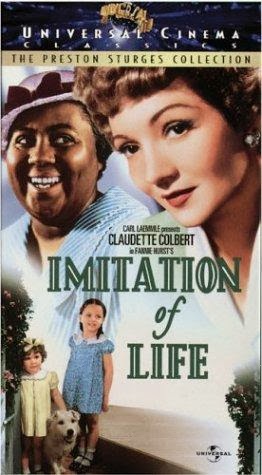
Over the summer, I had the sheer joy of spending some time with my cousin. If he and I were just longtime friends, I'd consider myself one of the luckiest guys in the world. The fact that we're related constantly has me sending up many, many prayers of gratitude. I'm doubly blessed. We stayed up very late one night at his house and watched a DVD of the 1934 Imitation of Life starring Claudette Colbert and Louise Beavers.
The celebrated 1959 Douglas Sirk remake starring Lana Turner and Juanita Moore as the mothers played by Colbert and Beavers seems to be more popular with today's audiences than the very fine original. That's probably because Sirk gave it a deluxe, melodramtic treatment with lush color, fabulous costumes by Jean Louis for Lana Turner, lurid situations, a glamorous stage career for Turner's character and a big memorable gospel number by the legendary Mahalia Jackson in the famous funeral scene.
My cousin and I talked about this after the movie. Both versions entertain us. We prefer the original because it stays on the racial drama more than the remake. Colbert becomes a food industry executive, a nationally successful businesswoman, in the original. Bea (Colbert) and Delilah (Beavers) are single working mothers raising their little girls. Bea and Delilah help each other. Delilah talks herself into a job as Bea's maid. Their little girls become friends. We learn that Peola's father was a very light-skinned black man.
Delilah's pancakes make Bea's diner business a big hit. Delilah is a good luck charm and her talent takes Bea to bigger success in the food business. Delilah becomes her famous corporate logo and is offered a percentage in Bea's lucrative business. The two single working mothers remain together and remain dear friends devoted to each other....
...both will be better off financially at the end than they were at the beginning....
...but there will always be that social barrier of race between them in their relationship.
One can move up in society while the other can only go so far with restricted freedom.
There's a different tone to the Douglas Sirk version.
With Lana Turner doing plays instead producing pancake mix, we focus on her theatrical mama drama trying to balance that career, motherhood, and her daughter's reckless mulatto best friend who's passing for white and breaking her poor black mother's heart.
My cousin and I have a lot of friends who prefer the remake to the original. When Mahalia Jackson sings, it makes them want to weep like the folks in church. I can totally understand that. The Great Mahalia was a force of nature. Her gospel singing could've made the men of Mount Rushmore shout "Amen!"
Here's the thing that they probably don't realize about the remake in comparison to the original: Susan Kohner as Sarah Jane, is a non-black actress who was playing a light-skinned black woman -- just like Jeanne Crain as Pinky and Ava Gardner in Show Boat. For her portrayal, Kohner was an Oscar nominee for Best Supporting Actress. Also nominated in that category was Juanita Moore as her mother. For Sirk's 1959 film, Moore made history as the fourth black actress ever to receive an Oscar nomination.
Susan Kohner went on to star in All the Fine Young Cannibals (1960) with Robert Wager, Natalie Wood and Louise Beavers, By Love Possessed (1961) with Lana Turner and Freud (1962)opposite Montgomery Clift as the wife of Sigmund Freud.
In the original Imitation of Life, Peola, the light-skinned black woman trying to pass for white, was played by Fredi Washington, herself a light-skinned black woman. The grown Peola is refined, stylish, conflicted and heartbreaking. She's at war with herself and society's racial exclusions. It was a bold, new image of a modern black American woman in a Hollywood film. If today we read that Fredi Washington was the first black actress nominated for the Oscar and Hattie McDaniel was the second, I would not be surprised. Look at the power, complexity, truth and charisma of her performance. It's got a quality that we'd come to associate with white actresses like Barbara Stanwyck.
Read her reviews from top publications in this 1934 trailer for the movie.
When I was in high school, I'd seen the 1959 version on local television. My mother told me about the original 1934 production and mentioned what a hit it was when she was a little girl growing up in New Jersey.Mom told me how her mother had loved seeing Imitation of Life in Manhattan. According to Mom, grandmother enthusiastically said "Black and white folks were crying during that funeral scene!" Mom told me to watch for the Claudette Colbert version. She added that I should know about actress Fredi Washington. I'm so glad my mother introduced me to the significance of the 1934 film.
Ms. Washington could not move on to other good roles in major Hollywood studio releases the way Susan Kohner did. Why? Because she was a black actress and Hollywood had not embraced racial diversity and equal opportunities then. Black women basically played maids, like Hattie McDaniel did in 1939's Gone With The Wind, the film that made her the first black person nominated for the Oscar and the first to win.
The second black person nominated for an Oscar was Ethel Waters. She was in the Best Supporting Actress category for playing the grandmother in 1949's race drama, Pinky.
Black actresses, on the whole, were not seen working upscale jobs in movies and wearing elegant, sophisticated outfits like Fredi Washington did in 1934's Imitation of Life.
Reportedly, Hollywood pleaded with Fredi Washington to pass for white so it could give her the kind of roles that went to Constance Bennett and Joan Crawford. Washington refused to deny her racial heritage. She went back to stage work in the New York theater and, later, became a Civil Rights activist. She was active with the NAACP.
So, while a bunch of my friends feel that 1959's Imitation of Life makes a bigger impact helped by the big voice of Mahalia Jackson, I feel that the stronger and more relevant comment on race in America comes in the 1934 original movie and in the behind-the-scenes story of its co-star, Fredi Washington.
In a way, actresses Fredi Washington and Susan Kohner were like Bea and Delilah in the first Imitation of Life. One could move up the Hollywood career ladder. The other could only go so far with restricted freedom. In the story, Bea could not have become wealthy without the cooking skill, the work and even the face of Delilah. But the world outside their Manhattan townhouse will not grant people like Delilah equal rights and privileges.
One note about the excellence of Louise Beavers as Delilah. She was just one year older than Fredi Washington when they played mother and grown daughter. Think of actors Beulah Bondi and Thomas Mitchell in my earlier blog post this month, "On Make Way For Tomorrow (1937)." It's another classic in which Louise Beavers performed.
As for the film's star, Claudette Colbert, 1934 was an excellent movie year for her. She starred in three films that were nominees for Best Picture. Imitation of Life was one.
She won the Best Actress Academy Award for the screwball comedy, It Happened One Night. Claudette Colbert's three movies nominated for Best Picture were: It Happened One Night (winner, Best Picture),Cecil B. DeMille's Cleopatra and Imitation of Life.