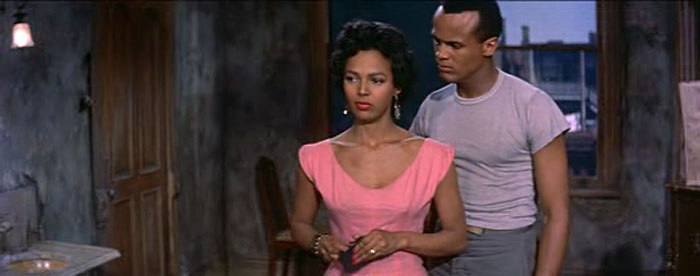
My mother and I were talking about the late and legendary black actress,
Dorothy Dandridge, yesterday. Mom and I started off talking about
Lena Horne. She had a place in our family history because Ms. Horne offered my mother a job as her assistant back in the 1980s when she was on tour with her hit one-woman Broadway show. I'll save that story for the book. Mom said, "Dorothy was a better actress." She was. And Dorothy worked in Hollywood studio films before Lena arrived on the scene.
If there's a career that crystallized the frustration of black performers in Hollywood at that time and also showed the utter stupidity of racial restrictions, it's the career of the beautiful and talented Dorothy Dandridge. She made history as the first black woman to be nominated for the Best Actress Academy Award. That year, the category had major buzz. Judy Garland was the favorite to win for her acclaimed comeback in the 1954 musical drama remake of
A Star Is Born. Grace Kelly was her major competition for dressing down in
The Country Girl as the wife of an alcoholic singer/actor attempting a Broadway comeback and Dandridge cracked the color barrier as
Carmen Jones. This was an all-black modern version of the Bizet opera,
Carmen, with Dorothy Dandridge as the doomed vamp. She sizzled in the role opposite Harry Belafonte.
Rent the DVD and see for yourself. Unlike Garland, she didn't do her own singing in this film. But her acting heats up the screen. Like Judy Garland, Dorothy Dandridge was a kid who did work on the MGM lot in the 1930s. She and her sister, Vivian, are in the "All God's Chillun Got Rhythm" musical number in 1937's
A Day at the Races starring the Marx Brothers. It's a good swing number with a great arrangement sung by the sublime Duke Ellington vocalist, Ivie Anderson. But visually it's pocked with stereotypical images of black people. Like other black actresses in Hollywood then, she went on to some uncredited roles as maids and jungle natives. But she did have her breakthroughs. In 1941, she did her own singing and dancing with the Nicholas Brothers. That was the slick "Chattanooga Choo Choo" number in 20th Century Fox's
Sun Valley Serenade.
Dorothy Dandridge would marry dancer Harold Nicholas. That same year,
Sundown came out. The World War 2 desert drama starred the glamourous Gene Tierney as a mysterious woman who travels to Kenya and will help fight the Nazis.
Tierney (in pics above) got the glamour treatment in desert attire. In the first five minutes of 1941's
Sundown, we see Dorothy in a small, sweet role as a shy African princess.
I wrote a blog piece on actress Lana Turner that I'll post later. It occurred to me that, had it not been for the Hollywood racial restrictions and inequality of the time, Dorothy Dandridge could have been just as juicy in some parts that Lana did. After her historic Oscar nomination for
Carmen Jones, she still had the same problems getting work. Why? Because there weren't lead roles in major Hollywood films for black actresses back then. 20th Century Fox released
Carmen Jones (1954)
and, reportedly, wanted her to follow that with a supporting role as an Asian slave in
The King and I (1956). The role eventually went to future Oscar-winner Rita Moreno. Dandridge starred in the film version of
Porgy and Bess, her other musical drama also directed by Otto Preminger. At that time in Hollywood, she wasn't permitted the interracial acting freedom that Whitney Huston had with Kevin Costner in
The Bodyguard or Beyoncé had in the comedies
Austin Powers: Goldmember and Steve Martin's 2006 remake of
The Pink Panther. Halle Berry, who played Dorothy Dandridge in a biopic for HBO and is the first black woman to win the Best Actress Academy Award, had the kind of film opportunities that Dandridge probably dreamed of having. Dandridge died young and broke in West Hollywood. Racism wasted a major talent. She never had the script opportunities that her buddies Ava Gardner and Marilyn Monroe did. Lena Horne called Dandridge "our Marilyn Monroe." Horne, even though she got groundbreaking glamour treatment onscreen in musical numbers during her MGM years of the 1940s, understood Dandridge's frustration. Horne was not allowed to act with the white performers (and friends) who were also MGM musical stars. Her numbers were separate. She could not interact and share screen time with Gene Kelly, Judy Garland and Frank Sinatra. She certainly couldn't take a short dip in the MGM pool with Esther Williams. Those were racial restrictions from studio hierarchy.


Dorothy Dandridge was a national magazine cover girl more than once.
Dandridge was the first black American female to grace the cover of
Life magazine.
There are three Lana Turner vehicles that, I feel, would have fit Dorothy Dandridge like a velvet glove had Hollywood been more racially enlightened. The first is a movie released the same year Dorothy danced with the Nicholas Brothers. It's the MGM drama with musical numbers,
Ziegfeld Girl. Judy Garland, Hedy Lamarr and Lana Turner star as three young ladies discovered by Broadway's Ziegfeld Follies. How will stardom change their lives? The highlight is Lana as the elevator operator from Brooklyn who goes up to the top floor of success then takes a glamorous nosedive as she hits the bottle and takes up with the wrong men. Lana Turner was in gorgeous decline going downstairs.
(By the way, in 1942, MGM hit a big hit with
White Cargo, the torrid tale of white British men on a rubber plantation in the Congo who fall for an African
femme fatale. The Congo temptress was played by Austrian Hedy Lamarr in "tropical" body make-up. Neither Dorothy Dandridge nor Lena Horne had a shot at the role.)
Dorothy Dandridge could've rocked that
Ziegfeld Girl role too.
One of Lana Turner's biggest MGM studio hits was one of the best of the 1940s
film noir productions. It's hot meat and murder when a young stranger played by John Garfield enters her diner in
The Postman Always Rings Twice. She's married to a sweet old guy but she desires a change -- in the business profits and in the bedroom.
Why couldn't Hollywood have a done an all-black version of it in the 1950s? In that decade, a lot of Hollywood classics were remade -- classics like
The Women, My Man Godfrey, It Happened One Night, The Major and the Minor, The Lady Eve, Nothing Sacred, Love Affair, Magnificent Obsession, Imitation of Life, Four Daughters and
A Star Is Born, to name a few. She could've been reteamed with Harry Belafonte.
The third is
The Bad and The Beautiful. Lana's the talented and troubled Hollywood outcast who hits the bottom, gets it together, pushes off and hits the top. We see how she become "the comeback kid" and started loving herself more than she loved liquor and the wrong men. Dorothy Dandridge would've looked fabulous in this role. And she could've brought some good inner rage to the surface for director Vincente Minnelli.
Hattie McDaniel made Oscar history as the first black actor to be nominated for an Oscar. She won Best Supporting Actress for 1939's
Gone With The Wind. Look at her career afterwards. You wouldn't know that she'd won a historic Academy Award by her billing in opening credits. She went on to play more maids. She was a versatile actress whose talent was under-utilized. John Huston's
In This Our Life and the World War 2 drama
Since You Went Away gave her a chance to do something different in modern-day domestic roles. The variety show comedy,
Thank Your Lucky Stars, was wartime entertainment packed with musical numbers showcasing stars on the Warner Bros. lot in the early 1940s. Top numbers featured Bette Davis, Ann Sheridan, Hattie McDaniel and Hattie McDaniel co-star, Olivia de Havilland. Recording and Broadway star Ethel Waters recreated her hit
Cabin in the Sky Broadway role in the MGM movie version. She introduced a new song written for the film. "Happiness Is Just a Thing Called Joe" was an Oscar nominee for Best Song. After that 1943 hit MGM musical, the first film directed by Vincente Minnelli, Hollywood didn't have another role for Ethel Waters until 1949. For her dramatic performance as the maid grandmother in the race drama
Pinky, Ethel Waters became the second black person nominated for an Academy Award. She was in the Best Supporting Actress category. The third black performer nominated was Dorothy Dandridge. After her nomination for Best Actress of 1954, she didn't have a film until 1957's
Island in the Sun. Set in the Caribbean and involving modern-day race relations, it's an ensemble piece. Joan Fontaine, James Mason and Joan Collins starred. Dandridge was reunited with Harry Belafonte as a handsome young Caribbean doctor.
She had pitifully little film work after her Oscar nomination for
Carmen Jones. Her last big film was Otto Preminger's
Porgy and Bess in 1959. She was Bess. Again, her operatic singing voice was dubbed. Sidney Poitier as Porgy was also dubbed musically. Metropolitan opera star Robert McFerrin, father of singer Bobby McFerrin, dubbed Poitier's singing voice. Pearl Bailey, Brock Peters and Sammy Davis, Jr. co-starred.
Again, Dorothy may not have done her own singing (even though she could sing), but her dramatic power, charisma and her beauty were still evident. Hollywood was not ready for the likes of her. She died at age 42 in 1965. Said Dandridge: "
Carmen Jones was the best break I've ever had. But no producer knocked on my door. There just aren't that many parts for a black actress."
See her fierce and fabulous performance as
Carmen Jones. You'll be stunned that she had so few Hollywood film opportunities after it. Racism in the arts benefits no one.
Watch for my blog piece on Lana Turner in
The Bad and The Beautiful.