Saturday, April 27, 2013

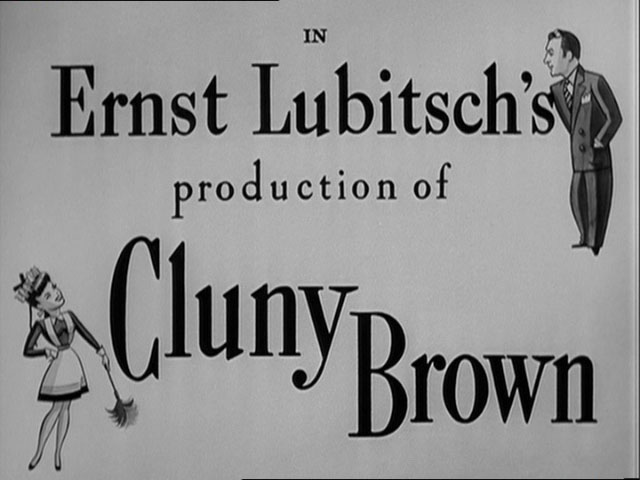
On CLUNY BROWN (1946)

Saintly.  Sexy.  Jennifer Jones was a natural beauty and a versatile actress.  Few Hollywood stars could switch as easily and effectively from virgin to vamp as she did.
Her first of five Academy Award nominations came for playing the French peasant girl who would be canonized as St. Bernadette of Lourdes.  Jennifer Jones won the Best Actress Oscar for her luminous and skillful work in The Song of Bernadette.
Her ephemeral loveliness was an asset again when she played a good girl who travels through time to help an artist in the surreal love story, Portrait of Jennie.
Then she could turn the coin over and get another Oscar nomination for playing the sexy half-breed seeking revenge on the gunslinger who lead her sexually astray.  Duel in the Sun was so chock full o' frontier passion that it was nicknamed Lust in the Dust.


That aspect of the Jennifer Jones roles fascinated me.  She could be so virginal in Since You Went Away, Love Letters and as the inspirational small town schoolteacher in Good Morning, Miss Dove.  Then she could sizzle and bring male hormones to a boil as Madame Bovary, Ruby Gentry and in Gone to Earth.

All those movies were dramas.  She rarely did comedies.  Her first comedy was her best thanks to one of the masters, director Ernst Lubitsch.  Long before Jane Withers became popular in a series of national TV commercials as "Josephine the Plumber," Jennifer Jones played a delightful British girl who could unclog your pipes in a jiffy.  Plumbing was her passion. Her day job was working as a parlor maid.  Her name was Cluny Brown.

When we first meet this perky and pretty young lady from London's lower class, she's wearing a silly and cheerful little hat.  A middle-aged man needs his pipe unclogged.  There's someone at his door.  He opens it.  We see Cluny.  She's a babe.  She says, "Well...shall we have a go at it?"  He doesn't realize she's a plumber.  As the gentleman visiting him says, "You see, she's not dressed for plumbing.  But what woman is?"  If I had to name my Top 5 favorite performances by Jennifer Jones, Cluny Brown would be in the list.  If I had to name my Top 5 favorite performances by Charles Boyer, Cluny Brown would be in the list.  He makes me laugh out loud with this performance as the visitor.

This Lubitsch comedy doesn't get a lot of attention like Trouble in Paradise, The Merry Widow, The Shop Around the Corner, Ninotchka and To Be or Not To Be but you should give it a chance.  I have loved this one for years.  For me, it's truly a "feel-good" movie. In fact, I had a rough day this week.  That night I watched Cluny Brown and laughed myself out of a funk.  That was not the first time this has been my go-to feel-good classic movie.  This movie lets Jennifer Jones have fun and get laughs playing both sides of that coin I mentioned.  Cluny is a good girl.  She has the purity of a saint yet she's also naturally sexy.  A cocktail makes her kittenish.  But she doesn't know where she belongs.  Where would you put a gorgeous girl who wants to bang on your pipes?  Cluny reviews the situation and prepares to practice her passion in the kitchen.  She's a friendly free spirit.

When she's under the sink. we learn what this Lubitsch comedy is about.  It's about social class and one's place in society.  The story starts in London, June 1938.  Adam Belinski (Charles Boyer) has managed to flee safely to England.  Hitler hates this writer.  But Hitler hates many people.  While the Londoners fret about the social politics of cocktail parties and teas, Adam knows such class divisions are silly when one considers that Hitler is gobbling up Europe and war is inevitable.  Cluny's wonderful spirit is confused and blocked by social restrictions.  "Cluny Brown, you don't know your place," she's told.  Mr. Belinski, fascinated by her talent for plumbing, feels that what's she been told is utter nonsense.  Her tells her, "Wherever you're happy, that's your place."

She's still under the sink.  But she's fascinated by his philosophy which is summed up in four words:  "Squirrels to the nuts."  Cluny has a cocktail with the two gents.  When her humorless uncle arrives to take her home, he sees how giddy spirits have made her.  She's purring.  He's shocked.
 Cluny's uncle sends her to Friars Carmel Manor in the country to work as a maid.  Gentle Lady Alice and kind Sir Henry mistake Cluny for a friend of the Colonel's.  There, a few years before Brits and Americans unite to rid the world of a global menace and fight for democracy, poor clueless Cluny learns the hard way that it's a major social blunder for the lower class and the upper class to have a cup of tea together.


Who winds up being invited to the manor as a weekend guest?  Mr. Belinksi.  Of course, he's going to fall in love with Cluny.  He keeps her from being fired as a maid. She's still trying to find her place.  She figures the best she can do is perhaps have her place determined by marriage.  She's courted by a most pompous local pharmacist played by Richard Haydn.  The actor is instantly recognizable from Ball of Fire, Please Don't Eat the Daisies and The Sound of Music.  The pharmacist lives with his mother.

Belinski can't stand him.  He's got to deal with this snob and with upper class Brits who, nice as they are, just don't seem to get it.  Do you have upscale liberal friends whose idea of active social involvement against the ills and injustices of society around them is posting a devastating essay they read in Sunday's New York Times onto their Facebook or Twitter pages before they go to brunch?  Then you'll understand how Belinski feels.

If you're a classic film fan, you've heard of "the Lubitsch touch."  Billy Wilder talked about it and idolized the director for it.  Is that touch evident in Cluny Brown?  Yes.  The two senior members of the Friars Carmel Manor domestic staff are the biggest snobs on the whole estate.  Those two older servants, who shudder at the thought of ever being spoken to as equals, are fabulous in their domestic smugness.  Another great touch is the 65 year-old mother of the pharmacist.  She has not one word of dialogue and gets laughs.  Stone-faced Mrs. Wilson just loudly clears her throat in every single scene.  She's practically a human rattle.  Lubitsch lets us imagine what she's thinking and not saying.  It's a wonderful touch.  So is the Fifth Avenue bookstore window sequence.  Not a word is heard and it's like a champagne cocktail.

One of my other favorite scenes that kills me every time is when Adam Belinski tries to reason with the  selfish and shapely Betty Cream.

She's already in bed when he enters her room to beg her to be more democratic in her treatment of people.  He comments on her hair and shoulders.  It's the expression on Boyer's face when his eyes land on her knockers that knocks me out every time.  He had a versatility too and it's often overlooked. He could effectively play the dangerous lover with a darkness in his soul -- like the carnival barker Liliom directed by Fritz Lang (the story later musicalized by Rodgers & Hammerstein and called Carousel)...


...and the abusive husband driving his wife mad in Gaslight with Ingrid Bergman.

He could also play tender lovers like in The Garden of Allah with Marlene Dietrich...

...and the twice-remade but never surpassed Love Affair with Irene Dunne.

Boyer was also a pro at comedy and Cluny Brown is one of his best.  It seems like he had such a ball making this movie.  He gives an absolutely bright sophisticated comedy performance as a clever, quick-minded gentleman whose philosophy is still relevant today.  Charles Boyer is just too cool.  Jennifer Jones is delicious.  So check out this Lubitsch comedy and remember what Mr. Bielinski said:  "Squirrels to the nuts."


Friday, April 26, 2013

The Real FORREST GUMP

Late one night this week, one of the HBO channels aired Forrest Gump, the film that brought Tom Hanks his second consecutive Oscar for Best Actor.  This touching story of a sweet, gentle Southern  man and his adventures as he often runs down the road of life was a huge box office hit.  People quoted lines from the movie.  The most famous line quoted from the film is "Life is like a box of chocolates.  You never know what you're going to get."

I was introduced to Forrest Gump by a WNBC TV local news camera crew member in the spring of 1994.  I was a regular on Weekend TODAY in New York and did liveshots in the field every weekend covering events and places perfect for family entertainment.  When we were in the van headed back to the station after a show, the audio guy was just giggling and guffawing at the book he was reading.  I asked him what he was reading.  The paperback, which he bought at a yard sale for 50 cents, was Forrest Gump, a novel by Winston Groom.  I'd read in Premiere Magazine that Tom Hanks had completed a film version of it.  Because the book got so many belly laughs from my co-worker, I checked it out from my local New York library.  I laughed too.  A lot.  I read the book within a week.  Forrest had many wild and memorable adventures in his life -- episodes from being a college football star and a wrestler, to being a soldier in Vietnam, an astronaut, working on a boat, and even bumbles through acting in a low-budget science-fiction movie in Hollywood with a cranky starlet named Raquel Welch.

It was a slightly cynical yet fun and very funny American story that followed this big, blond hunk of muscle.  Yes, you read that correctly.  In the novel, Forrest has a crew cut and looks more like this...

....like wrestler-turned-action movie star, John Cena.

This poor Southerner is not the brightest bulb on the front porch, but he has all those amazing episodes in his life because is an idiot savant.  Says Forrest in the book, "Bein' an idiot is no box o' chocolates."  People want him.  His mother is a whiny, clinging old bat who always wants him to do things for her.  His girlfriend, Jenny, likes to roll around with him a lot when he's naked and he can't really figure out why.  We readers know why.  To quote a Woody Allen movie, Forrest Gump is "hung like a loaf of French bread."

So...when I soon heard there were screenings of Forrest Gump for film reviewers and entertainment correspondents...I definitely made a reservation.  I'm a hardcore Tom Hanks fan.  I have been for years.  I just had to see how he was going to play a 6' 6" Southern muscle hunk with a low IQ and a big johnson.  Well, he didn't.  Screenwriter Eric Roth kept the main characters and many of the episodes while he flipped the tale from daffy cynical satire to sentimental love story.  Hanks was a not the same Forrest in the book.  He was a variation.  There was even a variation on the chocolates line.


Mama Gump was changed from an old biddy to a strong woman who was the most devoted, unselfish movie mother since Barbara Stanwyck as Stella Dallas.  No one can play a strong Southern woman like that native born Southern Californian, Sally Field.  She gave us tender scenes as Mrs. Gump, the single mother who gives Forrest his spirit.


Jenny becomes a poignant character in the movie.  There's more intimacy than lust.


If I had another talk show right now in New York City, I'd love to have author Winston Groom on as a guest.  He didn't write or co-write the screenplay adaptation of his novel.  Eric Roth did it alone and won an Oscar for his work.  (Years later, he pretty much rewrote his Forrest Gump screenplay and called it The Curious Case of Benjamin Button starring Brad Pitt).

This was the very fitting cover illustration for Winston Groom's 1986 novel.

The movie took Oscars for Best Actor, Best Director (Robert Zemeckis), Best Screenplay Adaptation and Best Picture of 1994.  Because the movie was such a colossal hit at the box office, paperback editions were selling well at top bookstores.  I lived a block away from a Barnes & Noble and saw folks pick up the book for purchase simply because they'd just seen the movie.  The paperback version got this new cover.

I often wondered how those folks felt after they read the book and discovered the night-and-day differences in the source material and what they'd seen on the screen.  With that paperback edition a best-seller because of the Tom Hanks movie, I'm sure Winston Groom pocketed a few extra royalty checks.  I sure hope he got a piece of the movie action.  But how did he feel when the screenplay removed a lot of the spice in his story and replaced it with sugar?  Or did he really care as he went to the bank...again?  I would totally dig doing an interview with Winston Groom.

And I loved the chapter with Raquel Welch.

Thursday, April 25, 2013

FUNNY GIRL and Me

The TCM Classic Film Festival kicks off later in Hollywood with the deluxe premiere of a restored classic.  A touched up Funny Girl starring Barbra Streisand hits the big screen this evening.  I wish I could be there.  Funny Girl -- one of my favorite movie musicals.
I'm a SoCal guy.  I was born and raised in Southern California.  A child of the '60s, I grew up in South Central Los Angeles.  And I loved it.  New York City had Broadway.  We had Hollywood.  For us, going to see major motion pictures was our Los Angeleno version of going to see a Broadway show.  When a big movie like My Fair Lady or Camelot played, you had to purchase reserved seats just like theatergoers do when seeing a Broadway show.  You could send in your requests to the movie theater via the mail but you always had to mark down a alternate date in case you first choice was sold out.  Those big movies would play at one theater in Hollywood for an exclusive engagement before opening wide at a local theater or drive-in near you.  I think My Fair Lady was such a hit that it played exclusively at the same theater for almost two years.  Now you can see it on TCM every other month.

I had Barbra Streisand's first albums.  I'd used my allowance to buy them when my parents went family shopping in Baldwin Hills at a store called FedCo.  I'd do my chores and homework so they would let me stay up and watch the early Barbra Streisand specials on CBS.

The first solo reserved seat I ever had to a movie was the one I had to see Funny Girl during its exclusive engagement in Hollywood.  I felt like I'd died and gone to heaven watching this new movie on a big screen in a Hollywood movie palace.  The theater was beautiful and clean.  The audience was packed.  There was an overture.  I was seated in a section called "Mezzanine."  I had a great view.


I saw Funny Girl at the Egyptian Theater in Hollywood. Mom drove me.


For one brief moment, I thought I'd see Funny Girl and lose my virginity the same evening.  That is, if I even knew how to lose my virginity.  Before I tell you what happened in the mezzanine, I have to reveal this to you honestly.  Early in my high school years -- well, pretty much all during my high school years -- I was a combination of these two sitcom kids:

The always positive but clueless Sue Heck on ABC's The Middle....

and the insecure, lactose intolerant Jordan on The Bernie Mac Show.


Like Jordan, I went to Catholic school.  Being in Catholic school, we really didn't hear dirty words.  We were in a Catholic cocoon.  We wouldn't know dirty words if we heard them.  We were too busy dealing with socially acceptable words we didn't even understand.  "Thou shalt not covet thy neighbor's wife."  Covet?  What's covet mean?  Did Sister St. Paul misspell that word when she wrote the 10 Commandments on the chalkboard?  Did she mean "cover"?  Thou shalt not cover thy neighbor's wife?  Naughty words relative to body parts or sexual recreation were alien to us.  I didn't hear some such words until I transferred to public school for the 4th to 6th grades.

I still recall how Dad dropped his fork onto his plate in shock one weekday evening during supper when I innocently said, "Daddy...what does 'titties' mean?  Is that like your navel?"  I was a new kid at public school.  The next evening, after Dad had given me a good talking to, I was so silent at the dinner table that I could've booked a role in Children of a Lesser God.

Dad took me with him to see Goldfinger.  James Bond was awesome.  But, when we were in the car driving home and I asked "Why did some people start laughing when the lady said her name was 'Pussy Galore'?," He said "I don't know" and "Don't ask me that anymore.  And don't ask your mother."

I still had no understanding of slang or "street-and-fence" words I heard.  Or ones I saw in some of Dad's paperback copies of Harold Robbins novels.

I had suggested a family outing.  "Why don't we all go see Funny Girl?"  Dad didn't want to be any part of that conversation.  My little sister just watched this whole interaction like it was performance art. Mom was the negotiator.  If I did my chores and homework, I could get a ticket to see the movie alone.  She would drive me to the Egyptian, go do some shopping and then pick me up when the movie was over.

I think, at that moment, Dad looked away and saw his dreams of being a grandfather roll away like a tumblewood on a deserted dirt road in a TV western.  Also, before I saw the film, I owned and had played the Funny Girl soundtrack so many times that I could lip sync every single cut on the album.  Perfectly.

The movie was thrilling.  Even better than the soundtrack.  I fell in love with Barbra Streisand.

OK, I admit it.  I fell in love with Omar Sharif too.

There was a college coed seated next to me on my right.  She let me look at her souvenir program during the overture and she smiled at me a lot.  She wore the kind of dress you'd have seen Dusty Springfield wear on American Bandstand.  It was a one-piece mini.  She was brunette and had a build that, decades later when I lived in New York, I would hear people call "zaftig."

For my early teen category, I'm pretty sure I'd integrated the audience for that showing.  Not that there was any segregation, mind you.  When I was in my seat I looked over the railing to spot any other black folks.  I saw an middle-aged couple like Mom and Dad.  No black kids my age down there or up in the mezzanine.  There was one big showshopper song we all waited for. An anthem of determination and a shout-down to people trying to block your path.  As soon as Barbra as Fanny Brice musically declared "Don't," you felt that entire audience collectively inhale with a community "Here it is!" feeling.  It was the "Don't Rain On My Parade" number....brilliantly shot, edited, orchestrated and sung.


Yes. I was the only young black kid seated alone at that showing of Funny Girl.  And I was the one who started applauding enthusiastically after La Streisand finished her final note in the song, leaving us to hear a few chugs of the tugboat before the screen read Intermission.

The coed next to me (she'd told me she was in college), said "You really liked it."  I replied, "Oh, yes!"  Then she sort of confidentially whispered, "A lot of my friends tell me I look like her."  I remember thinking Wow.  You kind of look more like Lainie Kazan but I politely said "That's cool!"

She had a little paper bag smack dab on her lap. Her hands were on her lap holding that little paper bag.   Then, with a low voice that I found to be kind of sexy, she looked at me and said, "Would you like some of my......marzipan?"

I'd never heard of marzipan.  But, the way she looked at me and the way she looked down at her lap when making the offer, I was positive that "marzipan" was Caucasian street talk for either "vagina" or "sexual intercourse."

I was confused.  I had no idea what to do.  I still had my ticket stub.  If we did leave so I could lose my innocence, could we be done before my mother came to pick me up?  More importantly, could it wait until after Barbra Streisand sang "My Man"?

I decided that watching the second half of Funny Girl was far more important than losing my virginity.  Shyly I answered, "No, thank you."

Then she reached into that sack, took a handful of its candy contents and popped it in her mouth.  Her mouth was full when she said, "I just love marzipan."

What an experience at the Egyptian Theater.  My first reserved seat at a Hollywood movie.  I led the entire mezzanine section in wild applause at the end of the "Don't Rain On My Parade Number."  And I learned that marzipan does not mean nookie.  Wow.  Knowledge is power.  And the movie experience was not over.
The "My Man" number made the coed cry.  She'd eaten all her marzipan.  We all had a great time at the movie.  I did have fun sitting next to her.  I beat Mom's eardrums as I gushed about Funny Girl all the way from Hollywood back home to Central Avenue.  In fact, I raved about it so much that, one Saturday, my mother and a friend from work went to see it.

When she got back home, Mom looked me, smiled and said "Honey, that girl can sang."  She loved it.

I bet tonight's Hollywood audience will break out into wild applause too.  One day, I actually want to see Funny Girl while having some marzipan.  Just for the heck of it.

Colman Domingo in RUSTIN

In the first ten minutes of Steven Spielberg's LINCOLN, we see Daniel Day-Lewis as Abraham Lincoln talking to two Black soldiers on a Ci...