Tuesday, November 16, 2021

Petula Clark Music Break

 What does singer/actress Petula Clark have in common with Ginger Rogers, Rita Hayworth, Audrey Hepburn and Cyd Charisse? She got to dance in a movie with Fred Astaire. As she told me on camera one morning on Fox 5's GOOD DAY NEW YORK when I had the great joy of meeting her, "I wasn't very good at it." I replied, "But you did it!" Petula Clark celebrated her 89th birthday this week. Now some of us who purchased her hit 45s of "Downtown," "Don't Sleep in the Subway," and "A Sign of the Times" when we were kids may find that impossible. However, in our baby boomer youth, we didn't know that Petula Clark, like Julie Andrews, had been a child entertainer in Great Britain during World War 2 and started acting in British movies in 1944. By the time she became a top pop star here in the U.S., she was already a veteran performer. I was then and still am a Petula Clark fan.


 My sister and I had a great Saturday afternoon at the movies when we were youngsters seeing Petula Clark and Peter O'Toole in the 1969 musical remake of 1939's GOODBYE, MR. CHIPS. Critics may have been lukewarm to the film, but I loved it. I loved the original song by Leslie Bricusse. I loved Petula Clark taking on the role previously done by Greer Garson. For Clark, as the woman who falls in love with and weds the shy British schoolteacher, the character was changed. In 1969, she was a popular music hall entertainer who liked to party. Ultimately, she finds some of those posh parties rather hollow but she finds happiness and fulfillment in the company of Mr. Chips, as she calls him. Bricusse passed away this year in October. He wrote some fabulous tunes for Pet to sing in the movie. "You and I," sung when Katherine (Clark) is now Mrs. Chipping, went on to become a favorite with jazz vocalists. Here it is, introduced by Petula Clark on the movie soundtrack.

Another original tune I love from the move is one Clark performs as the music hall star. In a clip from GOODBYE, MR. CHIPS, here is the rousing "London Is London."


Petula Clark and Fred Astaire played father and daughter in 1968's FINIAN'S RAINBOW. In this musical fantasy that takes on a social issue, they're two people from Ireland searching for a pot of gold in America. They go down South. There's a leprechaun involved. This was based on a Broadway hit that was pretty radical in 1947 when it opened. It tackled racial prejudice by having a bigoted White senator being turned Black to know how racial inequality feels. But, by the time FINIAN'S RAINBOW was adapted for the big screen by Warner Bros., America had gone through peak triumphs and turbulence of the 1960's Civil Rights Movement. Also it had seen popular movies dealing with racism, dealing with it in a way that won them Academy Awards. Those two hits films were IN THE HEAT OF THE NIGHT (1967) and GUESS WHO'S COMING TO DINNER (1967). Both starred Sidney Poitier and Beah Richards. When FINIAN'S RAINBOW arrived on screens, the material seemed a bit dated. Nevertheless Fred Astaire and Petula Clark had some magical musical moments. 

This is my favorite Petula Clark number. I totally dig the Brazilian jazz flavor given to the lush arrangement. With singer/actor Don Francks, here is "Old Devil Moon" from FINIAN'S RAINBOW.


I hope you enjoyed my Petula Clark music break.

Monday, November 15, 2021

William Holden and Ginger Rogers

 A buddy and I were once talking about William Holden and he said, "William Holden owned the 1950s." I agreed. And Holden did pretty well in the 1960s too. If my boyhood, if Mom and Dad saw that a William Holden movie playing at one of the three drive-in theaters we frequented, we went to see. They didn't care what the movie was about and they didn't care if the reviews for it happened to be lukewarm. William Holden was reason enough to go to the movies. He worked steadily and did good work through the 1940s, but nothing really made the good actor a big star. Then came 1950. He was the leading man in Billy Wilder's masterpiece, SUNSET BLVD and BORN YESTERDAY, the film that brought Judy Holliday the Best Actress Oscar. Billy Wilder's 1953 prisoner of war drama, STALAG 17, would land Holden the Oscar for Best Actor. More hit films were to come. Yes, Holden owned the 1950s.

More than any other Hollywood actor, William Holden had the right stuff and intellectual vibe to play a writer. Look at his performances as writers in SUNSET BLVD, BORN YESTERDAY, LOVE IS A MANY-SPLENDORED THING and PARIS WHEN IT SIZZLES. As a Broadway director, he knew good playwriting in THE COUNTRY GIRL. Add to that list 1953's FOREVER FEMALE. This light, sophisticated comedy has William Holden as an aspiring Broadway playwright who works in a Greenwich Village food market to pay the rent. His blunt but likable character, Stanley Krown, has written a play that interests a Broadway producer, played by Paul Douglas, who wants to produce it for a top Broadway star, played by Ginger Rogers. The producer is the star's ex-husband. He's still in love with her and gets jealous when a romance blossoms between her and the young playwright.


Beatrice Page (Rogers) currently stars as a 29-year old woman in a sophisticated comedy. Critics called her "radiant" but found the play mediocre. Beatrice is definitely middle-aged. Stanley's play is a good one, a mother and daughter drama. Bea, still a bit sensitive about playing older women even though she is one -- like ALL ABOUT EVE's Margo Channing -- asks for rewrites to make the mother younger.


In comes a pert but annoying young actress who's determined to be cast as the daughter in the production. She's played by Pat Crowley. Crowley became popular in the mid 1960s as the mom on the TV sitcom version of PLEASE DON'T EAT THE DAISIES.


When Stanley and Bea happen to meet at Sardi's after her opening night, he honestly tells her that he didn't like the play. "The greatest quality an actress can have is humility," says Stanley. He felt Bea lacked humility. She was charming, but she knew she was charming. Harry, the producer, is present at the table for this. Bea takes it well. Harry takes a copy of the play Stanley wrote. 


Although they've been divorced for so long that Harry owes Bea $11,000 in back alimony, they're still friends and they work together. We know from the beginning that she and Harry continue to have romantic feelings for each other even though she gets engaged to Stanley. Meanwhile, can the young playwright get his work onstage in his original vision? Will Bea commit to the mother role? Will Sally dial it down and learn how to be charming? Will the producer have a hit Broadway show thanks to Stanley's play? Will Stanley marry Bea?

Irving Rapper -- who guided Bette Davis through NOW, VOYAGER and THE CORN IS GREEN -- directed FOREVER FEMALE. Billy Wilder could've done it better, probably, but the three veteran stars keep it afloat. Billy Wilder, by the way, directed Ginger Rogers in one of her screwball comedy winners -- 1942's THE MAJOR AND THE MINOR from Paramount Pictures. This followed her landmark original screen musicals of the 1930s with Fred Astaire and her Best Actress Oscar win for the 1940 feminist drama, KITTY FOYLE.  Pat Crowley as Sally in FOREVER FEMALE is so obnoxious and overacts with such force that you often find yourself waiting for Sally's scenes to end. But there's a reason for  her tiring performance. The three stars know how to underplay a scene to perfection and that neutralizes Sally's hyperactivity. 

FOREVER FEMALE is movie Mom introduced me to when I was a kid. It was on TV one lazy, sweet Saturday night when our family was at home together and relaxing. Mom wanted to see it. She loved Ginger Rogers' performance as the Broadway star trying to adjust to her age. Rogers does indeed have the poise, carriage and elegance of a beloved Broadway star. 1953's FOREVER FEMALE is a movie that Ginger Rogers fans should see as a companion piece to her 1937 classic, STAGE DOOR.  In that one, Ginger gave one of her best film performances as the wisecracking Broadway hopeful living in a New York City boardinghouse for actresses.

It was kind o' cool to see Rogers and Holden as sweethearts. FOREVER FEMALE was a Paramount release and runs about 95 minutes.


Sunday, November 14, 2021

Kidman as Lucy Ricardo

 People had no problem with her wearing a fake nose and playing novelist Virginia Woolf. But, man, did people on Twitter get the knickers in a twist when they that Best Actress Oscar winner Nicole Kidman had been cast to play Lucille Ball when Ball achieved superstar status for being Lucy Ricardo on I LOVE LUCY. Kidman won her Oscar for playing Virginia Woolf in THE HOURS (2002). The tall actress will be seen opposite the equally tall fellow Oscar winner, Javier Bardem, as Desi Arnaz. This upcoming film, called BEING THE RICARDOS, comes to us from Aaron Sorkin, the man who gave us THE WEST WING. The story reportedly covers one week during an I LOVE LUCY filming, a week in which Ball and Arnaz face a career and a marital crisis. Their children, Lucie Arnaz and Desi Arnaz, Jr., are two of the show's producers. Although Kidman will do scenes as Ball playing Lucy Ricardo, Lucie Arnaz has told fans that this film is not a recreation of her parents' classic sitcom, it's about her parents as the real-life married couple offscreen. Here's a trailer.


This won't be the first time we've seen a production about the stormy but productive marriage of Lucille Ball and Desi Arnaz. Frances Fisher had a supporting role in Clint Eastwood's UNFORGIVEN, Oscar winner for Best Picture of 1992. After that she had a supporting role in TITANIC, Oscar winner for Best Picture of 1997. Before those movie assignments, Frances Fisher played Lucille Ball in the 1991 CBS presentation, LUCY & DESI: BEFORE THE LAUGHTER. Desi was played by Maurice Bernard. Here's something I found on YouTube.


Aaron Sorkin's BEING THE RICARDOS opens theatrically on December 10th. It arrives on Amazon Prime Video on December 21st.

Saturday, November 13, 2021

Ruth Negga in PASSING

She delivers a powerful performance in another film about race in America. The first one, 2016's LOVING, was about Richard and Mildred Loving. The couple, married in the 1950s, was jailed. Jailed for being married. He was White, she was Black and interracial marriage was illegal in some United States. They took legal action and took their case to the Supreme Court. In 1967, Loving v. Virginia won. The Supreme Court ruled that interracial marriage was legal all across America. For her work as Mildred Loving, Ruth Negga earned an Oscar nomination for Best Actress. Now Ruth Negga stars in PASSING, based on the acclaimed 1920s novel by Harlem Renaissance writer, Nella Larsen. The practice of light-skinned Black people pretending to be White was called passing. 

"Don't you know me?," Clare says when she approaches another woman seated in the classy hotel restaurant on a hot day in New York. The other woman, also very well-dressed, gives off an air of nervousness. She seems to be hiding her eyes with the brim of her delicate hat. We'll learn that she was nervous because she's Black. She doesn't make it a practice of passing but she can pass. She is seated in a place where Black people would not be welcomed. Clare, as it turns out, recognizes her friend whom she has not seen in 12 years. Nervous Irene had seen Clare being physically affectionate with a tall, handsome White men who left. Clare has made passing a ritual in her life. That man was her husband. He has no idea about the truth of her. He uses a racial slur in her presence. Irene has a Black husband, a doctor, and they live in Harlem with their two kids.

The point of passing is to have privilege, safety, equal opportunities and access. With her light skin and light hair, Clare can stay in a nice hotel room and order room service. An obviously Black person would not be allowed to stay in the hotel.

To pass, there must be separation to go hand-in-hand with the deception. And it can bring about jealousy. However, at some point, the person passing will long to go home. There will be a failing of Whiteness. Clare insinuates herself into Irene's Harlem life. Clare is jealous. Clare is bothered. But she allows it as she reflects "We're all of us passing for something or other. Aren't we?" 

Lovely and charismatic Clare seems to treat her passing as if it's a game she's winning while she describes her life as "pale." What will happen if the truth of things comes out? The performance from Ruth Negga as Clare is not the only terrific one in this film. The same praise goes to Tessa Thompson as the complicated, uneasy, middle class Irene and Andre Holland as Irene's wise husband. PASSING, now on Netflix, marks the directorial debut of actress Rebecca Hall. She also wrote the screenplay. Brava to Rebecca Hall for this amazing directorial debut. She gives us an elegant, potent film. Here's a trailer.


We've seen Black characters who are passing or who can pass in classic Hollywood films. There was the singer Julie LaVerne character in the 1936 and 1951 versions of SHOW BOAT, there was the light-skinned daughter of the Black maid in the 1934 and 1959 versions of IMITATION OF LIFE and there was the light-skinned nursing school graduate called PINKY (1949). Most of those films had a White actress playing the light-skinned Black woman. Only the original version of IMITATION OF LIFE (1934) had a real light-skinned Black actress playing the daughter who was passing. Fredi Washington was the actress and she gave an Oscar-nomination worthy performance. Ironically, Hollywood executives told Washington that if she pretended to be White, they could make her a glamorous 1930s movie star like Joan Crawford. She refused to deny her race and Hollywood had little work for her after 1934's IMITATION OF LIFE. 

Fredi Washington returned to New York City and did stage work.

PASSING, on Netflix, runs 1 hour 38 minutes. Netflix also has Ruth Negga in LOVING,

Friday, November 12, 2021

From Director James Whale

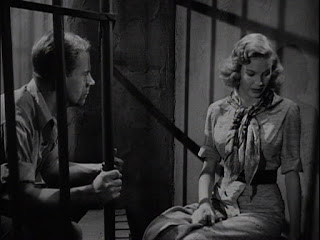
 For the most part, it's a two-character drama. If you're a fan of the classic 1930s work of director James Whale, the visuals of this short drama tell you it's another film from Whale. The expressionistic camera style. The striking play of light, darkness, shadow and lines in the black and white cinematographer. They call to mind images from his groundbreaking classics of the 1930s -- FRANKENSTEIN (1931), THE INVISIBLE MAN (1933) and BRIDE OF FRANKENSTEIN (1935). This 1949 short feature was the last film directed by James Whale. Just like those three horror movies he made, this non-horror drama features an outcast male figure who is hunted down by a predominantly male group of men. Whale's 1949 short film is HELLO OUT THERE! Based on a one-act play by William Saroyan and produced by millionaire Huntington Hartford, it gives actor Harry Morgan one of his rare film opportunities to have the lead role. He plays a gambler, a man behind bars in a Texas jail, a man "trying to break his bad luck." He's an intense, lonesome character who reveals "I've been lonesome all my life."


The story opens with the gambler yelling the title of the film. He's alone. A voice answers him. That voice comes from Ethel, the jail cook. She comes to the cell and tells him that he was knocked out and jailed. "They claim you tried to attack a woman," she tells him. His anger flares up and he tells her he never attacked a woman, They emotionally connect. Her loveliness, innocence and compassion touch his heart. He wishes they could run away together to San Francisco. He urges her not to stay in that small Texas town and settle into its conformity.

This was not a big budget production but it made good use of every penny in the budget it did have. It's a visually handsome production. Reportedly, it was shot in Hollywood at the KTTV television studios. Those were the Channel 11 call letters. It's now FOX 11 Los Angeles. Morgan bellows most of his dialogue as if he's onstage. However, this vehicle did come from a one-act play. He can be forgiven on that point because he gives a solid performance in a rare lead role. On television, he went on to a lead role as Pete in the early 1960s sitcom, PETE AND GLADYS. That sitcom followed his supporting role as a cop on the very popular DRAGNET. Years later came M*A*S*H* which really made Morgan a beloved TV sitcom actor. 

With his Everyman face and low, warm and recognizable voice, Harry Morgan was an excellent supporting actor in fine films such as STATE FAIR (1945), FROM THIS DAY FORWARD with Joan Fontaine, THE OX-BOW INCIDENT with Henry Fonda, HIGH NOON, THE GLENN MILLER STORY with James Stewart and INHERIT THE WIND with Spencer Tracy and Fredric March. James Whale put Morgan in the top role and you wish the actor had been given a similar opportunity in other films of the 1940s.

His 1930s horror classics made James Whale famous. However, he did work outside that genre keeping some of his classic monster movie sensibilities. To me, his 1936 adaptation of SHOW BOAT, based on the famous Broadway musical, is better than the deluxe 1951 remake from MGM. The racism and racial inequality that are a forceful undercurrent in the SHOW BOAT story are diluted somewhat in the MGM remake. It is unavoidable in Whale's version which stars Irene Dunne, Paul Robeson and Hattie McDaniel. Under Whale's direction, racism against Black people is the monster.

Whale, who died in 1957, was the openly gay film director portrayed by Ian McKellen in the 1998 biopic, GODS AND MONSTERS. The title came from a line of dialogue in Whale's BRIDE OF FRANKENSTEIN. 

1949's HELLO OUT THERE! is like one of those moving, meaningful episodes of Rod Serling's THE TWILIGHT ZONE that folks saw in the early 60s. The half-hour short film, the last work of director James Whale, is worth a look.

www.rarefilmm.com.


Thursday, November 11, 2021

Dinah Shore Music Break

 Network TV gives us THE VOICE and AMERICAN IDOL, shows that introduce us to singing show biz hopefuls in musical competition to be tomorrow's new star. I miss the weekly music variety shows and the network music variety specials that gave us professional, known talent who entertained us by doing what they did best. My generation remembers Dinah Shore as the cool lady who had her own popular daytime talk show in the 70s....AND...had a much-publicized romance with Burt Reynolds. My parents watched Dinah host her very popular weekly music variety show in the 50s. 

Dinah Shore was one of the top female vocalists of the 40s and 50s. Her records spent many weeks in the top five of the Billboard charts. This week, after watching so much cable news, I needed music to refresh my spirits. Here's a reminder that Dinah Shore was not just a daytime talk show host. Here is Dinah on her weekly NBC show with special guest, Peggy Lee.


This is my absolute favorite Dinah Shore vocal. It's from a Danny Kaye movie called UP IN ARMS. Dinah played the army nurse in love with Kaye's G.I. character -- even though he's clueless to it. The movie was a 1944 musical comedy meant to boost moviegoer morale during World War 2. "Now I Know," by Harold Arlen and Ted Koehler, was an Oscar nominee for Best Song.


UP IN ARMS is a movie that entertained me many times when I got home from school in my grade school years. It aired frequently on the local CBS late afternoon movie. OK. Here's another Dinah Shore bit. This is a dream sequence jive number from UP IN ARMS with Danny Kaye. Enjoy.


Wednesday, November 10, 2021

Dean Stockwell Trailers

 He had a great career, one that boasted an impressive and extensive list of credits. Veteran actor Dean Stockwell passed away at age 85. You could sort of tell which news outlets had someone on staff with a vast knowledge of film history. Most reports of Stockwell's death read that he was a star of the hit TV series QUANTUM LEAP, got an Oscar nomination for 1988's MARRIED TO THE MOB and also appeared in 1986's BLUE VELVET. For example, those were the only three acting credits mentioned by ABC evening news anchor David Muir.

Stockwell, one of my favorite actors, was a child actor who grew into a talented adult actor who made some quality films years before QUANTUM LEAP and BLUE VELVET. I first noticed him as THE BOY WITH GREEN HAIR (1948) when I was a kid in Catholic elementary school back in South Central Los Angeles. The nuns borrowed a projector and showed the movie in the school auditorium as a special treat one St. Patrick's Day. Here's a trailer for the movie.


As a gifted child actor and as a versatile adult actor, Dean Stockwell starred in some films that had prestigious roots. As a kid, he held his own in ANCHORS AWEIGH (1945) with Gene Kelly and Frank Sinatra, the Best Picture Oscar winner GENTLEMEN'S AGREEMENT (1947) with Gregory Peck, SONG OF THE THIN MAN with William Powell and Myrna Loy as the parents to his character, THE SECRET GARDEN (1949) with Margaret O'Brien and Rudyard Kipling's KIM (1950) with Errol Flynn. Just to name a few. Scott Bakula, Stockwell's QUANTUM LEAP co-star told The Hollywood Reporter "I loved him dearly." He added "Having been a famous child actor, he had a soft spot for every young actor who came on our set. He was very protective of their rights and safety...His big-hearted response to the kids made all of us take notice and be better guardians ourselves."

Stockwell had a talent for handling material based on acclaimed literary works. As a young man, Dean Stockwell excelled as one of the two killers in COMPULSION (1959), based on the infamous Leopold and Loeb murder case of 1924. Here's a trailer.


He gave another fine performance in SONS AND LOVERS (1960), based on the novel by D.H. Lawrence. Here's a trailer.


A Stockwell performance that grabs my heart every time is the one he gave in Eugene O'Neill's  LONG DAY'S JOURNEY INTO NIGHT (1962) with Katharine Hepburn. She received an Oscar nomination for Best Actress. Here's a trailer.


Dean Stockwell left us with a generous collection of sterling work to reappreciate, work that covered several decades.

Colman Domingo in RUSTIN

In the first ten minutes of Steven Spielberg's LINCOLN, we see Daniel Day-Lewis as Abraham Lincoln talking to two Black soldiers on a Ci...