Friday, March 21, 2014

Arise with Me: Oscar Talk

I arrived in New York City a few days before Oscar Sunday.  I had one day of on-camera work booked for a week later and wanted to be in town early.  The East Coast seemed to be getting a new snowstorm every 48 hours.  I didn't want to want to wind up booked on canceled flights and get rescheduled on flights that made me late.  I followed my hunch to arrive early and I'm glad I did.  Because I was in town and available, I was asked by host Mike Sargent of Arise TV's On Screen show to a a guest on the special On Screen Oscar edition.

March 2nd turned out to be quite the fabulous Hollywood Prom Night.  As I felt it would, this month's Oscar® production had a refreshing dose of diversity.  Ellen DeGeneres, the breakthrough lesbian performer and lovable daytime TV talk show queen, was the host.  Matthew McConaughey and Jared Leto won Oscars for performances in a film reminding us of the bigotry and medical confusion in the 1980s that surrounded the AIDS crisis.  Gravity, starring Sandra Bullock and George Clooney, won several Oscars.  Mexico's amazing Alfonso Cuarón took home the Best Director Oscar for his thrilling Gravity.


Alfonso Cuarón's previous directorial achievements include one of the Harry Potter adventures, 2004's Harry Potter and the Prisoner of Azkaban.  He also directed an often overlooked jewel of a film.  I have passionately recommended this movie to friends of mine who are dads with little girls.  For something to watch during father and daughter bonding time, Cuarón's 1995 film, A Little Princess, is the perfect rental.  Based on a work by the author of The Secret Garden, it's absolutely beautiful.
He also directed one of my favorite films -- Y Tu Mamá También.  If I'd been asked for a list of my Top Ten picks for the best films of 2001, this Mexican feature would've been one of them.  Funny, politically savvy, surprising, emotionally rich and boldly erotic, this is an excellent foreign film.  I've seen it several times and this highly original road movie never fails to knock me out.
A Little Princess, Y Tu Mamá También and Gravity are three films, each with a strong female character in the lead role.  An out-of-this world thriller about two astronauts on a mission that becomes harrowing, Gravity really has a story about connecting to life at its core.  It's about being grounded, not giving up and grabbing something meaningful to hold onto.  It's about not just drifting through life alone.

This was the perfect project for Sandra Bullock because, aside from all that, Gravity is basically Speed in space.  She's a smart woman in the driver's seat of an out-of-control vehicle and a handsome guy is giving her directions.

La Lupita was a highlight of Oscar night.  Lupita Nyong'o was radiant as she accepted her Oscar for Best Supporting Actress for her work in 12 Years a Slave.


Only one black actress has won the Best Actress Academy Award.  The Oscar went to Halle Berry for the 2001 drama, Monster's Ball.  As I've written previously, only two black actresses have more than one Oscar nomination to their credit.  Whoopi Goldberg and Viola Davis have two nominations each.  The category in which black women have won the most Hollywood gold has been in the Best Supporting Actress category.  From the historic Hattie McDaniel nomination and win for 1939's Gone With The Wind, to Whoopi Goldberg fifty years later for Ghost, to Jennifer Hudson for Dreamgirls to Mo'Nique for Precious...and now, Lupita Nyong'o.  The gorgeous La Lupita.

12 Years a Slave, directed by Steve McQueen, took the Oscar for Best Picture.


We talked about the nominees, gave some Oscar history and gave our Oscar predictions on that special edition of On Screen for Arise TV.  I was proud to be on the show.  It you'd like to see it, here you go:

On Screen, with host/film critic Mike Sargent, airs every Saturday with Sunday repeats on Arise TV.  The channel has yet to find a TV distributor here in America.  So, you can see the weekend film review/interview and entertainment news program online at Arise.TV.

Personally, I think it's good enough to be on TV here in the U.S.A.  It's on TV in London.

Thursday, March 20, 2014

Chris Lemmon, Hollywood Royalty

What a delightfully different father and son relationship.

His dad wore a dress.  But, even in women's clothing, he still came off as the Everyman.  That was Jack Lemmon's great cinematic quality.

To me, actor/writer Chris Lemmon is Hollywood royalty.  His late father, 2-time Oscar winner Jack Lemmon, got one of his Best Actor Oscar nominations for making us howl with laughter at a man's most desperate situation.  In Billy Wilder's truly classic Some Like It Hot, he's one of two best buddies and musicians.  They're running for their lives from killer gangsters in the 1920s because they witnessed a gangland slaying.  To keep from being recognized and taken out by deadly phallic symbols called "machine guns", they dress like dames and join an all-girl band boarding a train from Chicago to Florida.  Jack Lemmon was Jerry. Tony Curtis was Joe ("Josephine").
As if masquerading as one of the girls in the band to keep from being caught and gunned down isn't enough, Jerry ("Daphne"), is being pursued by a daffy, babe-chasing millionaire well into his AARP years.
My mother will confirm this:  When I was a kid, there were two people I wanted to be like when I grew up.  One was Fred Astaire and the other was Jack Lemmon.  I told Chris Lemmon that when he graciously invited me to his elegant Connecticut home for a podcast interview.  In his sweet memoir about his father, A Twist of Lemmon, there's a photo of him with his dad -- and Fred Astaire.  I'm still jealous of that photo.  For me, Jack Lemmon was a reason to ask my parents if I could go to the movies and use my student discount card for a Saturday matinee.  I didn't care about the movie's plot or the reviews.  If it starred Jack Lemmon, I'd be entertained.  Under the Yum Yum Tree, How to Murder Your Wife,  The Great Race, The April Fools and The Odd Couple all sent me home with a smile on face.

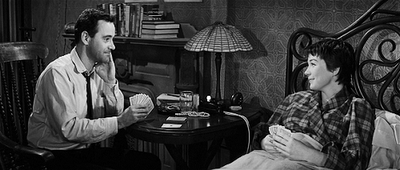
I told Chris that, when I watched his dad's movies on television and on the big screen, there was something specific about him that always connected to me and touched my heart.  For as much as Jack Lemmon made us laugh as he battled some funny working class humiliations, there was a mist of sadness behind the eyes in that sunny face.  You see it in Billy Wilder's other classic, The Apartment, as he plays C.C. "Bud" Baxter.  He's the white collar man moving up in the corporation.  Fran Kubelik (played beautifully by Shirley MacLaine) gives him a lift in the company.  She's an elevator operator.
You see that sadness as lonely, complicated Mr. Baxter gives Miss Kubelik an unexpected Christmas gift.  The gift of life.  He nurses her back to physical and emotional health after a failed suicide attempt in his apartment.  They're two lonely people who work in the same building and for the same company.  They're involved with the same boss.
That sadness is really evident in the shot the breaks my heart every time I see it. It's the last shot in Days of Wines and Roses.  Lemmon gave a devastating dramatic performance as the family man who joins Alcoholics Anonymous and tries to get his wife to do the same.  His last scene brings tears to my eyes every time.  What a brilliant, true performance.  In the memoir, Chris wrote about that sadness and his father's work in Days of Wine and Roses.
The Apartment (1960) and Days of Wine and Roses (1962) brought Jack Lemmon two more Oscar nominations for Best Actor.  In A Twist of Lemmon, Chris wrote honestly and proudly about how his father successfully battled alcoholism and used his experience to help others.  We talked about this in the interview.  My father joined A.A.  It took me years and years before I learned why he drank.  I shared that with Chris to let him know that I, too, had a dad whose drinking could get excessive.

One of the other things we talked about was Jack Lemmon's care for the world around him.  He got involved.  You can see it in his choice of film roles.  They're not all light-hearted comedies.  He took on social issues in dramas like Days of Wine and Roses, Save the Tiger (for which he won Best Actor of 1973), Missing (Oscar nomination for Best Actor of 1982) and his cameo appearance in Oliver Stone's JFK.  His Oscar nomination for Best Actor of 1979 came for the nuclear plant danger drama, The China Syndrome.  In this, he was a longtime employee for whom the job at the plant was like the spouse he didn't have.  He loved that job.  Then, when approached by a local news reporter, he must choose between social conscience and corporate loyalty when a plant mishap could put millions of lives in danger.

The box office hit film, co-starring Michael Douglas and Jane Fonda, was released shortly before America's real-life Three Mile Island crisis.  A partial nuclear meltdown happened at the plant located in Pennsylvania.  Three Mile Island became a top national headline.  Life imitated film art.

Jack Lemmon could tackle a social issue even in a comedy.  His 1996 White House comedy co-starring James Garner, My Fellow Americans, had a presidential embrace of gay rights.  Look at the Billy Wilder comedy that teamed Lemmon with Walter Matthau for the first time.  In The Fortune Cookie, Matthau plays the crooked lawyer whose brother-in-law was injured on the job.  The lawyer is so shady that he's nicknamed "Whiplash Willie."  For this performance, Matthau won the Oscar for Best Supporting Actor of 1966.


This is a Wilder comedy that deserves re-appreciation.  I never read or heard this mentioned  in reviews of The Fortune Cookie, but it's something that my parents liked a lot when they saw it.  I tell Chris in the podcast interview that my parents saw The Fortune Cookie as a clever, sophisticated statement on race relations in the Civil Rights era above the Mason-Dixon line.

Jack Lemmon played a network TV cameraman doing live NFL coverage on the field.  Number 44, Luther "Boom Boom" Jackson, is in the Cleveland game.  During one play, "Boom Boom" accidentally tackles the TV cameraman.  In the pic below, director/writer Billy Wilder gives direction to actor Ron Rich as Jackson while Lemmon as cameraman Harry Hinkle watches on the far right in a hooded jacket.

Harry's injuries are minor.  Willie sees his brother-in-law as the fortune cookie.  He coaxes him to feign serious injury so they can cash in for some big insurance money thanks to an accident seen on live national television.  The cameraman is uneasy about Willie's scheme but he goes along with it.  He gets more uneasy as he becomes friends with Luther, the articulate African-American gentleman of an NFL star.
Greedy, dishonest people in the cameraman's life are suspicious of the football star and regard him as a second-class citizen merely because of he's black.  What infuriates the cameraman so much that it causes him to break out of his unnecessary apparatus and break away from those greedy, dishonest people in his life?  Racist comments about his black friend.  Through the years, I've come to appreciate The Fortune Cookie as deeply as my parents did.  It's still an effective film.  The football star experiences the kind or racism many of us in "liberal" Northern states have experienced.

Chris Lemmon talked to me about his Uncle Walter.  Matthau and Jack Lemmon must've been brothers in a previous life.  From The Fortune Cookie...
...to The Odd Couple...
...to Grumpy Old Men....
...they were one of the best teams that Hollywood ever had.  In the interview, I think I made a mistake about Matthau.  He won an Oscar for Best Supporting Actor.  I may have mentioned that he got only one Oscar nomination for Best Actor.  Wrong.  He got two.  The Sunshine Boys brought him one.  Chris' dad helped him get the other for 1971's Kotch.

On this I make no mistake -- if a movie was being shot about moviemaking in the 1960s and a scene involved the making of The Odd Couple, the only person who could play Jack Lemmon would be Chris Lemmon.  Wait till you hear his uncanny imitations of his dad ... and the guy he called "Uncle Waltz," Walter Matthau.  Chris needs to be in a big screen comedy or doing TV sitcom gigs.  He's definitely got the skills and the charisma.
By the way, Chris hasn't written just a book.  He wrote a comedy screenplay that his dad read as he was being treated for cancer.  Jack Lemmon loved his son's screenplay.  Chris Lemmon would love to get it into production -- and he'd love Walter Matthau's actor/director son, Charlie, to be involved.  We talked about that also in the interview.

The energetic, animated Jack Lemmon made his film debut opposite Judy Holliday in It Should Happen To You.  That 1954 comedy feels fresh today.  Holliday played a sweet, ambitious single woman in New York City who dreams of fame.  She wants to become a celebrity.   And she does, thanks to what we'd nowadays call "reality television."  Lemmon plays the photographer who teaches her that it's not about being on-camera and having the masses know your name that's important.  It's about making your name stand for something.  That's what counts.


It Should Happen To You was directed by the Hollywood master, George Cukor (Dinner at Eight, Camille, The Women, The Philadelphia Story, Gaslight, Adam's Rib, Born Yesterday, 1954's A Star Is Born and My Fair Lady).  This bright comedy is one of Cukor's best of the 1950s.  For his introduction to movies, Jack Lemmon learned a very valuable lesson on screen acting from the acclaimed veteran director.

Chris tells us what Cukor taught his father.

Chris and his father appeared in a few films together.  Chris made his big screen debut in a thriller that starred his dad.  It was another in the Airport franchise.  Airport '77 boasted a big name cast, but the movie didn't take off at the box office or with critics.  Many felt that the plot about a jumbo airliner full of passengers that just seemed to disappear in flight was ludicrous.  Today, in 2014, it wouldn't be ludicrous.  Look at the Malaysian airliner story making news.  For his film debut, Chris had a few moments at a radar screen speaking naval terms that he really didn't understand.  Here's the trailer.
https://youtu.be/gZUkfmBCsrE.

Chris has funny stories about making that disaster movie.

Chris Lemmon is an actor, a gentleman, a great storyteller and an excellent pianist.  Like father, like son.  Here they are together.

Chris gave his memoir the same name given to one of his dad's record albums.

It would be wonderful to see Chris' charm and talent back on TV and back on the big screen again. Trust me, he did go on to work in movies that were way better than Airport '77.  And I really want him to get the money and a green light to shoot the screenplay that his father loved.  If I was a TCM executive, I'd tap Chris Lemmon to be a Guest Programmer one night on Turner Classic Movies with Robert Osborne.  He could present his favorite of his legendary father's classic films.  Chris tell us what that classic is in my podcast.  It would be interesting to see him select classics that didn't star Jack Lemmon and hear why they're some of Chris' favorite films.

Chris Lemmon is utilizing his piano and acting skills in a one-man show based on his memoir, A Twist of Lemmon:  A Tribute to My Father.  Tell the Hollywood folks that he's bringing his show to Southern California.
Interviewing Chris Lemmon this month was like a sweet full circle moment for me.  When I was just starting my professional broadcast TV career, one of my first assignments was an interview of Jack Lemmon.  I was nervous.  Imagine:  It's 1980.  My first TV job.  And I'm interviewing one of my favorite stars, a world-famous and beloved actor who'd won two Academy Awards.  I asked him a question about his early days working in TV in the 1950s and about making Mister Roberts with James Cagney.  That film brought Lemmon his first Oscar.  Cagney had seen Jack Lemmon in a 1950s TV production and thought he was left-handed because of his performance.  Lemmon wasn't a southpaw.  That was his acting choice.  Cagney then realizd that this new kid on the Hollywood block was a serious actor and in for the long run.  For Mister Roberts, Jack Lemmon won the Oscar for Best Supporting Actor of 1955.  The question I asked Mr. Lemmon was so specific that he was impressed with the homework I'd done.  After the interview, he advised me to continue along that path of doing interviews.  He felt I was good at it and needed to pursue it.  I took his advice.

I got to tell that story to Chris.  I treasured my time with his father.  I treasured my time with him.

Oh!  One last thing.  For decades, I've wondered if special pumps had to be made for Jack Lemmon to wear in Some Like It Hot because of men having bigger feet.  The answer is "no" and Chris told me why his dad was the perfect guy to wear women's shoes.
Not every son can say that about his father.  I hope you have as much fun listening to our interview as I had doing it.  Hear me with Chris Lemmon this Monday, March 24th, on my podcast at  BobbyRiversShow.com. We'll be there all week.

Tuesday, March 18, 2014

VERONICA MARS Attacks: Gender Roles

For years, I have loved this Jonathan Winters quote:  "If your ship doesn't come in, swim out to it."  I returned to the East Coast for a couple of week this month.  I was, in essence, swimming out to my ship in New York City.  It was a most productive and spiritually rejuvenating stay.  I fly out to New York with one day of on-camera TV work to do.  That was a return to be a guest movie critic on Arise TV's weekend show, On Screen.  The show is hosted by film critic and veteran NYC broadcaster, Mike Sargent.  He's also a filmmaker and those skills add a richness to his sensibilities as a film critic.

One of the new releases we reviewed on the March 15th edition of On Screen was Veronica Mars.  This is the big screen adaptation of the hit TV series starring Kristin Bell in the title role.  I was not able to be an avid weekly viewer of the TV series.  But I liked the episodes that I did see very much.  The show was smart, different, well-written and well-acted.  If you didn't follow the series, don't worry.  The screenplay is cleverly written with enough backstory to bring you up to speed.  If you did follow the series, it's very interesting to see how Veronica Mars has matured from teen to intelligent, talented and complicated young woman faced with a major career choice.  She's also faced with a murder mystery.  The work of solving it, the dedication to finding the criminal, will define her life and her needs.  Being a private eye will calm a certain restlessness in her soul.
This works as an well above average made-for-TV movie.  It works as big screen entertainment -- a good weekend matinee or a date movie for a young couple.

Here's what thrilled me the most about Veronica Mars, the movie:  It gives us a movie in a genre Hollywood has pretty much ignored.  Veronica Mars is an adult female private eye.  Adult female private eye movies are rare.  There was the very popular Nancy Drew series in the late 1930s from Warner Brothers starring Bonita Granville.  They were based on the popular mystery books.  But Nancy Drew was a spunky teen sleuth.  Veronica is now a grown-up.  She's questioning suspects.  She's questioning herself.  She's a private eye with a keen mind.

I'd like to see a sequel to this movie.  I feel this is a new genre that needs attention.  Let's face it.  In Hollywood movies -- even before they learned how to talk -- the private eye has always been the man.

In the early 1990s, an adult female private eye made it from books to the big screen.  Kathleen Turner was private detective V.I. Warshawski.  There was never a sequel, probably because Turner's film was not a box office success.  I don't think there was ever another big screen adaptation of one of the V. I. Warshawski mysteries starring another actress.

Victoria Iphigenia Warshawski is a Polish/Italian private investigator in Chicago.  She was created by and tracked down killers in a series of novels from author Sara Paretsky.  

The movie V. I. Warshawski was based on the Sara Paretsky novel entitled Deadlock.  Victoria, called "Vic," is a lean and athletic brunette.  She's the daughter of a Chicago cop.  She has a healthy appetite and loves ethnic meals.

This might be the time to revisit those novels and think about bringing Ms. Warshawski back to the movies.

One of the most fascinating and appealing characters I've seen in a documentary made after 2000 was the lesbian private eye in Kirby Dick's excellent This Film Is Not Yet Rated.  If Hollywood doesn't think female private eyes really exist, its male producers need to see this documentary about the ratings drama that filmmakers and actors have to endure.  The movie ratings board frustrates artists and people who respect films.  A woman in the woods breastfeeds her baby while sitting next to her loving farmer husband.  That exposed breast could bring an "R" rating to a film.  But if a young topless woman is running through the woods screaming for her life while being chased by a crazed farmer with a pitchfork, that could be rated only PG-13.  Here's the trailer for This Film Is Not Yet Rated.  Notice the totally cool lesbian private investigator.
Becky rocks.  Put Kirby Dick's documentary on your must-see list.

Someone else who rocked was actress Anne Francis.  In the 1960s, she played one of the coolest private eyes I've ever seen on network television to this day.  On Friday nights, when a lot of us babyboomers were kids, we loved watching her on ABC as Honey West.  I mentioned this show during my On Screen review of Veronica Mars.
Honey West always got her man.  She could handle a gun.  She drove a sports car.  She could take a big  dude down with a single karate chop.
In between being a luscious outer space babe in MGM's Forbidden Planet in the 1950s and being the Ziegfeld beauty and friend to Barbra Streisand as Funny Girl in the late 1960s, Anne Francis gave us Honey.
She was a sexy, smart, sophisticated, no-nonsense private eye with a warm personality and a pet ocelot. Honey West was a hipster without trying to be hip.  She had a handsome private eye partner named Sam, played by actor John Ericson.  Ericson and Francis co-starred in the MGM classic, Bad Day at Black Rock, starring Spencer Tracy and Robert Ryan.


In the early 1990s, I had dinner in Hollywood with a friend who worked for a major movie company.  We discussed upcoming projects on his company's plate.  He asked if I had any ideas.

I suggested getting the rights to ABC's Honey West and turn it into a film franchise starring Michelle Pfeiffer.  But did Hollywood listen to me?  No!


It was great to be back in New York City and invited on-camera to talk about the Veronica Mars killer of a high school reunion.  It was really great to see this young woman attack a gender role exclusivity in Hollywood films.  Please let there be a sequel.  I'd like to see Kristen Bell as this female private eye solve another mystery and open a new door for women in film.

As for swimming out to my ship -- I went out to New York to do one on-camera spot.  While there, one became four days of on-camera spots.  And I got some good interviews for my podcast.  I'm so glad I took the plunge and swam out.


Sunday, March 16, 2014

Billy Hayes After MIDNIGHT EXPRESS

Milwaukee.  A Turkish prison.  Hollywood filmmakers.  Drugs. Sex. Intimacy.  The urge to kill.  And now, the New York City stage.  Billy's had a full life.  And it seems to be getting fuller.
Writer/actor Billy Hayes knows about all that and we talk about all that this week on my Bobby Rivers Show podcast.  Billy and I lived in the same college dorm at different times.  We attended the same university.  We met when he was promoting his first book.
He's one of the bravest, boldest and most candid people I know.  In the 1970s, he wrote about his harrowing time in and escape from a brutal Turkish prison.  A student of Marquette University in Milwaukee, he was caught with hashish in Istanbul.  His memoir, Midnight Express, was a best seller that hooked the attention of Hollywood.  On screen, the very blond Billy Hayes was played by the dark-haired actor, Brad Davis.

The movie made the handsome young actor a star.  It was also nominated for the Best Picture of 1978 Academy Award.  Alan Parker was an Oscar nominee for Best Director.  John Hurt was nominated for Best Supporting Actor.  Writer/future Platoon and Wall Street director Oliver Stone won the Oscar for Best Adapted Screenplay.


How many liberties did Oliver Stone take with Billy's life and story in writing the screenplay?  Why was Billy's prison sentence for smuggling hash so severe?  Did he ever return to the place where he was held prisoner?  How did Turks feel about the film?  After he was no longer a captive, what was sex like?  As a free man, did he require more intimacy before sex due to the emotional effects of the harsh imprisonment he'd endured?  Was there sex in prison?

We talk about his life before, during and after Midnight Express.  If you're in New York City this month, you can see him tell some of the colorful, fascinating story himself.  Billy Hayes is still gleeful and giddy over the reviews for his one-man show, Riding the Midnight Express.

It's now onstage at the St. Luke's Theater on West 46th Street.

His current tale is one of responsibility, redemption and return.  Hear me out with Billy Hayes on this week's edition of the Bobby Rivers Show podcast, now available on iTunes.

Go to BobbyRiversShow.com.

Next month, in a second part, I talk to Billy about the late Brad Davis.  Blessed with good looks, talent and big screen charisma, Midnight Express made Davis a movie star.  At a time when actors were afraid to come out or to be outed, Brad Davis was an openly bisexual man who took on some challenging roles that showed his serious acting skills.  On the New York stage, he originated the role of the outspoken Ned Weeks in Larry Kramer's AIDS drama, The Normal Heart.  A TV adaptation of Kramer's 1985 play premieres on HBO this coming May.


Next month, Billy Hayes tells me more about his dear friend, actor Brad Davis.  Davis died of AIDS in 1991 at age 41.  The worst thing to happen to Billy Hayes in his young life was the best thing to happen to Brad Davis' movie career.  Theirs was quite a friendship.

For information on Billy's one-man show, go here: RidingTheMidnightExpress.com.


Colman Domingo in RUSTIN

In the first ten minutes of Steven Spielberg's LINCOLN, we see Daniel Day-Lewis as Abraham Lincoln talking to two Black soldiers on a Ci...